Control Transformer Fuse Sizing Calculator
Estimate transformer VA, primary current, secondary current, inrush current, time-delay fuse target, NEC-style overcurrent limits, and the next common fuse size.
📌Control transformer presets
📏Transformer and protection inputs
🧮Fuse sizing results
⚙Fuse and transformer spec grid
📊Reference tables
| Transformer VA | Primary 120 V | Primary 480 V | Secondary 24 V | Typical control use |
|---|---|---|---|---|
| 40 VA | 0.33 A | 0.08 A | 1.67 A | Thermostat, relay, small smart panel |
| 75 VA | 0.63 A | 0.16 A | 3.13 A | Door access, HVAC zone controls |
| 100 VA | 0.83 A | 0.21 A | 4.17 A | PLC input panel, sensor group |
| 250 VA | 2.08 A | 0.52 A | 10.42 A | Relay bank or smart control cabinet |
| 500 VA | 4.17 A | 1.04 A | 20.83 A | Machine control transformer |
| 1000 VA | 8.33 A | 2.08 A | 41.67 A | Large controls or multiple panels |
🛡NEC-style protection guide
| Arrangement | Primary current band | Primary max planning value | Secondary max planning value | Use this when |
|---|---|---|---|---|
| Primary only | 9 A or more | 125% of primary amps | Not used | Primary device is the only transformer OCPD |
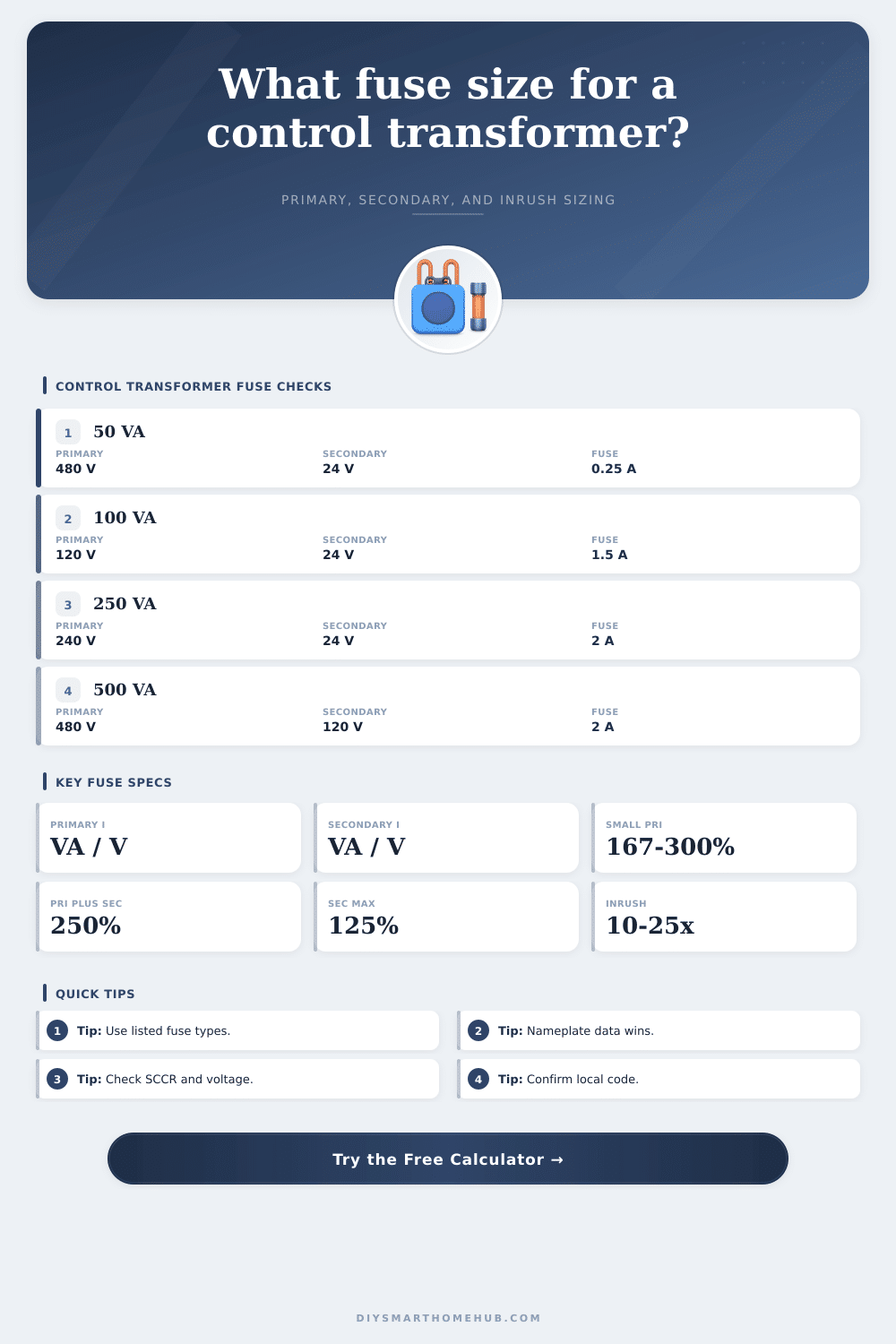
| Primary only | 2 A to under 9 A | 167% of primary amps | Not used | Small CPT primary current needs standard fuse rounding |
| Primary only | Under 2 A | 300% of primary amps | Not used | Very small control transformers with tiny primary current |
| Primary plus secondary | Any small CPT band | 250% of primary amps | 125% of secondary amps | Separate secondary fuse protects the low-voltage circuit |
| Secondary focus | Primary reviewed separately | Calculated as reference | 125% of secondary amps | Low-voltage branch protection is the main check |
🔌Common standard fuse sizes
| Range | Common sizes | Where it appears | Selection note |
|---|---|---|---|
| Fractional | 0.25, 0.5, 0.75, 1 A | Small 480 V primaries | Use listed small-fuse holders and voltage rating |
| Low control | 1.25, 1.5, 1.75, 2 A | 40-250 VA primaries | Time-delay response often matters for inrush |
| Panel control | 2.25, 2.5, 3, 3.5, 4 A | 120 V primaries or 120 V secondaries | Check conductor and terminal ampacity |
| Secondary branch | 5, 6, 7, 8, 10, 12 A | 24 V secondaries over 100 VA | Coordinate with Class 2 limits when applicable |
| Larger CPT | 15, 20, 25, 30, 40 A | 500-2000 VA low-voltage secondary | Verify interrupt rating and panel SCCR |
📝Preset comparison table
| Preset | Transformer | Voltage pair | Protection approach | Expected sizing cue |
|---|---|---|---|---|
| HVAC panel | 40 VA | 120 to 24 V | Primary plus secondary | Fractional primary, 2.5 A secondary |
| PLC cabinet | 100 VA | 480 to 24 V | Primary plus secondary | Small primary fuse, 6 A secondary |
| Motor control | 150 VA | 480 to 120 V | Primary only | Small primary with inrush review |
| Smart panel | 250 VA | 240 to 24 V | Primary plus secondary | Low primary, 15 A secondary band |
| Machine tool | 500 VA | 480 to 120 V | Primary only | Primary fuse governed by small-current rule |
| Plant panel | 1000 VA | 480 to 120 V | Primary plus secondary | Primary fuse and secondary branch check |
💡Practical sizing tips
In a hot warehouse you open the door of a panel that feeds power from a control transformer to relays. All seems OK; it’s a fine-looking device. But when starting up, will your system trip or stay on? That depends on tension between the fuse response and the magnetic inrush. To size fuses for transformers, you need to know how magnetizing current behave. The calculator does that for you. It converts voltage pairs (load) into corresponding amp ratings that help you protect your equipment with certainty.
When you turn on a transformer, it doesn’t just pull its rated current. Instead, it pulls a lot of current. It is a lot more then the primary current under load. That’s called the magnetizing inrush. It can be 10 to 25 times the rated primary current. It is long enough to burn through a fast acting fuse, yet brief enough for a time delay to ride through it. What you want is some kind of protection that will ride through the inrush, but trip at first hint of sustained short circuit.
How to Pick Fuses for Transformers
Folks makes a mistake doing nothing more than dividing the voltage by VA and rounding up. Start with true load on your system, also known as Connected load VA. This is the combined pull of all power supplies, coil loads, sensor loads, etc. Next, consider future growth and account for a little extra capacity (spare). Adding a new relay later will require changing out the panel. If you budgeted a 20% spare capacity now, you’ll avoid that expense down the road.
Safe loading is determined by transformer’s name plate. Primary and secondary voltage determine current relationship. Finally, how do we connect theory with real world? That’s where inrush multiplier comes into play. Common control transformers may have a standard multiplier of fifteen times rated current. But if yours shows high core saturation characteristics, increasing this value to twenty or even twenty-five allow the fuse to protect against absolute worst case.
Depending off your desire to isolate faults, there are choices for protection arrangements. Keeping everything on the line side simple with primary only means you need to carefully calculate to ensure the primary conductor is protected. A second layer of protection can come from adding secondary fuses. These will protect the low-voltage control circuit while allowing the primary fuse to be sized higher for inrush and still clear shorts on output side.
These decisions follow NEC-style limits, which cap primary protection at either 167% or 250% of the maximum current in the current band, depending on whether secondary protection are present. The numbers aren’t just arbitrary code compliance; they are an engineered tolerance for magnetic transients.
Tables provided with references is used to display average current draw at different voltages. For instance a transformer rated for 100VA and operating off 480V requires far less primary current than a similar 100VA transformer operating off 120V. This shift changes the fuse class completely. High voltage primaries use smaller fractional fuses, whereas lower secondary voltage transformers uses bigger midget or even plug fuses.
Check the interrupt rating against your panels’ short circuit current rating. Even if the fuse is correctly sized in amps, it will blow catastrophically if it cannot handle the fault energy. Keep in mind that ambient temperature is important. Fuses derate in heat! In extreme cases, a correctly specified fuse can blows too soon while in use. This is accounted for by the calculator; however, ventilation inside a cabinet rarely matches actualy heat generated.
For most cases, use Class CC time-delay fuses. These has two elements and handle inrush well but clear faults quickly. Picking a size isn’t as simple as choosing a number. It’s not “just” about size; it’s about how much is too much (and therefore unstable), versus how little is too little (and therefore unresponsive). Consult your local code and verify SCCR ratings. Leave the math to the tool.
The outcome is going to be peace of mind. You’ll know exactly what happened, why the transformer didn’t trip. How the fuse protected itself based off what was plugged into it, instead of some generic guess in the back of a rulebook.