Single Phase Motor Capacitor Sizing Calculator
Estimate run capacitor microfarads, start capacitor range, motor full-load amps, and minimum AC voltage rating from horsepower, voltage, frequency, load profile, and motor type.
Capacitor estimate
| Motor type | Run capacitor behavior | Start capacitor behavior | Typical use |
|---|---|---|---|
| PSC fan or blower | Continuous run capacitor, lower uF per amp | Usually no separate start capacitor | Fans, small blowers, air movers |
| Capacitor-start induction run | No continuous run capacitor in many designs | Large electrolytic start capacitor through switch | Tools, garage openers, general duty |
| Capacitor-start capacitor-run | Oil-filled run capacitor stays in circuit | Start capacitor adds locked-rotor torque | Pumps, compressors, heavier loads |
| Hermetic compressor motor | Run capacitor often required and heat sensitive | Start kit may be specified by compressor data | Refrigeration and HVAC compressors |
| Output | Approx FLA at 120 V | Approx FLA at 240 V | Planning note |
|---|---|---|---|
| 1/4 HP | 3.5 to 5.8 A | 1.8 to 2.9 A | Small fan or light pump range |
| 1/2 HP | 6.4 to 9.8 A | 3.2 to 4.9 A | Check nameplate FLA when available |
| 1 HP | 12 to 16 A | 6 to 8 A | Voltage drop can affect starting |
| 2 HP | 24 to 32 A | 12 to 16 A | Hard-start load may need exact OEM data |
| Line voltage | Calculated minimum at 25% | Common run capacitor VAC | Rule of thumb |
|---|---|---|---|
| 115 to 125 V | 144 to 156 VAC | 250 or 330 VAC | Higher VAC is acceptable if uF matches |
| 208 to 240 V | 260 to 300 VAC | 370 or 440 VAC | Do not replace 440 VAC with 370 VAC |
| 277 V | 346 VAC | 370 or 440 VAC | Use the equipment-specified class |
| 480 V single phase | 600 VAC | 660 VAC specialty | Use motor manufacturer data |
| Load profile | Run uF factor | Start multiplier | Best interpretation |
|---|---|---|---|
| Light fan load | 0.82x | 2.5x to 3.2x | Lower torque, smoother starts |
| Normal running load | 1.00x | 3.0x to 4.0x | General motor estimate |
| Pump or compressor load | 1.14x | 3.8x to 4.8x | Higher breakaway torque |
| Hard-start load | 1.25x | 4.3x to 5.5x | Use OEM start kit data where possible |
The well pump will sputter and stop mid-cycle, leaving you wondering if your motor went out. Often, it’s the capacitor and not the copper windings of the motor that is at fault. A capacitor is similar to a miniature power bank supplying just enough juice when required. Without this component, there is no phase shift to rotate rotor. There is no torque.
The right size is important. It’s not just plug and play. Any capacitor that fits is not what you want. Doing this will result in early failure of the unit. Use calculator above to get an estimate of needed microfarad value from your motor parameters. Knowing how it works will prevent mistakes.
Why Choosing the Right Capacitor Matters
Remember there are two types of capacitors: start capacitors and run capacitors. They resemble each other but have different functions. Run capacitors functions while the motor is running. Start capacitors only function for a couple of seconds to spin up the motor. Putting a start capacitor into a run circuit can cause a big bang. Likewise putting a run capacitor into a start circuit won’t give you enough starting power for a large load.
These differences are led off the input fields. First, you tell it what kind of motor: Is this a compressor? Is it a fan? That tells the tool what to assume about phase shift. Next, you specify voltage and horsepower. That’s your energy load. Then there’s efficiency and power factor, those factors represents loss in the real world. Nameplate may provide full-load amps, which provides accurate results if that’s your data point.
There’s also frequency adjustment. This is important when wiring equipment for international use, or if your grid is an old one where the standard isn’t 60 cycles per second but rather 50.
Other issues arise with shortcuts in voltage rating. Just because you have a 250 volt-rated capacitor doesn’t mean it’s suitable for a 120-volt circuit. Line surges go beyond that cushion. The calculator suggests a buffer of safety. Many times, the calculation advise a rating well beyond the nominal line voltage. That headroom means there will be some room to spare if the line fluctuates a bit. It is cheaper insurance than replacing capacitor again next year.
The other factor is load profile. A bathroom fan spins up against minimal air resistance. That’s easy compared to a pool pump moving water down clogged lines. To help it, a small amount of capacitance (less than what the tool would otherwise suggest) can be used. By tweaking its start range multiplier, the tool takes that into account. Higher torque at startup is needed with hard-start loads. Larger values of start capacitor results.
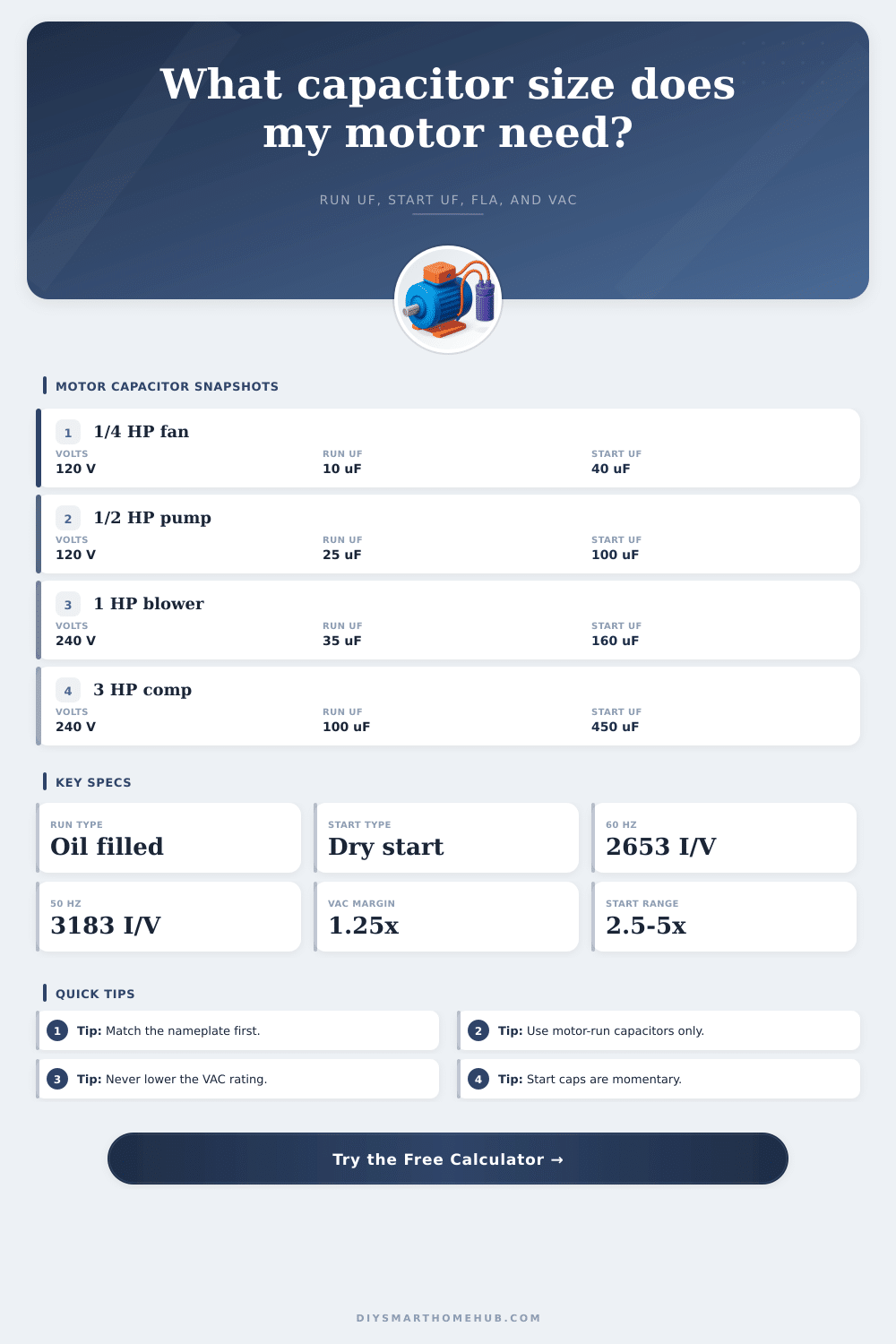
Operating in a hot enclosure and/or frequently starting will further stress these component. Don’t just use the base calculation, think about the environment. The tool also comes with reference tables for immediate sanity checking. The snapshots will tell you if your calculations are in line or out of range for what’s normal. Generally, a 120-volt half-horsepower pump should run on about 25 microfarads (and up to 100 when it’s starting). If your number is way off-base, recheck your numbers.
The capacitor replacement isn’t simply a matter of number-for-number from the label. There’s a mechanical load on that motor and replacing those capacitors is a means to return it to service reliably. Replace them correctly and you’ll get your motor humming again. Do it incorrectly and you would of run the risk of wrecking some pretty luxurius gear in the process. Always try to get as close as possible to what nameplate says. If there is no nameplate or if it’s faded, then use the math to find it.
After the proper capacitor has been added, the annoying hum goes away and all you hear is a well running motor doing its job.