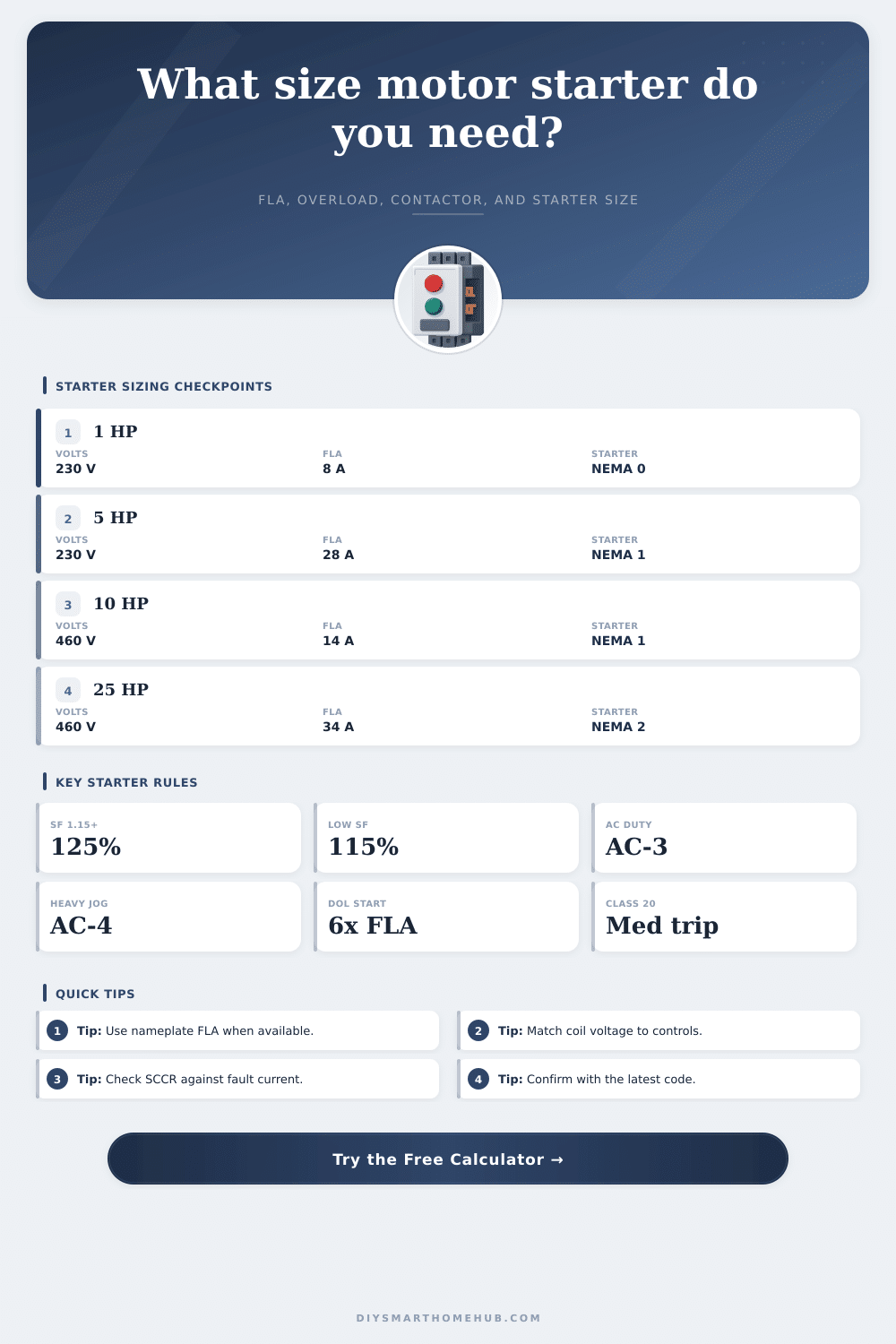
Motor Starter Sizing Calculator
Estimate motor full-load amps, overload setting, IEC AC-3 contactor current, NEMA starter size, and a short-circuit protection starting point from motor nameplate data.
Design note: This calculator is for preliminary sizing. Final motor circuits, overloads, SCCR, disconnects, conductors, and short-circuit protection must be verified against the installed equipment listing and the locally adopted electrical code.
⚙Starter Presets
📋Motor Nameplate Inputs
Starter Sizing Result
Ready🔧Starter / Overload Spec Grid
Standard IEC category for squirrel-cage motors switched off while running.
Common maximum overload setting for SF 1.15 or higher motors.
Middle trip class often used where acceleration is not unusually short or long.
Starter assembly SCCR should meet or exceed available fault current.
📊Reference Tables
| Motor HP | 1 Phase 230 V FLA | 3 Phase 230 V FLA | 3 Phase 460 V FLA | Common Starter Range |
|---|---|---|---|---|
| 1 HP | 8.0 A | 4.2 A | 2.1 A | NEMA 00 to 0 |
| 3 HP | 17 A | 9.6 A | 4.8 A | NEMA 0 |
| 5 HP | 28 A | 15.2 A | 7.6 A | NEMA 1 |
| 10 HP | 50 A | 28 A | 14 A | NEMA 1 to 2 |
| 25 HP | Not typical | 68 A | 34 A | NEMA 2 to 3 |
| NEMA Size | Continuous Amps | Max HP at 230 V | Max HP at 460/575 V | Typical Use |
|---|---|---|---|---|
| 00 | 9 A | 1.5 HP | 2 HP | Small pumps and fans |
| 0 | 18 A | 3 HP | 5 HP | Shop and HVAC motors |
| 1 | 27 A | 7.5 HP | 10 HP | Compressors and blowers |
| 2 | 45 A | 15 HP | 25 HP | Pumps and conveyors |
| 3 | 90 A | 35 HP | 50 HP | Larger machinery |
| IEC AC-3 Rating | Use When FLA Is Up To | Suggested Margin | Overload Relay Range | Starter Note |
|---|---|---|---|---|
| 9 A | 7.5 to 9 A | Light duty | Match FLA band | Small AC-3 contactor |
| 18 A | 15 to 18 A | Normal duty | Electronic or thermal | Common small starter |
| 32 A | 25 to 32 A | Normal duty | Set to nameplate FLA | Medium pump motor |
| 50 A | 40 to 50 A | Heavy starts | Check heat rise | Use listed enclosure |
| 80 A | 65 to 80 A | High duty | Verify SCCR | Coordinate upstream |
| Input Choice | Calculator Formula | Result Affects | Common Check | Field Reminder |
|---|---|---|---|---|
| HP or kW | HP x 0.746 = kW | Calculated FLA | Nameplate rating | Output power, not input |
| Voltage / phase | 1 phase or 3 phase current | FLA estimate | Supply voltage | Use line voltage |
| Service factor | 115% or 125% overload | Relay setting | Motor nameplate | Do not exceed listing |
| Starter duty | AC-3 or AC-4 margin | Contactor size | Starts per hour | Jogging needs margin |
| Fault current | kA versus SCCR need | Protection hint | Available kA | Panel SCCR matters |
💡Starter Sizing Tips
So many times you look at a burnt out contactor and ask yourself, “What in the world made my good motor trip the breaker again?” That’s not usualy the motor causing trouble. Most of the time it is the starter.
When choosing a motor starter, sizing is somewhat a shot in the dark. We want to choose a motor starter that protects our costly equipment but accounts for the limit on how much those component can handle. Under-size the motor starter and it melt your coils and causes nuisance trips. Over-size it and you lose the overload protection completly. You’re looking for the sweet spot between protecting your equipment at startup and making sure it doesn’t fail during normal operation.
How to Choose the Right Motor Starter
There is also this handy dandy full load amperage calculator. It will do all the work of calculating full load amps and give you the right NEMA size for what you input: Even without knowing the amp table off the top of your head you can still make an educated guesstimate pretty easily.
More important than simply memorizing the numbers though is knowing what they mean in the real world. Phase, voltage…check. Efficiency….uh oh. Power Factor…… Uh Oh. If you have a motor that is rated at 88% efficient it will pull noticeably more current then a motor rated at 95%. That can increase your overload setting by a notch or two, which force you to use a larger starter size.
The second hidden variable, service factor, will bite you in the ass when you least expect it. Motors with a service factor of 1.15 or higher can be run continuously at fifteen percent over their nameplate rating and suffer no damage. That’s why the headroom must be accounted for on your overload relay. Set it too tight and every time the load spikes a little bit the motor trip. Set it too loose and thermal element never opens up when the windings is cooking. The calculator automatically adjusts these multipliers so you don’t have to do the mental math while you’re holding a multimeter.
There’s also this bit about NEMA sizes: they has a strict logic. And it has very little to do with just horsepower. Because depending upon whether you are running 460 volt vs. 230 volt, your horsepower rating could vary. So what’s the difference? The voltage affects the current, and that’s what determines the frame size of the starter. That’s why we have all these reference tables. They plot the voltage-power meeting point to a physical frame size.
From there, choose the frame that matches your estimated load. Then, double-check that the overload relay range include your actual nameplate full-load amps. It is a small thing. But it makes an enormous difference when you’re figuring out what to order in inventory.
Duty Categories such as AC-3 or AC-4 do tell another story though and are rated by IEC standards. AC-3 is the standard start-stop and fits what we consider normal starting. AC-4 means frequent plugging or jogging of the machine, which necessitate much bigger contacts because they will arc. If your application has a conveyor reversing every time it needs an alignment check, your standard starter won’t last long. This type of duty category flags the tool and lets you know to increase the contactor rating before arc welding occurs in enclosure.
Short-circuit current rating is often ignored until the inspection fails. Maybe the panel can provide sixty kilamps of short circuit current at the panel bus. That means your starter assembly need to be rated for that hit and not explode. It is not the contactor alone, but the whole package of fuse or breaker, starter, and contactor. It won’t say on the datasheet for the contactor. There should of been a listed combo rating for the whole package.
Then there’s the silent role of ambient temperature. Relays are designed to trip at certain temperatures under normal conditions which typically means about forty degrees Celsius. That same relay placed in an unventilated panel or some really hot room is going to trip early. The calculator factors in ambient heat and provides you with a more realistic estimate of your settings. It is a way to avoid being frustrated on those days when the weather turns and you’re chasing ghost trips.
There are no exact science when it comes to motor size; rather, there are limits that must be carefully followed. On one hand, you don’t need so much power that you stall while starting; on the other hand, you don’t need so little power that you burn out before stopping. Striking a proper balance between these two extremes will keep your insurance rates down and your equipment working.
The burned-out contactor we started with? Probably an AC-4 deal used like an AC-3. Before reaching for the replacement piece, take note of the duty cycle.