Radiator Pipe Size Calculator
Size a hydronic radiator branch or main from circuit heat load, supply and return delta-T, target velocity, equivalent length, elbows, fittings, and the actual internal diameter of copper, PEX, or steel pipe.
📌Hydronic radiator presets
🔧Pipe sizing inputs
Pipe sizing result
Enter a circuit load and pipe layout, then calculate to see the recommended nominal size.
📊Hydronic sizing spec grid
📐Radiator load and flow reference
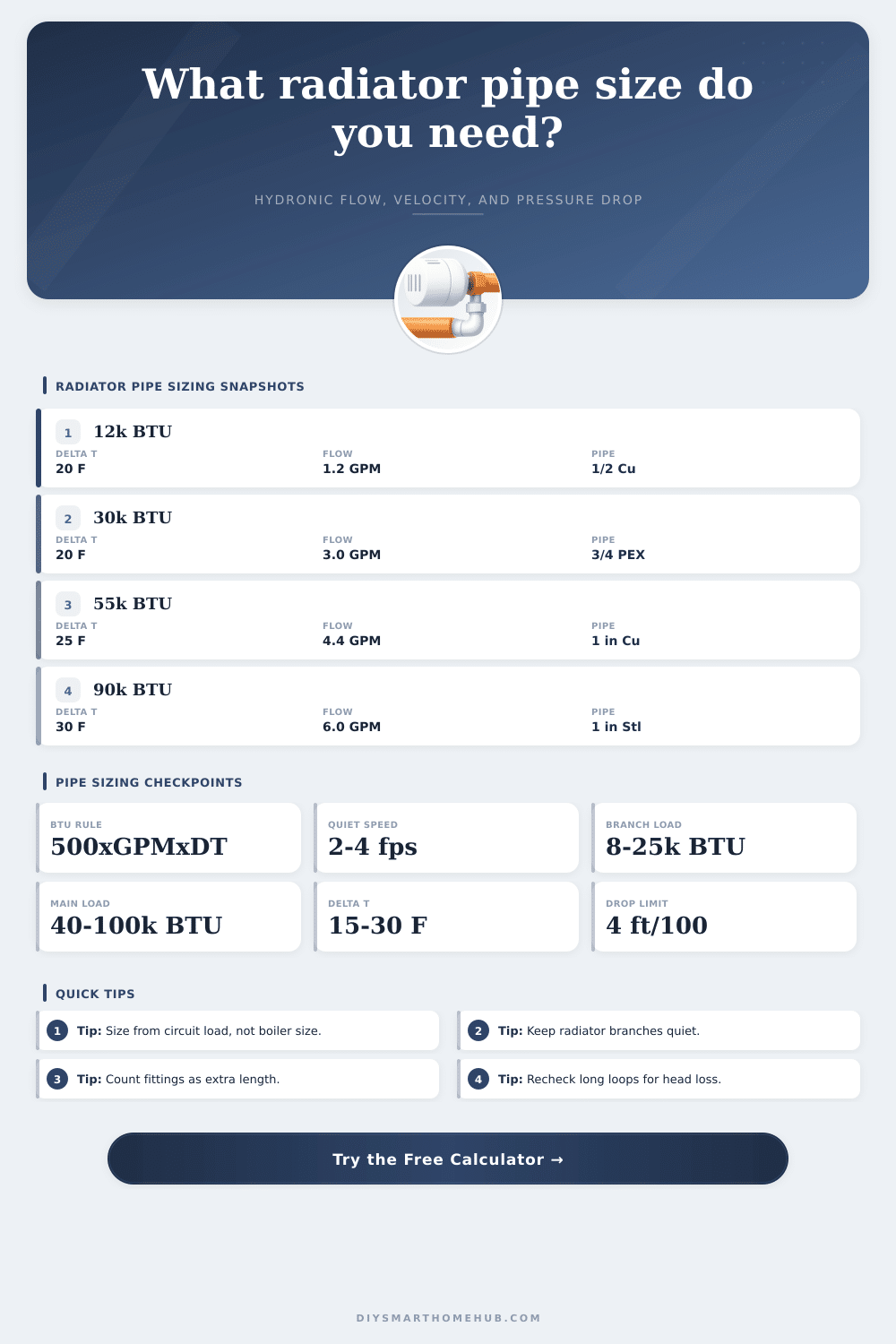
| Radiator circuit | Typical load | 20 F flow | Common starting size |
|---|---|---|---|
| Single panel radiator | 4,000-12,000 BTU/h | 0.4-1.2 GPM | 3/8 or 1/2 in copper or PEX |
| Two-room branch | 12,000-28,000 BTU/h | 1.2-2.8 GPM | 1/2 or 3/4 in branch |
| Baseboard zone loop | 20,000-45,000 BTU/h | 2.0-4.5 GPM | 3/4 in copper or PEX |
| Floor manifold feed | 35,000-70,000 BTU/h | 3.5-7.0 GPM | 3/4 to 1 in main |
| Apartment riser | 50,000-110,000 BTU/h | 5.0-11.0 GPM | 1 to 1 1/4 in main |
🛠Pipe/spec comparison grid
| Pipe type | Hazen C used | Strength in sizing | Watch point |
|---|---|---|---|
| Copper Type L | 140 | Predictable ID, compact fittings, good for radiator branches | Use actual ID; nominal size is not the inside diameter |
| Copper Type M | 140 | Slightly larger ID than Type L for the same nominal tube size | Local code may restrict where it can be used |
| Oxygen-barrier PEX | 150 | Flexible home runs with fewer elbows and quieter routing | Smaller ID than copper nominal size can raise velocity |
| PEX-AL-PEX | 150 | Holds shape well and often uses fewer support bends | Fitting IDs can be the controlling restriction |
| Steel Schedule 40 | 120 | Large mains and older hydronic systems | Roughness and age can increase circulator head |
| Threaded steel standard | 110 | Conservative check for older radiator risers | Use lower C values when corrosion or scale is likely |
🌡Delta-T and velocity guide
| Design choice | Typical range | Sizing effect | Use when |
|---|---|---|---|
| 10 F delta-T | High flow | Requires larger pipe and pump head | Low-temperature emitters need tight control |
| 20 F delta-T | Standard hydronic | Balanced flow for most radiator zones | Typical baseboard, panel radiator, or cast-iron work |
| 30 F delta-T | Lower flow | Can reduce pipe size but increases emitter temperature spread | Long mains or condensing boiler return targets |
| Below 2 fps | Very quiet | Usually low friction and larger pipe | Bedroom branches and short radiator home runs |
| 2-4 fps | Quiet design | Common hydronic branch target | Most residential radiator circuits |
| 4-6 fps | Main-only range | Smaller pipe but more friction and noise risk | Short mechanical-room mains with acceptable head loss |
📋Common radiator pipe sizes
| Nominal size | Copper Type L ID | PEX ID used | Steel Sch 40 ID |
|---|---|---|---|
| 3/8 in | 0.430 in | 0.350 in | Not typical |
| 1/2 in | 0.545 in | 0.475 in | 0.622 in |
| 5/8 in | 0.652 in | 0.574 in | Not typical |
| 3/4 in | 0.785 in | 0.671 in | 0.824 in |
| 1 in | 1.025 in | 0.862 in | 1.049 in |
| 1 1/4 in | 1.265 in | 1.054 in | 1.380 in |
| 1 1/2 in | 1.505 in | 1.244 in | 1.610 in |
| 2 in | 1.985 in | 1.629 in | 2.067 in |
💡Pipe sizing notes
When it comes to heating system piping, larger isn’t necessarily better. We tend to think that a larger pipe is going to deliver more heat. Not exactly. The truth is a bit complex: Oversized piping mask issues related to water flow; it also cost you money. Under-sized piping lead to cold spots and can be noisy.
Sizing your pipe correctly require thinking about both the capacity of your circulator pump as well as how much hydraulic resistance is too much. When you put in your circuit load in the calculator above it will figure it out for you. But what does it mean? Why should you believe it? To get comfortabley with the answer, I want you to understand variables at play here.
Why Pipe Size Matters for Your Heating System
The most important one is your heat load, which is how much heat that particular main or branch need to provide. You don’t size your pipe based off your boiler’s maximum output. That causes under sized mains and starved radiators. What you’re looking at is the actual BTU demand from the rooms served by that individual run. That’s where a lot of DIYers go wrong and their calculation fall apart before they even start.
Then there’s the delta T. This is how many degrees hotter your water is coming out of your boiler then when it goes back into the system after running through your radiators. The classic goal is 20 degrees F. Smaller temperature difference mean you have to push more volume through to get the same amount of heat off. So you’re forced up a pipe size. This is because you still want manageable speed in your pipes. Bigger delta T mean lower flow rate. You can get away with a small pipe here…but then you have to have emitters that’ll work with higher supply temps. There is tradeoff between material cost and pump energy.
Next is velocity. When the water flows, does it go too fast? If the velocity is too high, it will create noise. Typically, you want less than 4 feet per second for velocity in the home. That’s usually quiet. The tool know that based on pipe size and will check it for you. You’ll know it’s too high because you may hear whistling in the pipe or just rushing water. That’s not good to live with and tells you there are too many friction losses which means you are over-taxing your pump. Many folks miss this one till winter rolls around and they want the heat on.
Then there’s material selection, where “nominal size” isn’t your friend. Even a half inch of pipe (copper, steel, PEX) doesn’t equal the same inside diameter. For example, Type L copper, commonly used for radiator branches, is easy to solder and has predictable interior dimensions; however, nominal sizes lie, meaning a half-inch copper pipe does not have the same internal diameter as a half-inch steel pipe. PEX is flexible with fewer fittings and therefore has lower friction loss from elbows. But PEX will generally have a smaller ID compared to nominal size, which means you can end up pushing velocity higher if you’re not careful. Steel piping is rougher inside, meaning increased resistance over time as it scales up. You can see all these in the table I’ve put at the bottom of the page, comparing actual IDs side by side.
The last consideration for pipe size is pressure drop: Each foot of pipe add a certain amount of resistance, as does each valve and each elbow. The longer the run, the more turns there are. All of these require larger pipes to keep the pressure drop within the limits of your circulator. You may find you have lukewarm water on one side of the house and warm water on another; but the boiler is firing away like mad. Is there a pressure drop beyond your pump’s curve? The water just isn’t moving fast enough to get the space warmed up.
Don’t overlook fitting equivalents either. What seems like a simple straight run on paper may actualy be the equivalent of dozens of feet of resistance if it includes eight elbows and four valves. That’s why accounting for fitting losses will prevent unwelcome surprises after installation.
By properly sizing your system, you’ll ensure that all of your radiators is heated efficiently. This saves wasted electricity by avoiding an overworked pump, and also spares you from complaining about noisy plumbing. It’s a balancing act between physical constraints and physics that rewards you with benefits in both longevity and comfort.