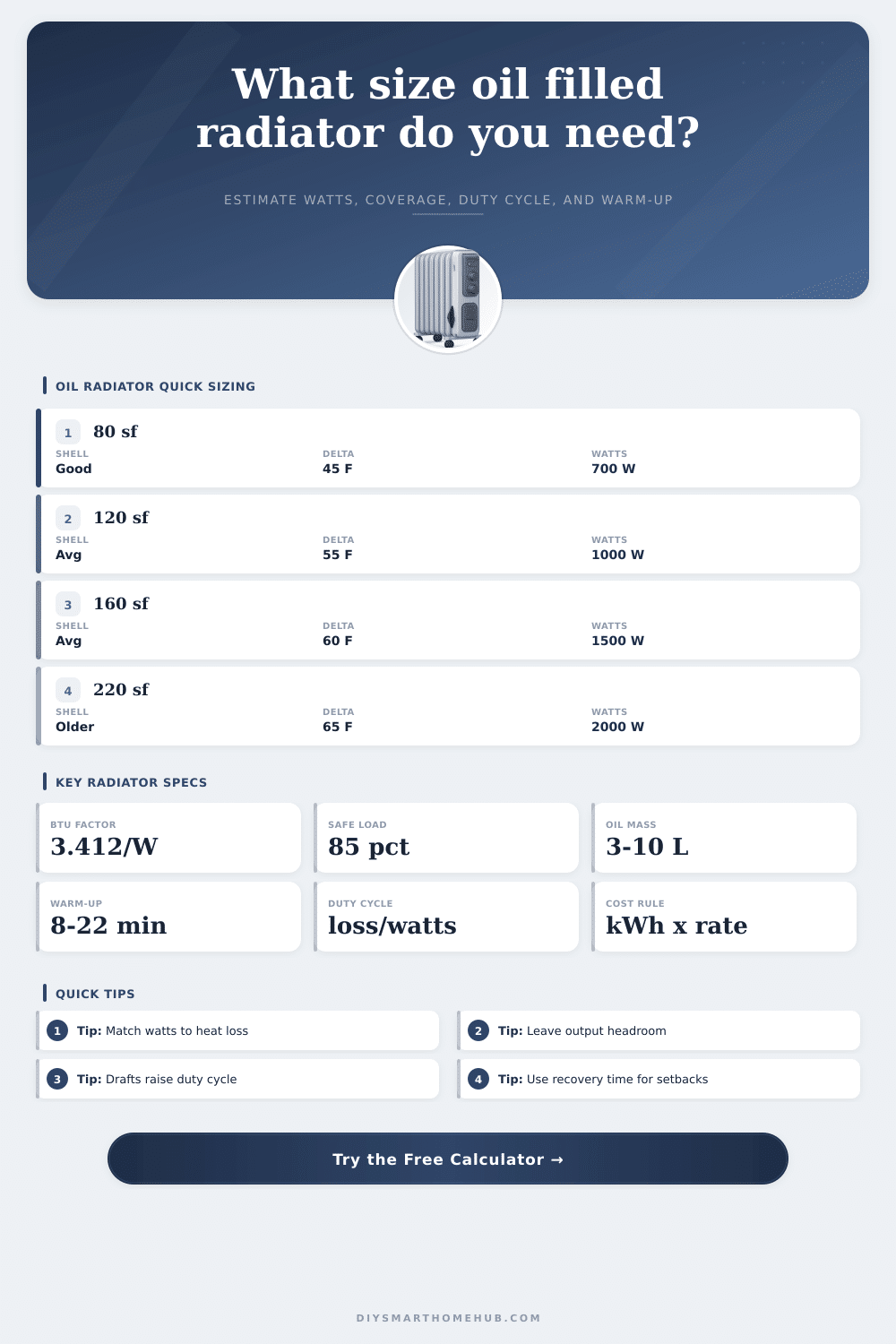
Oil Filled Radiator Size Calculator
Estimate the oil-filled radiator wattage a room needs from heat loss, then check safe coverage, duty cycle, warm-up behavior, recovery time, and electricity use.
🌡Oil-Filled Radiator Presets
Choose a realistic oil radiator class, then adjust the room area, ceiling height, shell condition, design temperature split, and operating profile.
📏Room and Radiator Inputs
💡Oil-Filled Radiator Spec Grid
Best for small offices, bedrooms, and insulated rooms where the calculated heat loss is modest.
Useful for average rooms when recovery speed matters more than the smallest possible wattage.
A typical 120 V portable-heater ceiling in North America, often about 5,118 BTU/hr.
Common on 230 V supplies and larger rooms; use the duty-cycle result to avoid undersizing.
📊Heat-Loss Profile Reference
| Room profile | Base heat loss | Best use | Sizing caution |
|---|---|---|---|
| Tight interior room | 6 BTU/hr per sq ft at 30°F split | Interior office or well-insulated bedroom | Recovery can still be slow with high thermal mass |
| Good insulated room | 8 BTU/hr per sq ft at 30°F split | Newer exterior room with decent windows | Check door undercuts and cold corners |
| Average room | 10 BTU/hr per sq ft at 30°F split | Typical bedroom or living room | Use measured drafts if the duty cycle looks high |
| Exposed corner room | 13 BTU/hr per sq ft at 30°F split | Two exterior walls or above a garage | Coverage falls quickly in cold weather |
| Older drafty room | 16 BTU/hr per sq ft at 30°F split | Older windows, infiltration, weak air sealing | Large rooms may exceed portable-heater output |
| Sunroom or weak shell | 22 BTU/hr per sq ft at 30°F split | Glass-heavy or lightly insulated spaces | Use as a spot heater unless heat loss is improved |
🔌Oil Radiator Wattage Reference
| Radiator preset | Nominal output | Heat output | Typical oil mass behavior |
|---|---|---|---|
| Mini 5-fin | 500 W | 1,706 BTU/hr | Fast element heat, low stored heat |
| Low-output compact | 700 W | 2,388 BTU/hr | Small oil charge, gentle cycling |
| Compact 7-fin | 900 W | 3,071 BTU/hr | Moderate stored heat for small rooms |
| Bedroom 7-fin | 1000 W | 3,412 BTU/hr | Good balance for low-noise room heat |
| Mid-size 9-fin | 1200 W | 4,095 BTU/hr | More surface area, steadier output |
| Standard 7-9 fin | 1500 W | 5,118 BTU/hr | Common maximum for 120 V portable units |
| High-mass 11-fin | 1500 W | 5,118 BTU/hr | Slower warm-up, longer coast-down |
| Tall 230 V class | 2000 W | 6,824 BTU/hr | Large surface area for bigger rooms |
| Large 230 V class | 2500 W | 8,530 BTU/hr | High output with long recovery headroom |
🏠Safe Room Coverage Reference
| Room condition | 500 W | 1000 W | 1500 W | 2000 W |
|---|---|---|---|---|
| Good room, 45°F split | 70 sq ft | 141 sq ft | 211 sq ft | 282 sq ft |
| Average room, 55°F split | 47 sq ft | 93 sq ft | 140 sq ft | 186 sq ft |
| Corner room, 60°F split | 31 sq ft | 63 sq ft | 94 sq ft | 125 sq ft |
| Older drafty, 65°F split | 22 sq ft | 45 sq ft | 67 sq ft | 90 sq ft |
🧮Formula Breakdown Reference
| Formula | Calculator expression | What it tells you | Planning use |
|---|---|---|---|
| Room heat loss | Area x base loss x delta factor x ceiling factor | Watts needed to hold temperature | Primary radiator sizing anchor |
| Duty cycle | Heat loss W / radiator W | Share of time the element must be on | Shows if the unit is near its limit |
| Oil warm-up | Oil and steel heat capacity / input watts | Approximate radiator body warm-up time | Explains delayed comfort response |
| Recovery time | Room thermal mass / surplus output | Hours to recover a 5°F setback | Checks whether setbacks are practical |
| Electricity use | kW x hours x duty cycle | Daily kWh and cost | Compares operating profiles |
💡Oil Radiator Sizing Tips
The calculator limits coverage to 85% of nominal radiator output so the heater has headroom for thermostat cycling, door openings, drafts, and colder-than-average hours.
An oil-filled radiator may hold a room quietly once the room is warm, but a heavy room with a large setback needs surplus wattage to recover in a reasonable time.
Oil-filled radiators works by heating the mineral oil that is contained within the radiator. The heated oil radiates warmth into the room. Because the oil retains heat even after the heating element is switched off, the oil-filled radiator will continue to provide warmth to the room even after the element is switched off.
Unlike fan-forced radiators, which provide warmth but then become cold after the thermostat switch is triggered to that temperature, oil-filled radiators will continue to provide steady warmth in the areas where they are deploy. For these reasons, many people choose to use oil-filled radiators in there bedrooms or small offices. In each case, though, the oil-filled radiator should be matched with the size of the area to be warmed to ensure that the unit isnt working at a maximum capacity.
How to Choose the Right Size Oil-Filled Radiator
One of the first considerations regarding the proper sizing of an oil-filled radiator is the heat loss of the area that is to be warmed. Heat loss occur through each of the walls, the ceiling, and the windows of the area to be warmed. The rate of heat loss is dependent upon the insulation quality of the room as well as the difference between the indoor and outdoor temperatures.
For instance, a room that contains two exterior walls will lose heat at a faster rate then a bedroom that is located in the interior of the structure. Similarly, a room that has a high ceiling will lose heat more easily than a smaller area. The oil-filled radiator size calculator can determine the heat loss of the room to be warmed by processing the square footage of the area, the height of the ceiling, and the quality of the insulation within the room.
The output of the calculator is the wattage that is required to warm the area to the desired temperature. Another consideration with oil-filled radiator is the headroom that is provided for the radiator to effectively cycle on and off to maintain the selected temperature within the area. If the radiator is sized to provide heat to the area that is required to warm the area to the chosen temperature, the radiator will continuously cycle on and off within the colder portions of the winter months.
If the oil-filled radiator is continuously cycling on and off, the life of the heating element will be shortened. Additionally, the oil-filled radiator will use more electricity than if it were to cycle on and off more less frequently. The size of the oil-filled radiator is calculated to allow for 85% loading of the oil-filled radiator to provide for instances of drafts or doors that are opened within the area.
The calculator will show both the wattage of the oil-filled radiator that is recommended for the area to be warmed and the size of the area that will be warmed by that wattage of oil-filled radiator. Another consideration with oil-filled radiators is the recovery time of the radiator. Recovery time is the amount of time that it will take for the oil-filled radiator to return to the desired temperature of the area after the temperature has been decreased.
For instance, if an individual sets an oil-filled radiator to 68 degrees within the area when an individual sleeps, it may be desired to lower the temperature of the area to conserve energy. After waking, the oil-filled radiator may have to work to bring the area back to 68 degrees. The time it will take for the oil-filled radiator to increase in temperature is dependent upon the thermal mass of the walls and furnishings within the area.
For instance, a room that contains plaster walls will hold more heat than if the walls contained another type of material. The amount of heat held by the area will impact the length of time that it will take for the oil-filled radiator to warm the area. Calculators that determine the recovery time allow individuals to determine whether purchasing an oil-filled radiator of a larger size than the area to be warmed is a benefit to that area.
Another consideration of the cost of oil-filled radiators is related to the concept of the electricity cost. Oil-filled radiators are only drawn to full power if the heating element is on. Thus, the longer that the element is on, the more electricity that the oil-filled radiator will consume.
For instance, an oil-filled radiator that operates at a 60% duty cycle will use less electricity than an oil-filled radiator that operates 100% of the time. Thus, the oil-filled radiator cost calculator considers the cost of electricity within the individual’s location, the number of hours in which the oil-filled radiator is to be expected to be used each day, and the duty cycle in which the oil-filled radiator will cycle on and off within the area to provide for the cost each day or each month of operation. This cost can be used to compare the cost of two oil-filled radiator models.
Many individuals make mistakes when purchasing oil-filled radiators of the size that they require for the rooms in which those devices are to be deployed. For instance, many individuals purchase the largest oil-filled radiator that will fit within the electrical outlet in the room. However, if an oil-filled radiator is deployed within a drafty room, it may struggle to heat the area and maintain that temperature.
Additionally, those who size the oil-filled radiator according to the coldest portion of the winter months may find that during the remainder of those months the oil-filled radiator is too large for the area to be warmed. An oil-filled radiator that is too large for the area to be warmed will cycle on and off too frequently which can cause the individual to experience a lack of even temperatures within the area. Both the duty cycle and recovery time of oil-filled radiators can help to individuals to avoid these mistakes in purchasing the device.
The most beneficial use of the oil-filled radiator size calculator is to use the calculator to determine the wattage and duty cycle of the oil-filled radiator that is recommended for the area that is to be warmed. In addition to the wattage and duty cycle, individuals should also use the calculator to determine the recovery time of the oil-filled radiator that is to be used within the area. If the recovery time is longer than two hours, it may be beneficial to increase the size of the oil-filled radiator to each area.
Once the wattage and the recovery time have been determined for an oil-filled radiator, the oil-filled radiator will provide steady warmth to those who use the space in which that radiator is deployed.