Radiator Size Calculator for Heat Pumps
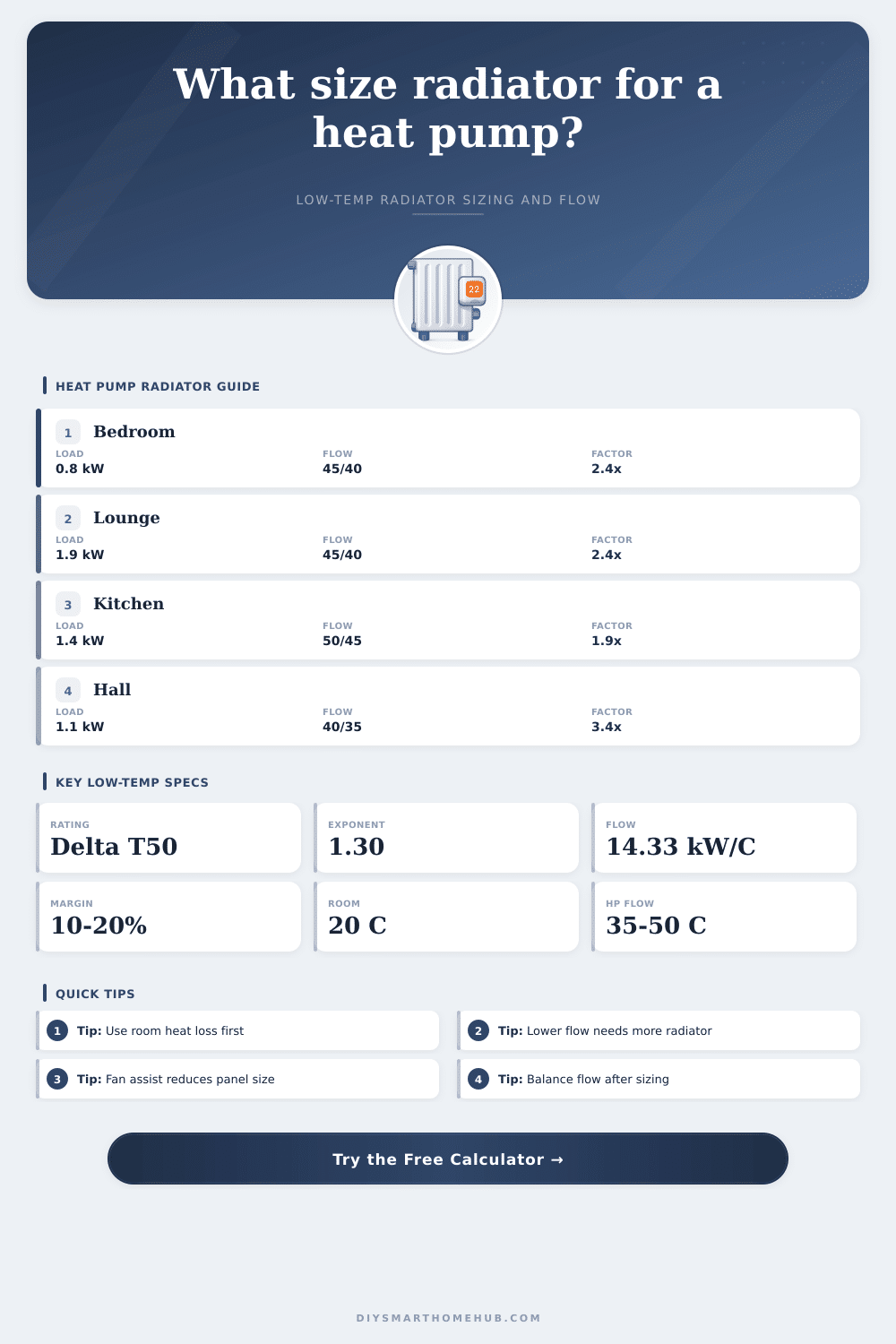
Estimate radiator size for low-temperature heat pump flow and return water, including room heat loss, mean water-air delta-T, radiator derating exponent, oversize multiplier, and required flow rate.
🎛Heat Pump Radiator Presets
Pick a common low-temperature radiator scenario, then adjust the room heat loss, flow and return temperatures, radiator rating type, and sizing margin.
📏Low-Temperature Radiator Inputs
📊Low-Temperature Radiator Spec Grid
Standard radiator output reference based on 75 C mean water and 20 C room air.
Mean water is 42.5 C, so radiator output is a fraction of Delta T50 rating.
Radiators with more convection usually derate more steeply at lower temperatures.
Narrow flow-return delta improves emitter output but raises pump flow requirement.
📘Reference Tables
Radiator derating by heat pump water temperature
| Flow/return | Mean water | Delta-T to 20 C room | Approx output vs Delta T50 |
|---|---|---|---|
| 55/45 C | 50 C | 30 K | About 51% for n 1.32 |
| 50/45 C | 47.5 C | 27.5 K | About 45% for n 1.32 |
| 45/40 C | 42.5 C | 22.5 K | About 35% for n 1.32 |
| 40/35 C | 37.5 C | 17.5 K | About 25% for n 1.32 |
| 35/30 C | 32.5 C | 12.5 K | About 16% for n 1.32 |
Typical room heat-loss planning ranges
| Room condition | BTU/hr sq ft | W per m2 | Use when |
|---|---|---|---|
| Very low loss shell | 10-14 | 32-44 | Deep retrofit, airtight, strong insulation |
| Modern insulated room | 16-22 | 50-69 | Typical updated home with double glazing |
| Average insulated room | 23-30 | 73-95 | Mixed insulation or exposed walls |
| Older envelope room | 32-40 | 101-126 | Older home before major fabric upgrades |
| Cold or exposed room | 40-50 | 126-158 | Corner room, high ceilings, high glazing |
Radiator type comparison for heat pumps
| Emitter type | Typical exponent | Low-temp strength | Watch point |
|---|---|---|---|
| Type 11 panel | 1.30 | Simple replacement in small rooms | Limited surface area at 40-45 C flow |
| Type 22 panel | 1.32 | Common upgrade with more convector area | Depth and wall clearance |
| Type 33 panel | 1.33 | High catalog output in same width | Thicker body, more water volume |
| Column radiator | 1.25 | Gentler derating and larger water content | Often needs more wall length |
| Fan-assisted radiator | 1.10 | Strong output at very low water temperature | Electrical power and fan sound |
| Towel rail | 1.28 | Good supplemental bathroom emitter | Usually weak as the only heat source |
Common heat-pump radiator projects
| Project | Room size | Heat loss | Water target |
|---|---|---|---|
| Small bedroom panel | 120-160 sq ft / 11-15 m2 | 0.6-1.0 kW | 45/40 C |
| Large lounge replacement | 260-380 sq ft / 24-35 m2 | 1.6-2.8 kW | 45/40 or 50/45 C |
| Kitchen diner radiator | 180-300 sq ft / 17-28 m2 | 1.2-2.2 kW | 45/40 C |
| Hall or landing column | 100-220 sq ft / 9-20 m2 | 0.7-1.6 kW | 40/35 or 45/40 C |
| Open plan fan-assisted | 450-700 sq ft / 42-65 m2 | 2.8-5.0 kW | 35/30 or 40/35 C |
💡Heat Pump Radiator Sizing Tips
Existing radiators may have been selected for 70 C or higher boiler water. A heat pump running 45/40 C needs the same room heat loss covered at a much lower mean water-air delta-T.
Lower return temperatures help heat pump efficiency, but the water split also sets GPM or L/min. A very tight split can make radiator output look better while asking more from the circulator.
When you switch from a gas boiler to a heat pump, you will find that you will need larger radiator. Gas boilers heat water to 70 C or higher while heat pumps work best with water at 45 C or lower. Because heat pumps use water at a lower temperature, the radiator will need to contain more surface area so that it can produce the same amount of heat as the smaller radiator with higher temperature water.
The radiator will have to contain more surface areas in order to provide the same amount of heat to the room as a radiator with smaller temperature difference between the water and the air in the room. The amount of heat that the radiator gives off is dependent upon the difference between the temperature of the water within the radiator and the air in the room. If water from a gas boiler is used, there will be a great difference between the water and the air in the room, thus allowing the radiator to release a great deal of heat into the room.
Why you need bigger radiators for a heat pump
However, when a heat pump system is use, the water within the radiator will be much less hot than in the instance with the gas boiler, thus causing the heat output from the radiator to be less. Therefore, in order to counteract the decrease in the heat output of the radiator, the radiator must be larger in size. In order to determine the size of the radiator that is required for your space, it is first necessary to determine the heat loss of the room.
A moddern bedroom that has good insulation may only have a heat loss of 12 to 18 BTU per square foot. However, if the room is older or does not have good insulation, such as windows that do not have much insulation, the heat loss can be as high as 35 to 40 BTU per square foot. The heat loss of a space must be known in order to determine how much heat that the space will need in order to remain comfortable.
Once you know the heat loss of the space, you can determine the size of the radiator that will be necessary in that space. The amount of heat that the radiator will emit when used in a heat pump will be less than if it is used in a system that uses higher water temperatures. Manufacturers rate the amount of heat that radiators will emit when there is a 50-degree difference between the water within the radiator and the air in the room.
In heat pump systems, the flow and return temperatures are 45 and 40 C, respectively. This creates a 22 or 23 degree difference in temperature between the radiator and the room air. Therefore, the amount of heat that the radiator gives off will be less.
A radiator calculator will tell you the oversize multiplier for your situation to help determine whether you need a standard panel radiator, a double convector radiator, a taller column radiator, or a radiator with fan assistance. Flow and return temperatures will also allow you to calculate the flow of the water within the system. The higher the temperature difference between the water in the radiator and the air in the room, the higher the amount of heat in the water that will be able to warm the space.
A higher temperature difference means that the pump that heats the water will have to push more gallon of water per minute through the system. This can be calculated by the radiator size calculator in order to determine whether the flow of water will remain within the limits of the water pump that is to be installed in the home. While many individuals may try to size the radiators according to the size of the radiators that are currently within the home or from the pictures of the radiators that are available in radiator catalogs, such methods are not accurate when installing heat pumps.
The old radiators within the home were sized for water temperatures of 70 degrees, which are not used within heat pump systems. Additionally, the pictures of the radiators do not indicate how much heat the radiator will output at the 42 C mean water temperature that is used within heat pump systems. You can use the information described in this article to size the radiators for each room in your home based off the heat loss of each room, the different outputs of radiators at different temperature differences, and the flow of water calculations.
The tables provided on the page will allow you to determine derating percentages of radiators at different temperatures, as well as understand the different ranges of heat loss of spaces of various sizes. These tables will help you to decide whether you need a type 22 radiator or column radiator. Additionally, the tables will allow you to understand which radiator types will hold their heat output better at low water temperatures.
While the radiator calculator will allow you to size the radiators for a heating system that utilizes water at low temperatures, the calculator will not allow you to account for how the individual within the home will use the house, or how different areas of the house may be used differently from one another. For instance, rooms that are to be used as bedrooms may have different temperature requirements than the lounge area within the house. A calculator cannot factor in these variables, thus allowing the individual to size the radiators in the rooms in which they intend for the rooms to be utilized.
However, the calculator will provide a baseline from which to start sizing the radiators. In order to ensure that the radiators will function correctly in the heat pump system, you should follow three steps. First, you will have to measure the heat loss of the individual rooms in your home.
Second, you will have to accept that because the radiator will be used with water at a lower temperature, it will have to be larger to provide the same amount of heat to the rooms as smaller radiators did with hotter water from the boiler. Third, you will have to make certain that the water pump in your system can move the amount of water that will be required by the system to reach the necessary radiators in your home. By following these three steps in your home, you will ensure that the radiators will correctly and efficient provide the heat that is necessary to provide comfort to individuals who live within your home.