Boiler Gas Pipe Size Calculator
Estimate natural-gas or LP vapor boiler piping from appliance input BTU, BTU-to-CFH conversion, longest-length sizing, specific gravity, allowable pressure drop, branch demand, trunk demand, and screened pipe diameter.
🔧Gas Pipe Presets
Pick a boiler gas piping scenario, then adjust the load, gas type, run length, pressure-drop basis, and pipe material for the actual job.
📏Boiler Gas Pipe Inputs
Full Boiler Gas Pipe Breakdown
This calculator is a screening aid, not an approval document. Final gas piping must follow the adopted fuel-gas code, appliance instructions, meter/regulator limits, pressure testing rules, and listed manufacturer tables.
⚙Gas Pipe Spec Grid
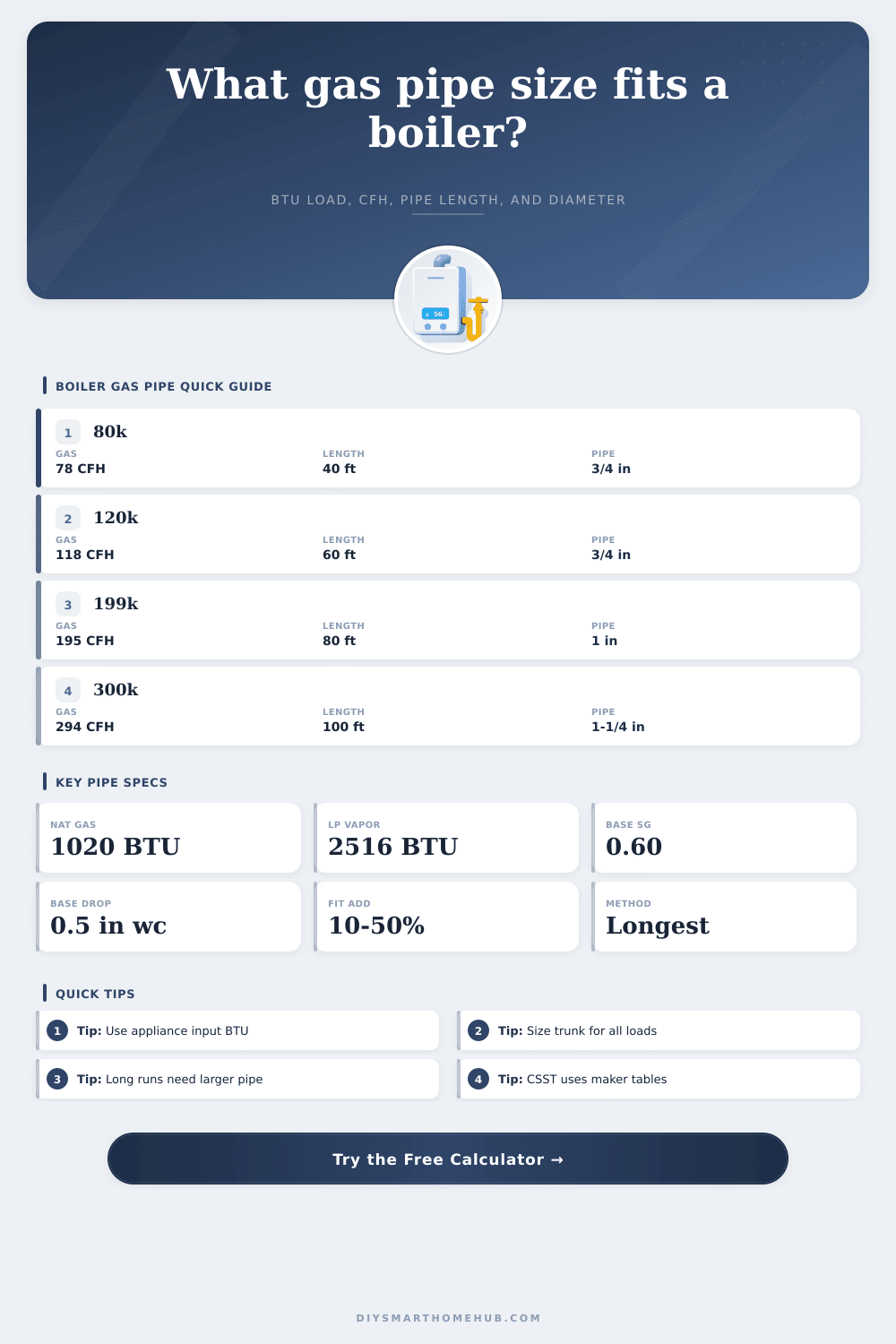
Boiler gas flow is appliance input BTU/hr divided by fuel heating value in BTU per cubic foot.
Many low-pressure sizing tables are based on natural gas near 0.60 specific gravity.
Residential low-pressure screens often compare against a half-inch water-column drop basis.
Each section is checked with the longest run so remote appliances retain enough pressure.
📊Boiler Gas Pipe Reference Tables
BTU Load to CFH Conversion
| Gas basis | Heat value | Specific gravity | CFH formula |
|---|---|---|---|
| Typical natural gas | 1020 BTU/ft3 | 0.60 | CFH = input BTU/hr / 1020 |
| Code-table natural gas | 1000 BTU/ft3 | 0.60 | CFH = input BTU/hr / 1000 |
| Rich natural gas | 1050 BTU/ft3 | 0.62 | CFH decreases, SG slightly reduces capacity |
| LP vapor | 2516 BTU/ft3 | 1.52 | Lower CFH demand, higher SG capacity penalty |
| Low-BTU mixed gas | 900 BTU/ft3 | 0.65 | Higher CFH demand for the same boiler input |
Representative Low-Pressure Schedule 40 Capacity
| Length row | 1/2 in | 3/4 in | 1 in | 1-1/4 in | 1-1/2 in | 2 in |
|---|---|---|---|---|---|---|
| 20 ft | 120 CFH | 250 CFH | 465 CFH | 950 CFH | 1460 CFH | 2750 CFH |
| 40 ft | 82 CFH | 170 CFH | 320 CFH | 660 CFH | 990 CFH | 1900 CFH |
| 60 ft | 66 CFH | 138 CFH | 260 CFH | 530 CFH | 810 CFH | 1520 CFH |
| 100 ft | 50 CFH | 103 CFH | 195 CFH | 400 CFH | 620 CFH | 1150 CFH |
| 150 ft | 40 CFH | 84 CFH | 160 CFH | 325 CFH | 500 CFH | 950 CFH |
Longest-Length Branch and Trunk Logic
| Pipe section | Demand used | Length used | Calculator output |
|---|---|---|---|
| Boiler branch | Boiler CFH only | Longest run x fittings factor | Branch diameter and branch margin |
| Shared trunk | Boiler CFH plus other CFH | Longest run x fittings factor | Trunk diameter and trunk margin |
| Branch-only comparison | Boiler CFH only | Actual boiler branch x fittings factor | Shows how conservative longest length is |
| Pressure-drop correction | Same CFH load | Same sizing length | Capacity x square root of selected drop / 0.5 |
| Specific-gravity correction | Same CFH load | Same sizing length | Capacity x square root of 0.60 / selected SG |
Material and System Screening Factors
| Material or system | Screen factor | Use in calculator | Field verification |
|---|---|---|---|
| Schedule 40 black steel | 1.00 | Base low-pressure capacity table | Use adopted fuel-gas table for final size |
| Schedule 80 steel | 0.86 | Reduced area screen versus Schedule 40 | Confirm internal diameter and table basis |
| Type L copper tube | 0.82 | Capacity screen where copper gas piping is allowed | Check gas composition and local code |
| Underground PE pipe | 0.95 | Preliminary underground service screen | Use PE manufacturer and utility tables |
| CSST | 0.58 | Conservative flexible tubing screen | Use the exact CSST brand sizing chart |
| Appliance connector | 0.38 | Short final connector warning only | Use connector rating, length, and appliance listing |
Common Boiler Gas Pipe Scenarios
| Boiler scenario | Typical input | Natural gas flow | Pipe sizing note |
|---|---|---|---|
| Small wall-hung boiler | 60k-90k BTU/hr | 59-88 CFH at 1020 BTU/ft3 | Often limited by long 1/2 in branches |
| Standard mod-con boiler | 100k-150k BTU/hr | 98-147 CFH at 1020 BTU/ft3 | Commonly needs 3/4 in or larger on long runs |
| High-input combi | 180k-199k BTU/hr | 176-195 CFH at 1020 BTU/ft3 | Longest-length method often moves to 1 in |
| Boiler plus water heater trunk | 180k-260k combined | 176-255 CFH at 1020 BTU/ft3 | Trunk size can exceed the boiler branch size |
| Light commercial boiler | 300k-500k BTU/hr | 294-490 CFH at 1020 BTU/ft3 | Meter, regulator, pressure, and code table dominate |
💡Gas Pipe Sizing Tips
A boiler branch carries only the boiler input, while the upstream trunk must carry every connected gas load downstream of that section.
CSST, appliance connectors, PE systems, and listed tubing can have very different capacities from nominal steel pipe of similar size.
Sizing a gas pipe for a boiler require that you account for many different variable in your calculations. In order for a boiler to function correctly, the gas pipe that supply the fuel to that boiler must be able to supply enough fuel to the boiler to allow it to perform its function, as well as maintain a proper pressure within the system. If the gas pipe isnt sized correct, the gas pipe may create a pressure drop within the system.
A pressure drop within a gas system that supply fuel to a boiler can lead to many different problem with that boiler, such as the development of a noisy burner flame or the short cycling of the boiler. One of the first variable to consider when sizing a gas pipe for a boiler is the input rating of the boiler. The input rating of the boiler will tell you the maximum amount of fuel that the burner within the boiler want to burn.
How to Size a Gas Pipe for a Boiler
This unit can be converted to unit of cubic feet per hour by understanding the heating value of the gas that will be used to heat the water for the system; natural gas and propane has different heating values. Thus, this factor is important in determining the flow rate of the gas through the gas pipe. The length of the gas pipe is another important factor in determining the size of that gas pipe.
The length of the gas pipe that should be used is the longest run of gas pipe between the meter and the farthest outlet of the system. Using this measurement will ensure that the remote appliance within the system dont experience a drop in pressure within the system when all of the appliances are running at the same time. In addition to the length of the gas pipe, it is also important to add a fittings allowance to the length of the gas pipe.
Elbows and tees within the gas pipe create turbulence within that system; the fittings allowance account for the turbulence that these pipe components create. A twenty percent allowance for the fittings may be used in residential gas pipe systems; however, a fifty percent allowance may be used in systems that contain many direction change for the gas pipe. The branch pipe and the trunk pipe into which the branch pipe is installed must be sized differently.
The branch pipe is only used to supply gas to the boiler; however, the trunk pipe must be capable of supplying gas to the boiler as well as to any appliance that may utilize the trunk pipe. Thus, the trunk pipe must be sized to handle the total load created by the boiler and all other appliance that utilize that trunk pipe. If the trunk pipe is smaller than the boiler require, the trunk pipe will restrict the flow of fuel to the boiler.
The material of the gas pipe is another factor to consider. Black steel pipe is the standard material used in the calculation for gas piping systems. However, corrugated stainless steel tubing, copper and polyethylene tubing has different rates of internal friction.
Because of this, a larger nominal size is often required for flexible tubing compared to rigid gas piping. Additionally, you should always check the manufacturer’s specification for the gas pipe, as the material of the pipe will impact the amount of gas that can flow through the pipe. Two more factor that must be considered are the pressure drop and specific gravity of the fuel.
A half-inch of water column is the standard pressure drop that is allowed in low pressure gas systems. A higher pressure drop can be specified in the system design in order to allow for more capacity of the gas system. The specific gravity of the fuel impact how much resistance the fuel will encounter as it moves through the gas pipe.
Because propane has a higher specific gravity than natural gas, propane will lose more pressure traveling through the gas pipe than natural gas at the same flow rate. Commonly, people make mistake when sizing gas piping systems. Many people make the mistake of only sizing the branch gas pipe and forgetting to size the trunk pipe.
Additionally, many people will use the measured length of the gas pipe instead of the longest run of the gas pipe, or they will forget to allow for the fittings in the system. If these step are skipped, the gas boiler may not be able to reach its full input rating. A calculator can be used to determine both the branch and trunk pipe margin for the system to avoid these mistake.
There are other factor outside the calculation to consider in the sizing of the gas pipe. First consider the capacity of the meter that will be used to measure the gas that is to flow into the system. Additionally, local gas code should also be considered and compared to the size of the gas pipe that was calculated.
Lastly, the goal is for the boiler to receive steady pressure at full fire. If both the branch and trunk pipe have a positive margin when all allowance are made, then the gas pipe will perform as calculated.