Industrial Boiler Size Calculator
Size a steam boiler plant from process steam demand, operating pressure, feedwater temperature, boiler horsepower, load factor, fuel input, blowdown allowance, and N+1 redundancy.
🏭Industrial Plant Presets
Load a typical plant profile, then tune the steam demand, pressure, feedwater, load factor, blowdown, efficiency, and redundancy assumptions.
⚙Steam Plant Inputs
Full Formula Breakdown
This calculator is a preliminary industrial steam sizing aid. Final boiler selection should use measured process loads, code requirements, manufacturer performance data, burner turndown, emissions limits, water treatment assumptions, and pressure-drop checks.
📊Industrial Steam Spec Grid
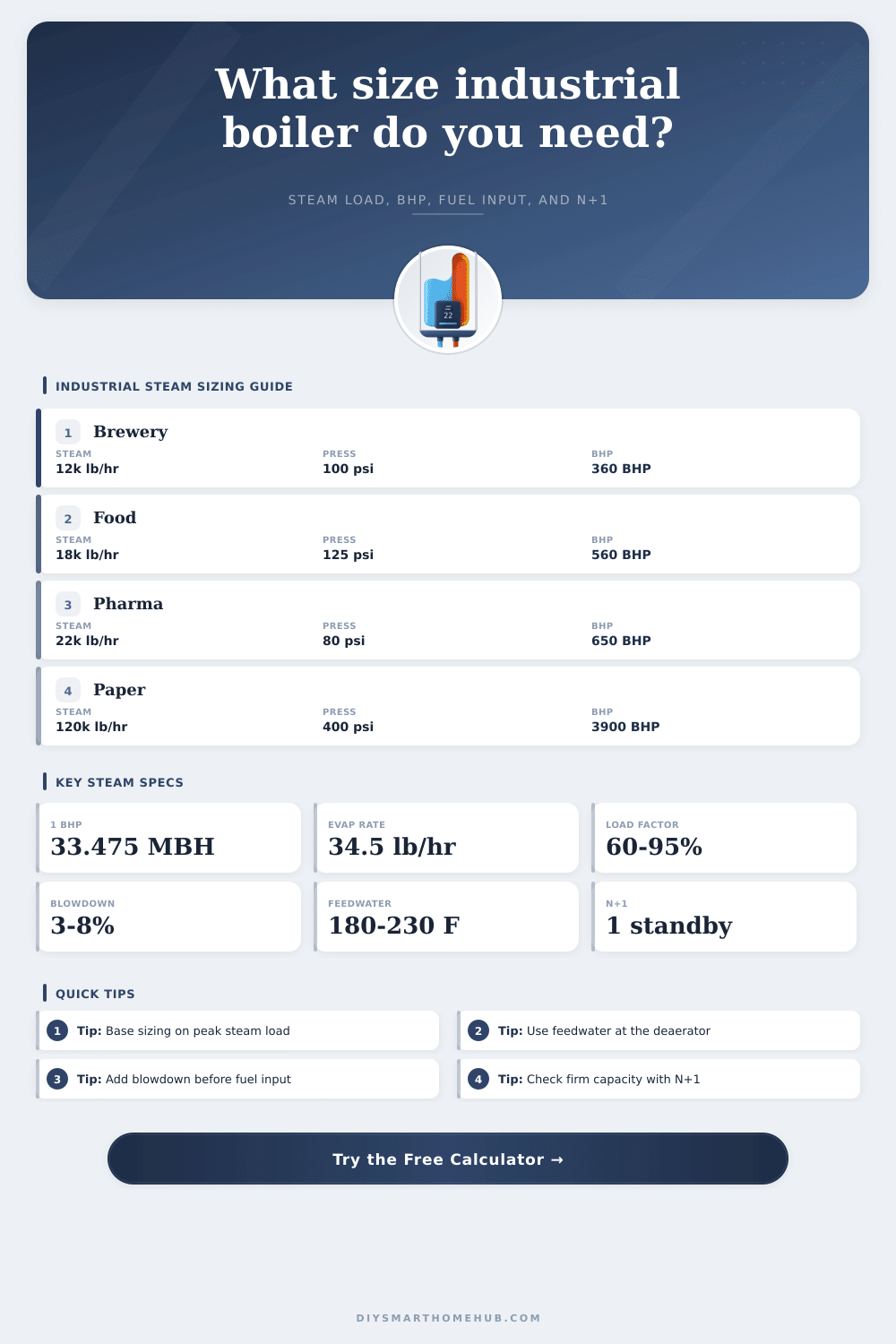
Traditional evaporation from and at 212 F. Actual condition BHP should use the enthalpy rise.
Boiler horsepower is a heat-rate unit equal to 33,475 BTU/hr of output.
Lower TDS control can reduce blowdown; poor condensate return usually increases it.
Hotter feedwater reduces fuel input by lowering the required enthalpy rise.
🧱Industrial Boiler / Spec Comparison Grid
Scotch marine firetube
- Range50-800 BHP
- Pressure15-250 psig
- Strengthsteady load
- Useplants
Flexible watertube
- Range100-1500 BHP
- Pressureup to 450
- Strengthfast steam
- Useprocess
D-type watertube
- Range500+ BHP
- Pressurehigh
- Strengthlarge load
- Usemill steam
Electric steam
- Rangesmall-mid
- Pressurelow-mid
- Strengthno stack
- Useclean rooms
📘Reference Tables
Steam Pressure And Approximate Enthalpy
| Pressure | Sat Temp | Dry Steam h | Typical Use |
|---|---|---|---|
| 50 psig / 3.4 barg | 298 F / 148 C | 1174 BTU/lb | Low-pressure process, humidification, washdown |
| 100 psig / 6.9 barg | 338 F / 170 C | 1188 BTU/lb | Food, brewery, hospital sterilization |
| 250 psig / 17.2 barg | 406 F / 208 C | 1202 BTU/lb | Refinery utility headers and reboilers |
| 600 psig / 41.4 barg | 489 F / 254 C | 1205 BTU/lb | Large industrial watertube plants |
Process Load Factor Reference
| Process Pattern | Load Factor | Sizing Note | Examples |
|---|---|---|---|
| Batch demand with peaks | 60-75% | Check accumulator or surge capacity separately. | Autoclaves, retorts, batch kettles |
| Mixed process plant | 75-88% | Use simultaneous peak production schedule. | Food, textile, laundry |
| Continuous production | 88-95% | Base on measured sustained steam flow. | Paper dryers, refinery, chemical |
| Critical utility header | 90-100% | Apply firm capacity and standby requirements. | Hospitals, district steam, pharma |
Fuel Input Reference
| Fuel | HHV Reference | Calculator Output | Best Fit |
|---|---|---|---|
| Natural gas | 1,030 BTU per ft³ | MCF/hr and therm/hr | Most packaged industrial steam plants |
| Propane vapor | 91,500 BTU per gal | gal/hr | Remote process plants and backup firing |
| No. 2 fuel oil | 138,500 BTU per gal | gal/hr | Backup or dual-fuel industrial boilers |
| Electric resistance | 3,412 BTU per kWh | input kW | Clean rooms, pilot plants, small process loads |
Blowdown And Feedwater Allowances
| Water Program | Blowdown | Feedwater | Sizing Effect |
|---|---|---|---|
| Good condensate return | 2-4% | 200-230 F | Lower fuel input and makeup flow |
| Average process plant | 4-7% | 180-215 F | Common preliminary sizing basis |
| High makeup water | 7-10% | 140-190 F | Raises BHP and burner input |
| Variable quality water | 10-15% | 120-180 F | Needs conservative margin and review |
💡Industrial Boiler Sizing Tips
Connected equipment nameplate steam can be much higher than simultaneous production demand. Use plant logs, batch timing, or a process schedule to set the load factor before adding blowdown and redundancy.
A plant can meet total installed capacity and still miss N+1 if the largest boiler is too large. Compare the remaining modules against the target steam load with margin included.
To size an industrial boiler, you first need to determine the amount of steam that the plant will require at any given moment. You will need to determine the amount of steam required during peak productions and the amount of steam that the plant will require if the boiler is taken offline for maintenance. Each of these variables will impact the amount of heat that the boiler will need to make.
Because the boiler will release each of these variables in the amount of heat, each of these variables will also impact the amount of fuel that the boiler will need to burn in order to reach that amount of heat. The amount of steam that the process will require is typically not the same than the nameplate ratings for the individual pieces of equipment within the process. While each piece of equipment may have a high load that is connected to the equipment, the load that is required of the steam supply will only occur if many of these machine are in operation at the same time.
How to Size a Steam Boiler
The load factor is important to consider to determine how many unit of steam will actualy be required during the peak periods of operation for the plant. Using a calculator will perform the math necessary to determine the steam load, steam pressure, and feedwater temperature requirements for the process. Using the boiler steam sizing calculator will also prevent the need for guessing the proper amount of enthalpy rise and blowdown for the steam system.
The temperature of the feedwater that is supplied to the boiler will impact the amount of fuel that is required for operation of the boiler. If the temperature of the feedwater is high, such as 190 F, the boiler will have to supply heat to the water in order to raise the temperature of the water to the steam temperature requirement for the process. The higher the starting temperature of the feedwater, the less fuel the boiler will require.
If the starting temperature is increased by 30 degrees, the amount of fuel that will be saved will increase in relation to the rise in the starting temperature. If the starting temperature of the feedwater is low, the burner will have to work harder to heat the water to the steam temperature. The cold makeup water increases the required boiler horsepower for steam generation.
Plants that use condensate return and hot deaerators will have smaller firing rates than plants that lose condensate to the atmosphere. The rate at which steam is blown down from the boiler will also impact the amount of fuel that is required to operate the boiler. Each gallon of water that is blown down will have to be replaced with new water that will also be heated within the boiler.
A 5% blowdown rate will require the boiler to produce 5% more steam than the amount that the process will consume. This blowdown rate will affect the fuel input calculation for the steam system. Additionally, the blowdown rate will also impact the number of steam modules that will be required for the steam system.
A reference table will allow you to determine how different water treatment programs will impact the blowdown rate and the feedwater temperature. Using the reference table will allow you to determine a realistic starting point for your steam system calculation. After determining the gross steam requirement for the steam system, there are other factors to consider within the steam system.
One of the factors to consider is the redundancy of the steam system. Redundancy within the steam system ensures that the steam system can continue to meet the target load within the steam system if one of the boilers within the system is offline for maintenance. There are different types of redundancy within a steam system.
An N+1 system is one form of redundancy that provides for one full module of steam production capacity that is left in reserve. A steam sizing tool will allow you to see if each of the remaining steam modules have the capacity to meet the adjusted steam load of the steam system. This will allow you to see if any steam modules are too small or too large relative to the steam requirements of the process.
Other physical constraints will also impact the choice of steam boiler that is selected for the steam system. Factors such as the height of the chimney, the allowable emissions, the available floor space within the steam system, and the electrical service will impact whether package boilers or watertube boilers are selected. The turndown ratio of the burners within each steam module will also impact the steam system.
If each burner has a good turndown ratio, the burner may be able to reduce its steam output to 20% of its maximum steam capacity. A burner that has a good turndown ratio will not short cycle its operation during the shoulder seasons. If each burner has a relatively poorly turndown ratio, it may be necessary to oversize each steam boiler with respect to steam capacity to accommodate the low steam loads during these seasons.
Overall, the goal of sizing each of the boilers within the steam system will be to create a steam system that is reliable should one of the boilers within the system be offline for maintenance. The steam system should also be efficient within operation should steam loads drop below the target loads. While a steam sizing calculator provides the starting point for steam system sizing calculations, there are other factors that must also be considered when making a final decision regarding the steam system.