Gas Boiler Size Calculator
Estimate a natural-gas or LP hydronic boiler from building heat loss, AFUE, domestic hot-water add-on, gas input BTU, pipe-load allowance, and minimum-fire modulation.
🏠Gas Boiler Presets
Choose a realistic hydronic gas-boiler scenario, then adjust the heat-loss level, DHW demand, AFUE, pipe capacity, and modulation values for the actual building.
📏Gas Boiler Sizing Inputs
This calculator is a sizing aid. Final gas boiler selection should follow local fuel-gas code, manufacturer ratings, venting limits, combustion-air rules, and a proper heat-loss calculation.
⚙Gas Boiler Spec Grid
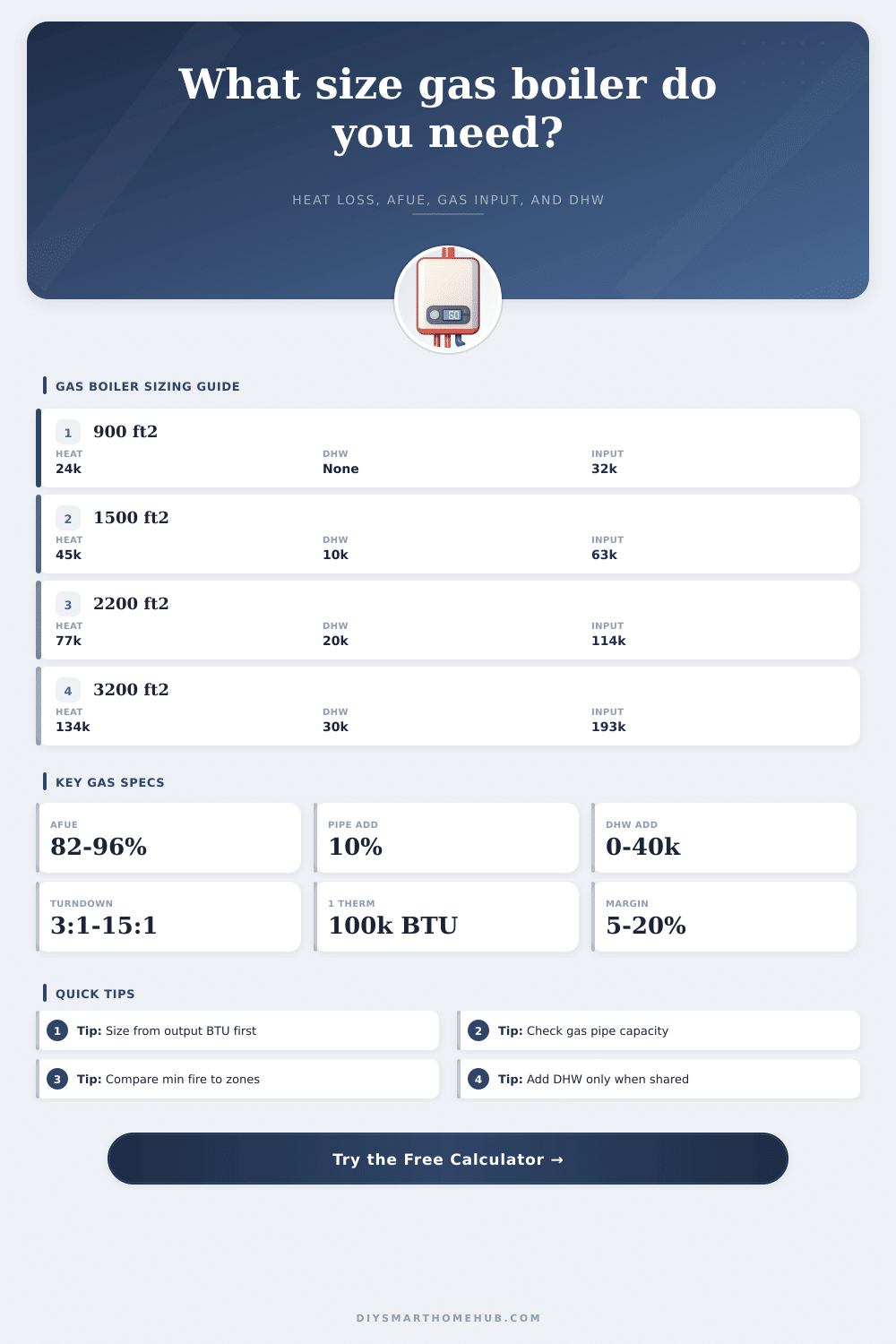
Typical non-condensing gas boiler range; compare boiler output, not just input.
Condensing boilers can be higher when return water stays cool enough.
Higher turndown lowers minimum fire and helps small zones run longer.
Use the calculator pipe check as an early warning before formal gas sizing.
📊Gas Boiler Reference Tables
Building Heat-Loss Intensity
| Envelope condition | BTU/hr sq ft | Typical use | Calculator note |
|---|---|---|---|
| Very tight / low load | 15-20 | New shell, excellent air sealing | Confirm small-zone cycling carefully |
| Modern insulated | 22-28 | Updated windows and insulation | Often fits compact modulating boilers |
| Average existing home | 30-36 | Typical mixed envelope | Use measured heat loss if possible |
| Older or drafty home | 40-48 | Limited insulation, air leakage | Envelope upgrades can downsize boiler |
| Cold or leaky design | 50-60 | Cold climate or poor shell | Avoid guessing above this range |
Common Gas Boiler Output Classes
| Output class | Approx input at 84% | Approx input at 95% | Best fit signal |
|---|---|---|---|
| 40,000 BTU/hr | 47,600 BTU/hr | 42,100 BTU/hr | Small condos or low-load zones |
| 60,000 BTU/hr | 71,400 BTU/hr | 63,200 BTU/hr | Small homes, tight ranches |
| 80,000 BTU/hr | 95,200 BTU/hr | 84,200 BTU/hr | Average homes with modest DHW |
| 120,000 BTU/hr | 142,900 BTU/hr | 126,300 BTU/hr | Larger homes or indirect tank load |
| 180,000 BTU/hr | 214,300 BTU/hr | 189,500 BTU/hr | Large homes or high combi allowance |
Gas Pipe and Load Allowance
| Check item | Formula | Why it matters | Action if tight |
|---|---|---|---|
| Boiler gas input | Output / AFUE | Fuel piping is sized from input load | Use rated input from the boiler label |
| Pipe allowance | Input x 1.10 | Allows headroom in this screening calc | Run full fuel-gas pipe sizing tables |
| Available capacity | Pipe or meter capacity left | Other gas appliances reduce margin | Recalculate with all connected loads |
| Pipe margin | Available - allowed load | Negative margin means the boiler may starve | Upsize pipe or reduce connected load |
DHW Add-On and Pickup Profiles
| Profile | DHW add-on | Pickup factor | Use case |
|---|---|---|---|
| Space heat only | 0 BTU/hr | 5% | No indirect tank or combi demand assigned |
| Small indirect | 10,000 BTU/hr | 10% | Small tank, mild recovery expectation |
| Standard indirect | 20,000 BTU/hr | 15% | Common hydronic tank sizing allowance |
| Large indirect | 30,000 BTU/hr | 18% | Larger storage tank or faster recovery |
| Combi allowance | 40,000 BTU/hr | 20% | Early screen for high domestic demand |
🧮Preset Result Examples
Low-load homes
- Tight condo24k-40k output
- Radiant slab45k-60k output
- Small ranch50k-80k output
Higher-load homes
- Average baseboard80k-100k output
- Old radiators120k output
- Cold climate180k+ output
💡Gas Boiler Sizing Tips
Heat emitters and rooms need output BTU/hr. Gas piping and meter checks need input BTU/hr, so AFUE is the bridge between the two numbers.
A boiler that meets the design-day load can still short-cycle if its minimum-fire output is larger than the smallest active zone load.
Choosing the correct sizes for a gas boiler is an important process. Choosing the correct size for a gas boiler will ensure that your home remains warm during the winter months and that your fuel costs remains low. If the size of your gas boiler are too large for your home, then the gas boiler will waste fuel and wear out faster than it should due to the fact that a large gas boiler will have to cycle its on and off switch too frequent.
Alternatively, if the size of your gas boiler is too small for your home, then the gas boiler will struggle to heat your home during cold winter days, and the small size of the gas boiler will require many of the homes residents to utilize space heaters to remain warm during the winter months. You can utilize the calculator located on this page to determine the correct size for your gas boiler. To utilize the calculator, you will need to enter information regarding your home and the number of resident in your home that use hot water.
How to Choose the Right Size Gas Boiler
The first calculation that you must make when sizing a gas boiler is the heat loss of the building. Each building lose heat at a different rate. Homes that are newly constructed tend to have tighter building envelopes that lose heat at a slower rate than older homes, which often have windows and walls that do not have insulation.
You can select a heat loss intensity on the calculator that matches your homes construction, and you can make an envelope adjustment for homes that fall in between the two category. This adjustment will allow for the heat output to be changed by thousands of BTU per hour with even a small adjustment to the insulation of the home. An additional requirement that must be accounted for in addition to the heat loss calculations is the requirement of the gas boiler to heat the domestic water in the home.
If the gas boiler will provide domestic hot water to the home through an indirect tank, the size of the tank will contribute to the calculation of the size of a gas boiler. The size of the tank will contribute to the gas output requirements of the boiler, as domestic hot water will be drawn from the tank. Additionally, there will be a pickup factor to the determination of the gas output requirements of the gas boiler.
This pickup factor accounts for the need to simultaniously heat the domestic water tank and domestic water pipe. If your home does not use an indirect tank to heat domestic water, this calculation is not necessary. The use of a separate domestic water heater will allow the gas boiler to remain smaller in size.
Another factor in the determination of the size of the gas boiler is the capacity of the gas pipes into the gas boiler. A ten percent adjustment is made for the capacity of the gas pipes in the calculation of the size of the gas boiler. This adjustment will allow you to see if your existing gas pipes has enough capacity to supply the gas boiler with the amount of gas that it requires to perform at its maximum efficiency.
If the calculation determines that you do not have enough capacity in your gas pipes, you will have to either increase the diameter of the gas pipes leading into the boiler, or you will have to reduce the loads that are drawn from the gas boiler. Another factor in the determination of the size of the gas boiler is the modulation range of the gas boiler. Gas boilers that have a high turndown ratio are able to adjust to a lower firing rate than gas boilers that do not have such a high turndown ratio.
You can compare the adjustment of the minimum fire output of the gas boiler to the size of the smallest zone within the home that is to be heated. This comparison will allow you to ensure that the gas boiler will not short cycle within the home. Gas boilers that short cycle will waste fuel and wear out more faster than gas boilers that do not have to cycle on and off as often.
The Annual Fuel Utilization Efficiency (AFUE) of a gas boiler is another factor in determining the size of the gas boiler. The AFUE of a gas boiler indicates the amount of fuel that that gas boiler burns that is converted into usable heat energy. Gas boilers that have higher AFUE ratings will convert a higher percentage of the fuel that is burned into usable heat.
This factor will contribute to the calculation of the size of the gas boiler, which will ensure that the input figure for the gas boiler is accurate. In the real world, each of these factors can change at the same time. For instance, the number of residents in your home may determine the size of the domestic water tank for your home, but your home may also have been newly insulated which would decrease the heat loss of the home.
Each of these variables can be adjusted independently of each other on the calculator. By being able to adjust each variable independently, you can see which variables has the greatest impact upon the size of the gas boiler. Additionally, this calculator also shows the relationship between the minimum fire output of the gas boiler and the gas pipe margin.
These two variables are the most common reasons why a person may have to swap out their gas boiler after it has been installed. The goal of this calculator is to determine the size of the gas boiler that meets three specific conditions: that it can cover the heat load that is calculated for the design day of the home; that it leaves enough capacity in the gas pipes to allow for expansion (in the case of a gas water heater, for instance); and that it is able to fire at a low rate to heat the smallest zone within the home without short cycling. By ensuring that the gas boiler meets these three conditions, you will have a gas boiler system that is efficient and reliable throughout the heating season.
You should of checked these things carefully.