Condensing Boiler Size Calculator
Estimate a condensing boiler from design heat loss, return-water temperature, AFUE, modulation range, hydronic flow delta-T, boiler kW, BTU/hr, and short-cycle risk.
🏠Condensing Boiler Presets
Pick a hydronic heating scenario, then adjust the envelope load, emitter temperatures, AFUE, turndown, and water content to fit the actual system.
📏Boiler Sizing Inputs
--
⚙Condensing and Modulation Spec Grid
📊Reference Tables
Return-water condensation factor
| Return water | Condensing behavior | Seasonal factor | Use in calculator |
|---|---|---|---|
| 95 F / 35 C | Deep condensing | 1.02 to rated | Radiant slab and oversized radiators |
| 110 F / 43 C | Strong condensing | 1.01 to rated | Panel radiators and reset curves |
| 120 F / 49 C | Good condensing | 1.00 to rated | Cast iron radiators, lower fan coils |
| 130 F / 54 C | Partial condensing | 0.98 to rated | Low-temperature baseboard |
| 145 F / 63 C | Limited condensing | 0.94 to rated | Standard baseboard on cold days |
| 150 F / 66 C | Mostly non-condensing | 0.92 to rated | Hot hydro-air coils |
Hydronic flow by boiler delta-T
| Output load | 15 F delta-T | 20 F delta-T | 30 F delta-T |
|---|---|---|---|
| 30,000 BTU/hr | 4.0 GPM | 3.0 GPM | 2.0 GPM |
| 50,000 BTU/hr | 6.7 GPM | 5.0 GPM | 3.3 GPM |
| 75,000 BTU/hr | 10.0 GPM | 7.5 GPM | 5.0 GPM |
| 100,000 BTU/hr | 13.3 GPM | 10.0 GPM | 6.7 GPM |
| 130,000 BTU/hr | 17.3 GPM | 13.0 GPM | 8.7 GPM |
Modulation and short-cycle guide
| Turndown | 100k output minimum | Best fit | Watch point |
|---|---|---|---|
| 3:1 | 33,300 BTU/hr | Large open zones | Often too high for micro-zones |
| 5:1 | 20,000 BTU/hr | Typical baseboard homes | Check shoulder-season calls |
| 8:1 | 12,500 BTU/hr | Mixed radiator zones | Still verify smallest zone |
| 10:1 | 10,000 BTU/hr | Radiant and low-load homes | Piping volume still matters |
| 15:1 | 6,700 BTU/hr | Small zones, tight shells | Controls must be tuned well |
Common sizing scenarios
| Scenario | Area | Design loss | Typical boiler output |
|---|---|---|---|
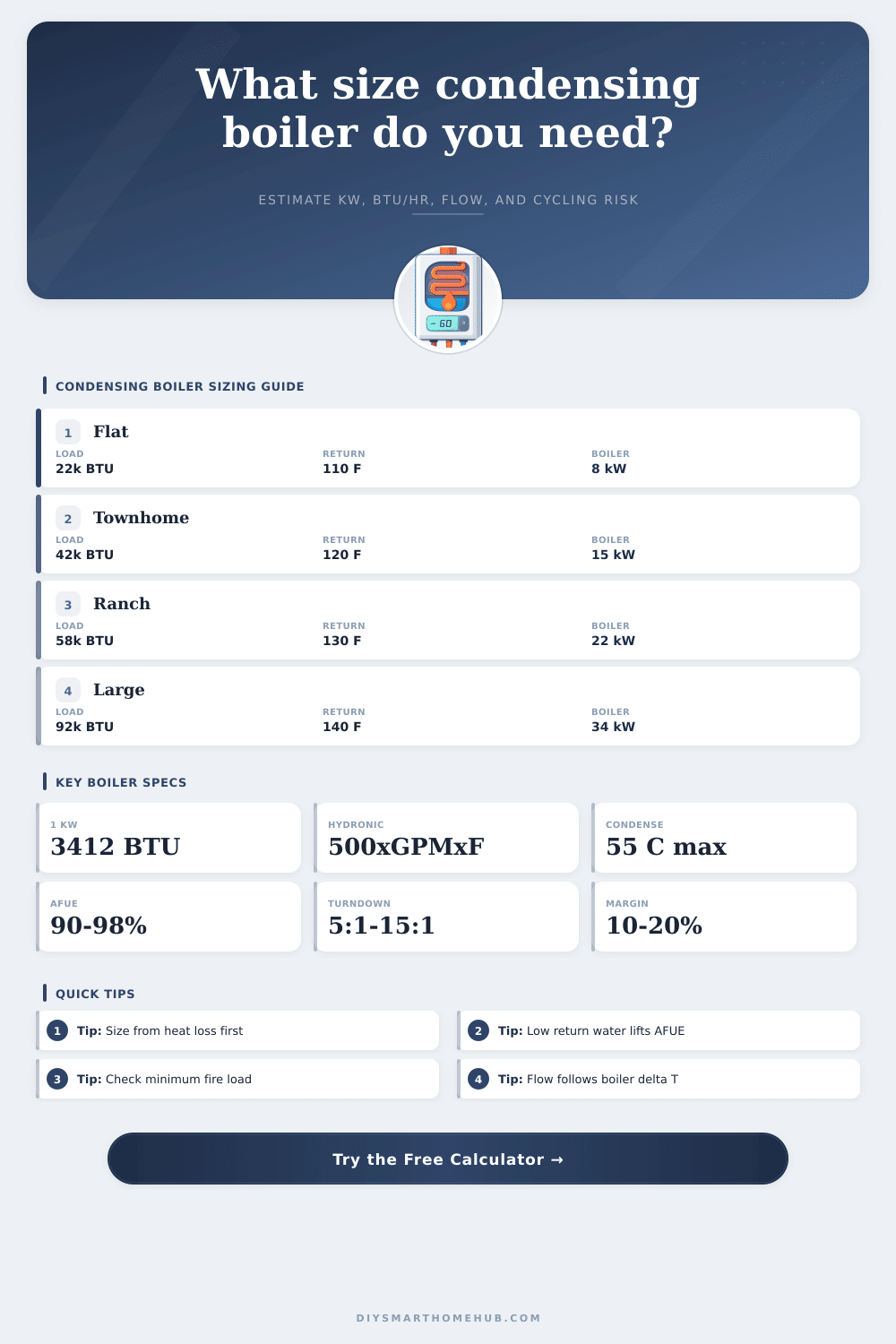
| Tight apartment | 750 ft2 / 70 m2 | 14k to 20k BTU/hr | 6 to 8 kW |
| Modern townhome | 1,450 ft2 / 135 m2 | 32k to 45k BTU/hr | 12 to 16 kW |
| Insulated ranch | 1,900 ft2 / 177 m2 | 48k to 65k BTU/hr | 18 to 24 kW |
| Large cold-climate home | 3,000 ft2 / 279 m2 | 90k to 130k BTU/hr | 32 to 45 kW |
💡Condensing Boiler Sizing Tips
Replacement boilers are often selected from the old nameplate, but a condensing boiler should start with the building heat loss, then add a measured margin. Oversizing raises minimum fire and can erase modulation benefits.
A 95% AFUE boiler may not operate near that level if the emitters require hot return water. Outdoor reset, larger emitters, and lower supply targets keep the boiler in condensing mode for more of the season.
Choosing a condensing boiler requires that you determine the correct size for the house, and choosing a condensing boiler also require that you understand how the condensing boiler will interact with the heating system. The size of the old boiler is not a correct metric for determining the size of the condensing boiler that you should purchase. The metric that you should use is the heat loss of the house.
The heat loss of the house is the result of how well the house is sealed, the amount of glass in the house, and the type of emitters that is used to distribute heat to the various areas of the house. By inputting these different variable into a calculator, you can determine the load that is required for the house to maintain a consistent indoor temperature, and that load is the number that you should use to purchase your condensing boiler. Another factor that you should consider when purchasing a condensing boiler is the return water temperature of the condensing boiler.
How to Choose the Right Size Condensing Boiler
Even if the condensing boiler is rated at a high efficiency level, that efficiency will not be obtained if the return water temperature of the condensing boiler rise to 130 degrees. The type of emitter that is used in the house will dictate the return water temperature. For instance, a radiant slab will have a return water temperature of 95 degrees, but standard baseboards may have a return water temperature of 145 degrees.
This factor will dictate whether or not the condensing boiler will be able to condense the heat during the shoulder seasons or whether or not it will act like a conventional boiler. The modulation range of the condensing boiler is another factor that you should consider when purchasing a condensing boiler. Condensing boilers can feature a 5-to-1 turndown ratio, meaning that the condensing boiler can reduce its output to one-fifth of its rated output.
However, one-fifth of the condensing boiler’s output may be too high for the smallest heating zone within the house. A calculator can help determine if the condensing boiler features a minimum fire rate that is compatible with the smallest heating zone. Furthermore, the calculator will also use the water volume in the system to calculate the cycle length for the condensing boiler.
Condensing boilers that cycle on and off too often waste fuel, wear down over time, and are not as efficient as they could be. Another factor to consider is the flow rate for the condensing boiler, which dictates what type of pump must be used in the system. A calculator can help by determining the number of gallons per minute that the condensing boiler will require.
A common flow rate is 20 degree. However, some designers may set the delta-T to 25 degrees or 30 degrees to minimize the amount of power that is required for the circulator pump in the system. With this number determined by the calculator, it will be possible to see whether or not the circulator pump that is currently in the system can handle the load or whether a different pump is required.
The condensing boiler sizing documentation also includes tables to provide answers to specific questions about the condensing boiler. One table shows the impact of return water temperature on the condensing boiler throughout the heating season. Another table displays the flow rates of the condensing boiler at various degrees of delta-T.
This helps to answer the question of whether or not a condensing boiler with a high degree of delta-T would be appropriate for the system’s piping. Another table displays the turndown ratio of condensing boilers and their performance against the heating loads of the smallest zones within a house. This can help determine whether or not a condensing boiler with a high turndown ratio is worth the extra cost.
Real houses are not always as specified in the documentation. Factors like air leakage and the orientation of the house impact the heat loss of the house. A calculator will give you a starting point for your condensing boiler, but you will have to use your own judgment to determine the proper size of your condensing boiler.
You may want to include an extra margin of error for condensing boilers in cold climates, for instance, while condensing boilers in well-insulated houses may be able to feature smaller margin of error. It is easier to make these decisions once you have data that is visible regarding the heat loss of your house and the modulation range of your condensing boiler. The last factor to consider when purchasing a condensing boiler is the volume of water within the system.
The higher the volume of water within the heating system, the longer that the condensing boiler can run when the demands of the house are low. Condensing boilers installed into older houses may be able to feature oversized boilers because the older heating systems contained a larger volume of water. Condensing boilers installed into newer houses, especially those that have a low water content, may not have the same level of flexibility in choosing oversized condensing boilers.
Condensing boiler sizing calculators uses the water volume in the system to calculate the cycle length of the condensing boiler. This cycle length will help you to determine whether or not your condensing boiler and your heating system’s piping are compatible. By selecting a condensing boiler that satisfies three specific conditions, you will ensure that the condensing boiler will function at its best for your heating system.
First, you want to ensure that the condensing boiler’s minimum output is below that of the smallest heating zones within your house. Second, you want to ensure that the return water temperature of the condensing boiler is cool enough so that the condensing boiler can condense the heat. Third, the flow rate of the condensing boiler should match that of the existing piping in the system.
By conditioning condensing boilers to meet these three criteria, you will ensure that your condensing boiler will remain quiet, have an extended life for the condensing boiler, and meet the efficiency ratings that the manufacturer of the condensing boiler provided.