Forced Air Furnace Size Calculator
Estimate delivered furnace output, rated input BTU/hr, blower and duct CFM, temperature rise, zoning diversity, and a practical nominal sizing range from home area, climate, envelope quality, AFUE, and airflow assumptions.
🏠Forced-Air Home Presets
Pick a starting profile for a gas, propane, or oil forced-air furnace, then adjust the area, shell, AFUE, duct reserve, and zoning profile.
⚙Furnace Sizing Inputs
📊Forced-Air Furnace Spec Comparison
80 AFUE Single Stage
- Typical input40k-140k
- Delivered output0.80 x input
- Blower stylePSC or ECM
- Best fitSimple ducts
90-92 AFUE Two Stage
- Typical input40k-120k
- Delivered output0.90 x input
- Blower styleMulti-speed
- Best fitMixed loads
95-97 AFUE Condensing
- Typical input40k-120k
- Delivered output0.95 x input
- Blower styleECM common
- Best fitTighter homes
Modulating Variable Speed
- Typical input60k-120k
- Delivered output0.96 x input
- Blower styleVariable ECM
- Best fitZoned homes
📐Core Forced-Air Reference Values
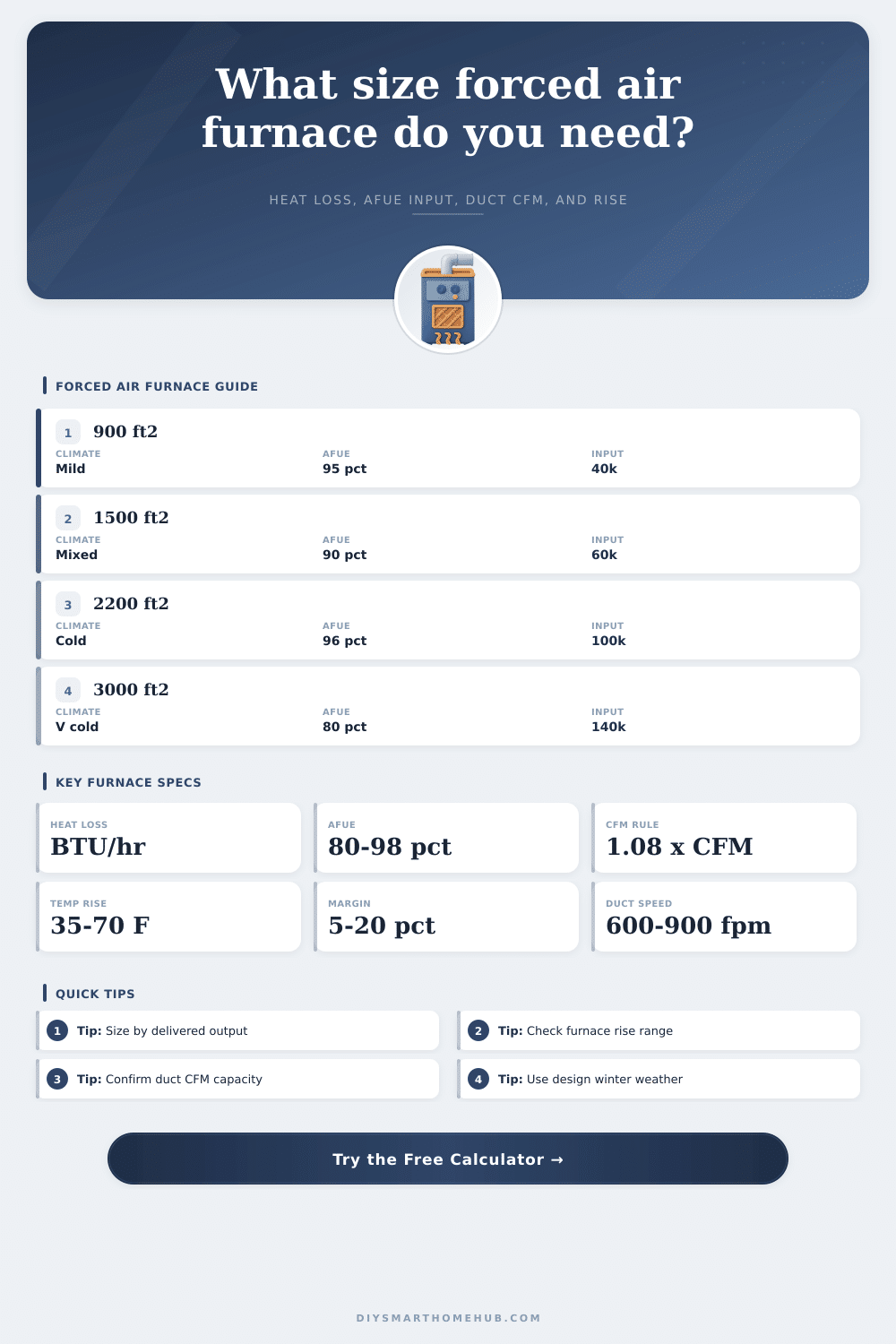
BTU/hr = 1.08 x CFM x temperature rise for standard-density indoor air.
Many furnaces list a nameplate supply-air rise range near this band.
A modest cushion covers weather and modeling uncertainty without major oversizing.
Typical residential main-duct velocity targets often sit in this comfort range.
📋Reference Tables
| Winter climate profile | Rule-of-thumb load | Metric equivalent | Use when |
|---|---|---|---|
| Mild winter | 25 BTU/hr per ft2 | 79 W per m2 | Coastal or southern heating design temperatures. |
| Mixed winter | 32 BTU/hr per ft2 | 101 W per m2 | Moderate climates and average construction. |
| Cold winter | 42 BTU/hr per ft2 | 133 W per m2 | Cold inland climates or higher heat loss homes. |
| Very cold winter | 52 BTU/hr per ft2 | 164 W per m2 | Northern climates with deep winter design days. |
| Extreme cold | 62 BTU/hr per ft2 | 196 W per m2 | Severe winter zones before a formal load calculation. |
| AFUE rating | Input for 60k output | Input for 80k output | Output formula |
|---|---|---|---|
| 80% | 75,000 BTU/hr | 100,000 BTU/hr | Input x 0.80 |
| 90% | 66,700 BTU/hr | 88,900 BTU/hr | Input x 0.90 |
| 95% | 63,200 BTU/hr | 84,200 BTU/hr | Input x 0.95 |
| 98% | 61,200 BTU/hr | 81,600 BTU/hr | Input x 0.98 |
| Delivered output | CFM at 35 F rise | CFM at 45 F rise | CFM at 60 F rise |
|---|---|---|---|
| 40,000 BTU/hr | 1,058 CFM | 823 CFM | 617 CFM |
| 60,000 BTU/hr | 1,587 CFM | 1,235 CFM | 926 CFM |
| 80,000 BTU/hr | 2,116 CFM | 1,646 CFM | 1,235 CFM |
| 100,000 BTU/hr | 2,646 CFM | 2,058 CFM | 1,543 CFM |
| Forced-air duct check | Typical target | Calculator use | What it protects |
|---|---|---|---|
| Main trunk velocity | 600-900 fpm | Compare against required CFM | Noise and pressure drop |
| Branch velocity | 500-700 fpm | Room-by-room balancing | Comfort and throw |
| Return velocity | 300-500 fpm grille face | Return-side capacity check | Filter pressure and blower load |
| Static pressure | Often 0.5 in. w.c. | Use blower table after sizing | Actual delivered airflow |
💡Forced-Air Sizing Tips
A 100,000 BTU/hr input furnace does not deliver 100,000 BTU/hr unless it is 100% efficient. Compare the heat loss to delivered output, then divide by AFUE to estimate rated input.
If the ducts cannot move the required CFM, the furnace may run above its nameplate temperature rise. That can limit comfort and should be checked with the actual blower table.
This calculator gives a planning estimate. Final equipment selection should be checked against a room-by-room Manual J load, furnace nameplate rise range, gas input rating, and blower performance data.
Selecting the correct sizes for a forced air furnace is critical to ensuring that a forced air furnace effectively heat a home. If a forced air furnace is too small for the home that is to be heated, the room within the home will remain cold during the winter month. If a forced air furnace is too large, though, the furnace will cycle on and off too frequent within the home, leading to the waste of the fuel that is required to heat the home, as well as the rapid wearing out of the forced air furnace itself.
The size of the forced air furnace that is to be selected must be based off the heat loss of the home itself, as an understanding of the heat loss of the home is the only way to ensure that the forced air furnace that is installed is of the correct size. The heat loss of a home can vary based upon several different factor. For instance, the heat loss of the home will change based upon the local winter design temperature, the quality of the insulation of the home, the quality of the window of the home, the height of the ceiling of the home, and how the home is divided into heating zone.
How to Choose the Right Size Forced Air Furnace
For instance, a home with average insulation requirement will require thirty-two BTUs per square foot of living space, but a home that is located in an area that has winter temperature that drop below those of the average winter climate may require more than forty BTUs per square foot of living space. By accounting for each of these factor for the home that is to be heated, a home can be calculated as having a certain amount of BTUs that will be lost to the outside of the home during the winter month. This heat loss value will be used to calculate the capacity of the forced air furnace that is required to effectively heat the home.
In calculating the required capacity of the forced air furnace, it is important to translate the heat loss to the capacity of the furnace, yet ensure that the calculation consider both the input BTU of the furnace and the output BTU of the furnace. Furnaces are rated according to their input BTU, but the BTU that exit the furnace and heats the home is the output BTU. The output BTU is calculated by multiply the input BTU by the AFUE percentage of the furnace.
For instance, a ninety-two percent efficient furnace will output ninety-two percent of the input BTU of the furnace; the calculator will determine this value automaticly. This output BTU is the value of BTUs that the home require for heating. Another factor that the calculator must consider is the airflow of the forced air furnace.
The forced air furnace must be able to heat the air to the proper rise in temperature, which the manufacturer of the furnace publishes. The rise in temperature is usually between thirty-five and seventy degree. The forced air furnace cannot heat the air to too high of a temperature rise, or the furnace will overheat.
The forced air furnace cannot heat the air to too low of a temperature rise, though, lest the air that exit the forced air registers in the home will feel too cool. The amount of cubic feet of air that must be moved per minute is calculated by dividing the output BTU by one point zero eight, and dividing that value by the target temperature rise. This calculation is performed by the calculator, and the calculator also consider the duct system of the home and its efficiency in relation to the forced air furnace.
Another consideration that the calculator must consider is the zoning of the home. Homes that are divided into zone have different thermostat for each of the zones. Thus, each zone does not require heat at the same time.
The size of the forced air furnace does, however, need to be able to supply enough heat to the largest zone of the home. The calculator will apply a factor to the calculation to account for this diversity in the heating needs of the homes zones, yet will also apply a guardrail to the calculation to ensure that the recommendation for the size of the forced air furnace cannot drop to a value that would not provide enough heat to heat the largest zone of the home. Another factor that the calculator consider in determining the size of the forced air furnace is the quality of the insulation of the home and the height of the ceiling within the home.
Homes that use high-quality insulation of their walls and floor will lose less heat than homes with low-quality insulation. Homes with tall ceiling will require more BTUs to heat those homes to the same temperature as homes with ceilings of less height. Thus, forced air furnaces of the same size can be required for homes of the same square footage, yet with different quality of insulation and different height in the ceilings of the home.
The final factor that is considered is the duct capacity of the home. Even if a forced air furnace is of the correct size for the home, the duct of the home will determine how well the forced air furnace function. For instance, if the duct system of the home cannot move the amount of air that the forced air furnace creates, the air will not be able to effectively heat the room within the home.
Furthermore, the duct system will develop excessive pressure if the air is forced through the duct at too high of a rate. The trunk velocity must be between six hundred and nine hundred feet per minute, and the return duct must not become starved for air. Another goal of the calculation is to ensure that the forced air furnace will cycle on and off in long enough cycle to effectively heat the home.
The forced air furnace should not short cycle, nor should it push air that feels lukewarm throughout the home. Thus, the calculator will estimate the size of the forced air furnace that is required to heat the home, but the calculator could of more accurate determined the size by performing a calculation of the heating requirement of each room in the home, and consulting the blower table for the forced air furnace model that is to be used.