Off-Grid Battery Bank Calculator
Size a battery bank from daily watt-hours, autonomy days, system voltage, chemistry depth of discharge, inverter efficiency, battery module size, load demand, and recharge target.
⚡Off-Grid Presets
🔧Battery Bank Inputs
Full Sizing Breakdown
🔋Battery Chemistry Spec Grid
📊Chemistry Comparison Table
| Chemistry | Typical usable DoD | Nominal voltage examples | Best fit |
|---|---|---|---|
| LiFePO4 | 80% to 90% | 12.8 V, 25.6 V, 51.2 V | Frequent cycling, cabins, RVs, backup systems |
| AGM lead acid | About 50% | 12 V blocks | Simple standby banks with moderate discharge depth |
| Flooded lead acid | About 50% | 6 V golf cart, 12 V marine | Serviceable banks where ventilation and watering are planned |
| Gel lead acid | About 50% | 12 V blocks | Low current sealed banks with careful charge voltage control |
| Lithium titanate | About 80% | 24 V and 48 V packs | Cold or high-cycle specialty systems |
⚙Voltage and Load Planning Table
| System voltage | Common load range | Approx DC amps at 2,000 W | Planning note |
|---|---|---|---|
| 12 V | Under 1,500 W | 185 A at 90% efficiency | Useful for small RV loads; cable current rises quickly. |
| 24 V | 1,000 W to 3,000 W | 93 A at 90% efficiency | Good middle ground for cabins and compact solar systems. |
| 48 V | 2,000 W and higher | 46 A at 90% efficiency | Preferred for larger inverter loads and longer DC cable runs. |
| Series strings | Match target voltage | Battery volts add | Four 12.8 V modules in series make a 51.2 V nominal string. |
🏠Common Off-Grid Bank Sizes
| Use case | Daily energy | Autonomy | Typical bank target |
|---|---|---|---|
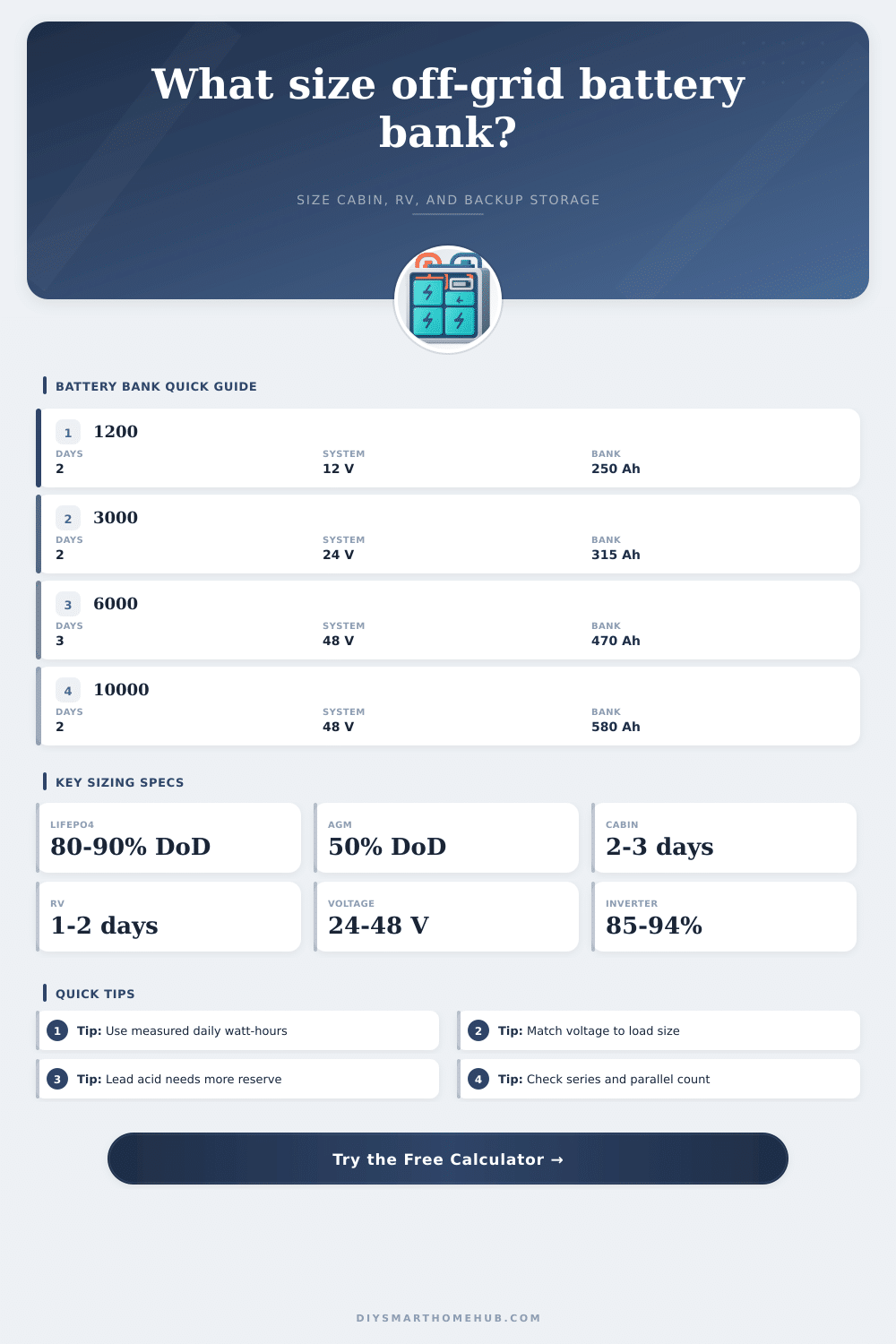
| Weekend RV lights, pump, fridge controls | 800 to 1,500 Wh/day | 1 to 2 days | 12 V 200 to 300 Ah lithium |
| Small cabin with DC fridge and laptop | 2,000 to 3,500 Wh/day | 2 days | 24 V 250 to 400 Ah lithium |
| Remote work cabin with Starlink-class internet | 4,000 to 6,000 Wh/day | 2 to 3 days | 48 V 250 to 400 Ah lithium |
| Home backup essentials | 6,000 to 10,000 Wh/day | 1 to 2 days | 48 V 300 to 600 Ah lithium |
☀Recharge Target Reference
| Daily load | 4-hour recharge | 5-hour recharge | 6-hour recharge |
|---|---|---|---|
| 1,500 Wh/day | 417 W plus losses | 333 W plus losses | 278 W plus losses |
| 3,000 Wh/day | 833 W plus losses | 667 W plus losses | 556 W plus losses |
| 6,000 Wh/day | 1,667 W plus losses | 1,333 W plus losses | 1,111 W plus losses |
| 10,000 Wh/day | 2,778 W plus losses | 2,222 W plus losses | 1,852 W plus losses |
💡Battery Bank Sizing Tips
In order to determine the size of a battery bank that is necessary for you’re off-grid power systems, you must calculate the amount of energy that your off-grid system use every day. The amount of energy that off-grid systems use every day is the most important number in creating a battery bank, as the amount of energy that is used every day will determine the capacity of the battery bank. For instance, off-grid systems with small appliances like an refrigerator with LED lights and a laptop charger may use around three thousand watt-hours of energy every day.
Adding appliance like a water pump to the energy use of the off-grid system will increase the amount of energy that that system use every day. After determining the amount of energy that the off-grid system uses every day, you must also decide how many day you would like the battery bank to provide power to the off-grid system without requiring that it is recharged. This number of days that the battery bank will provide power to the off-grid system is referred to as the autonomy of the battery bank, and establishing a number of days of autonomy for the battery bank will provide a safety margin for the battery bank that cant be recharged.
How to Size a Battery Bank for Off-Grid Power
The chemistry of the batteries that you will use in the battery bank is a factor to consider in determining the size of that battery bank. Different chemistry batteries has different limits to the amount of energy that can be used from the battery bank. For instance, lithium iron phosphate batteries allow for eighty or ninety percent of the battery capacity to be used from the battery bank, but lead acid batteries only permit for fifty percent of the battery banks capacity to be used.
Because more of the capacity can be used from the lithium iron phosphate batteries, fewer of these batteries will be required to provide the energy that the off-grid system requires. Lead acid batteries, however, require that less of the battery bank’s capacity be used to ensure that the lead acid batteries do not break after a few season of use. Battery banks with chemistries that permit deep discharge require careful management of the battery bank to avoid over-discharging the battery bank.
Another factor to consider for the size of the battery bank is the voltage of the system. Off-grid systems with twelve volt batteries are suitable for small loads of electrical device. For larger loads, however, twenty-four volt or forty-eight volt systems is recommended.
Higher voltages permit for the current in the system to be reduce. Reducing the current in the system permits for the wires to be thinner and for the wires to generate less heat within the system. The charge speed of the charging source is another factor to consider.
If you desire for your battery bank to be recharged quickly, your battery bank will need to recieve more power from the charging source than the amount of energy that the off-grid system uses each day. Because of energy loss during the battery bank charging process, the charging source will have to provide additional power to the battery bank to make up for the energy used by the off-grid system. Should the charging source be too small to provide enough energy to the battery bank, the battery bank will remain low on energy even while the sun is shine on the solar panels that charge the battery bank.
Additionally, another factor to consider is how the weather impact the charging source of the battery bank. For instance, the energy provided by solar panels is reduced in cloudy weather, and the capacity of lithium batteries are reduced in cold weather. The layout of the battery bank is another factor to consider.
Batteries can be connected in series to increase the voltage of the system, or the batteries can be connected in parallel to increase the total capacity of the battery bank. Additionally, another factor to consider is the voltage drop that can occur in the cables that connect the batteries. If the cables are long, the voltage drop that occurs in the system may lead to a loss of power to the off-grid system.
To avoid this potential loss of power, many off-grid system builders will add a safety margin to the size of the battery bank that is constructed for the off-grid system. Thus, the goal in building the battery bank is to provide enough energy to the off-grid system to power the essential loads, yet to include enough extra capacity to the battery bank to ensure that the energy is not constantly being monitor for its level of charge.