ERV CFM Calculator
Estimate continuous ERV airflow from floor area, occupant count, bedrooms, target ACH, and sensible and latent recovery efficiency.
1.Pick a home profile
2.Enter sizing details
3.Live sizing notes
Balanced ERV estimate
The calculator compares an ASHRAE-style floor-area plus people estimate against the requested ACH airflow.
4.ERV/spec grid for this result
5.CFM sizing reference
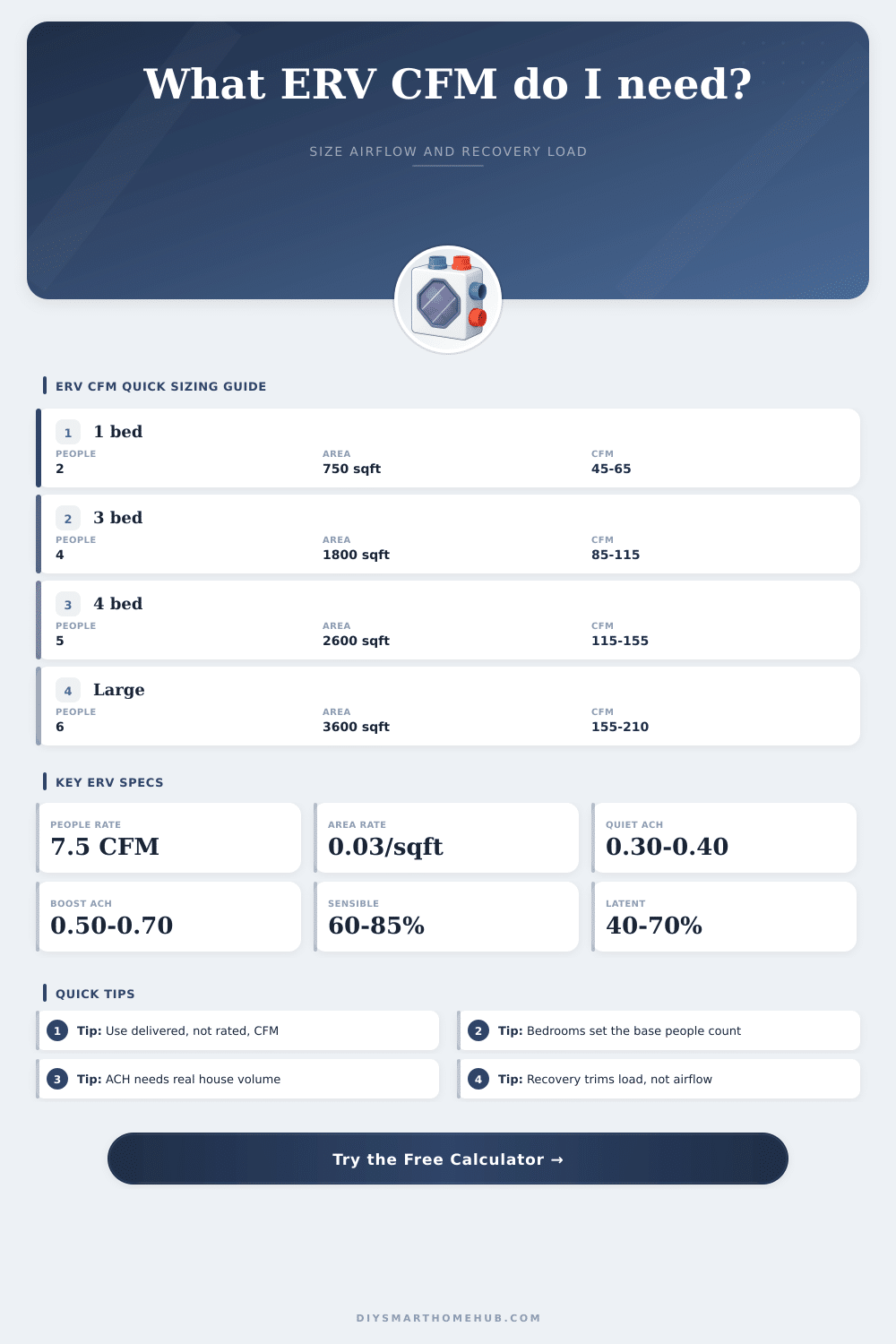
| Home profile | Typical area | Continuous ERV CFM | Sizing note |
|---|---|---|---|
| Small apartment or suite | 500 to 900 sq ft | 35 to 70 CFM | Bedroom and occupant count often control more than ACH. |
| Two to three bedroom home | 1200 to 2100 sq ft | 70 to 125 CFM | Area plus people and 0.30 to 0.40 ACH usually align. |
| Four bedroom family home | 2200 to 3200 sq ft | 110 to 170 CFM | Use low-speed continuous airflow with a separate boost mode if available. |
| Large or high-ceiling plan | 3200 sq ft and up | 150 to 230 CFM | Volume can push ACH airflow above the area plus people estimate. |
6.Recovery formula reference
| Formula | Use | Calculator inputs | Meaning |
|---|---|---|---|
| 0.03 x area + 7.5 x people | ASHRAE-style CFM | Floor area, occupants, bedrooms | A practical whole-home ventilation baseline. |
| Volume x ACH / 60 | ACH CFM | Area, ceiling height, target ACH | Turns house volume into continuous airflow. |
| 1.08 x CFM x deltaT x SRE | Sensible recovery | Airflow, profile, sensible efficiency | Estimated temperature load recovered by the ERV core. |
| 0.68 x CFM x grains x LRE | Latent recovery | Airflow, profile, latent efficiency | Estimated moisture load recovered by the ERV core. |
7.Outdoor design profiles
| Profile | Temperature delta | Grain difference | When it matters |
|---|---|---|---|
| Mixed season | 20 F | 22 grains/lb | Useful for shoulder months and moderate climates. |
| Cold winter | 55 F | 30 grains/lb | Sensible recovery dominates the ventilation load. |
| Hot dry summer | 24 F | 18 grains/lb | Sensible recovery matters more than moisture transfer. |
| Hot humid summer | 17 F | 56 grains/lb | Latent recovery can be a major part of ERV value. |
| Shoulder season | 10 F | 12 grains/lb | Ventilation airflow matters more than load reduction. |
8.Room airflow balancing guide
| Zone | Supply or exhaust | Typical share | Balancing note |
|---|---|---|---|
| Bedrooms | Supply | 40 to 60 percent | Distribute supply by occupancy and room use. |
| Living area | Supply | 20 to 35 percent | Useful when open areas are occupied for long periods. |
| Baths and laundry | Exhaust | 30 to 50 percent | Use continuous exhaust shares, not bath fan boost ratings. |
| Kitchen vicinity | Exhaust | 15 to 30 percent | Do not replace a range hood with ERV exhaust airflow. |
9.Practical sizing tips
The calculator uses the larger of the ASHRAE-style CFM and ACH CFM as the delivered continuous target. The equipment nameplate can be higher because ducts, filters, balancing dampers, and commissioning settings affect delivered airflow.
Sensible and latent recovery efficiency reduce the heating, cooling, and moisture load caused by outdoor air. They do not reduce the amount of fresh air needed for the occupants and floor area.
An energy recovery ventilator will move outdoor air into the house and move indoor air out of the house. The airflow that the unit moves is importance in determining whether or not the unit create problems for the house indoor air quality. If the airflow is too low, the house will begin to feel stuffy.
If the airflow is too high, the energy recovery ventilator will cost the 住户 money because it will condition air that is not needed to be condition. Thus, it is important to understand the various inputs that is required to calculate the airflow that the energy recovery ventilator will create. One of the first inputs to enter into the energy recovery ventilator calculator is the occupant counts of the house.
How to Find the Right Airflow for an Energy Recovery Ventilator
The number of residents in the house can be entered into the calculator. Additionally, the number of bedroom can also be entered into the calculator as a backup to the number of residents. The number of bedrooms is one way to estimate the number of residents as the number of bedrooms may be more high than the number of residents.
The next input to the energy recovery ventilator calculator is the floor area of the house. The floor area input allows the calculator to account for the volume of air that must be exchange in the house even if the house is completely empty of residents. The third input is the height of the house’s ceiling.
The calculator uses the height of the ceiling to convert the floor area into unit of cubic feet because the air change calculations must be performed in unit of cubic feet to be accurate. The target air changes per hour is another setting for which the individual who desires to calculate the airflow that will be created by the energy recovery ventilator must make a determination. For most homes, the target air change per hour is between 0.30 and 0.50 for continuous operation of the energy recovery ventilator.
In homes that have tight envelopes (meaning that there is little movement of outside air into the house), an air change per hour rating that is lower than 0.50 may be used. In homes with more activity, pets, or moisture issues, the target air change per hour may be set to a higher value. The airflow that the target air change per hour determines are compared to the airflow that is calculated from the number of residents and the area of the house.
The higher of the two airflow rate will be selected so that the energy recovery ventilator is not undersized to perform its task for the house. Recovery efficiency is another value that does not impact the airflow rate of the energy recovery ventilator. However, it does reduce the load on the air that pass through the energy recovery ventilator’s core.
Sensible recovery of air will reduce the difference in temperature between the incoming and outgoing air. Latent recovery will reduce the difference in moisture content between incoming and outgoing air. In cold climates, sensible recovery will create the most savings for the residence.
In humid climates, latent recovery will create the most savings for the residence. Both the gross load and the recovered load for the energy recovery ventilator may be displayed on the calculator so that the individual can review the energy recovery capabilities of the energy recovery ventilator’s core. The outdoor design profile impact the settings of the energy recovery ventilator.
For instance, using the shoulder-season outdoor design profile will create small numbers for the airflow rate calculations. Using the hot-humid outdoor design profile will create larger numbers in relation to the latent heat recovery calculation. Rather than attempting to find the highest percentage for air recovery in hot and humid climates, the settings for the energy recovery ventilator should be adjusted so that the energy recovery ventilator is able to handle the most extreme month in the climate for which the house is locate.
If the energy recovery ventilator is not able to handle that extreme month, the house may feel clammy, or the residents may experience increased utility bill. The cubic feet per minute (CFM) value that is listed on the energy recovery ventilator unit is not the airflow that will be deliver throughout the house. That value is the airflow rate of the unit when the air is moving through the air filters and ducts.
The airflow will be less throughout the house, therefore an energy recovery ventilator will provide an allowance for the airflow that is determined by the airflow calculations but higher than that delivered airflow rate to account for the airflow reduction in the house. Additionally, the airflow settings of the energy recovery ventilator are not to be used as a means of compensating for insufficient airflow rate into the house. High values of recovery efficiency will not compensate for insufficient airflow into the house of the residents that live within the house.
The reference table located on the calculator may assist in determining the airflow rate of the energy recovery ventilator for the individual’s house. These reference tables are provided so that the individual does not need to calculate each scenario. Rather, they can use the reference tables to determine the airflow rate for various size of houses.
These tables can be used to verify that the airflow rate that is calculated for the house is a reasonable value before the individual purchase the energy recovery ventilator. The goal is to find an airflow rate that ensures that the house always feel fresh. However, the airflow should not be so high that the energy recovery ventilator becomes the largest load on the heating or cooling system for the residence.
The calculator will calculate the airflow as long as the individual enter the correct value for the inputs for the house.