Portable Power Station Calculator
Estimate usable battery energy, device runtime, inverter headroom, and solar recharge time from battery Wh, inverter watts, load watts, duty cycle, efficiency, DoD, and peak-sun assumptions.
⚡Scenario presets
🔋Power station and load inputs
📊Selected station spec check
The load ratio is based on continuous inverter watts. Surge starting behavior still needs the appliance nameplate or measured startup reading.
🧭Power station comparison grid
Compact station
250 to 400 Wh battery, 300 to 600 W inverter, best for routers, phones, LED lights, and short laptop sessions.
Weekend station
500 to 800 Wh battery, 600 to 1000 W inverter, useful for CPAP nights, laptops, small pumps, and mixed electronics.
Backup station
1000 to 1500 Wh battery, 1200 to 2000 W inverter, strong fit for refrigerator cycling, network gear, and medical loads.
High-capacity station
2000 Wh or larger battery, 2000 W or larger inverter, suited to longer outages, tiny-home essentials, and tool bursts.
📋Common device load table
| Device group | Typical watts | Duty cycle | Calculator note |
|---|---|---|---|
| Router, ONT, mesh node | 18 to 45 W | 100% | Always-on draw makes runtime mostly a battery Wh problem. |
| CPAP without humidifier | 30 to 60 W | 100% | Use the measured overnight average when available. |
| Laptop plus monitor | 70 to 140 W | 50 to 85% | Charging cycles make the average lower than peak adapter watts. |
| Refrigerator cycling | 120 to 220 W | 25 to 45% | Startup surge can exceed running watts by several times. |
| Small sump pump cycles | 500 to 1000 W | 10 to 25% | Check inverter surge separately from this runtime estimate. |
🔌Battery and inverter class table
| Station class | Battery Wh range | Inverter range | Best sizing use |
|---|---|---|---|
| Small electronics | 250 to 400 Wh | 300 to 600 W | Network backup, phones, tablets, and efficient lights. |
| Overnight support | 500 to 800 Wh | 600 to 1000 W | CPAP, laptop day, small fan, and short appliance windows. |
| Essential backup | 1000 to 1500 Wh | 1200 to 2000 W | Fridge cycles, medical gear, camera/NVR, and mixed AC loads. |
| Extended support | 2000 to 3000 Wh | 2000 to 3000 W | Tiny-home essentials, tool bursts, larger pumps, and longer reserve. |
| Expandable system | 3000 Wh plus | 3000 W plus | Multiple batteries, high solar input, and managed household circuits. |
☀Solar recharge planning table
| Battery to refill | Solar array | Effective charge power | Approximate clear-sun time |
|---|---|---|---|
| 500 Wh usable | 200 W | 160 W | About 3.1 peak-sun hours before taper. |
| 850 Wh usable | 400 W | 320 W | About 2.7 peak-sun hours before taper. |
| 1300 Wh usable | 600 W | 480 W | About 2.7 peak-sun hours before taper. |
| 1800 Wh usable | 800 W | 640 W | About 2.8 peak-sun hours before taper. |
🧮Preset scenario table
| Preset | Battery and inverter | Load model | Solar model |
|---|---|---|---|
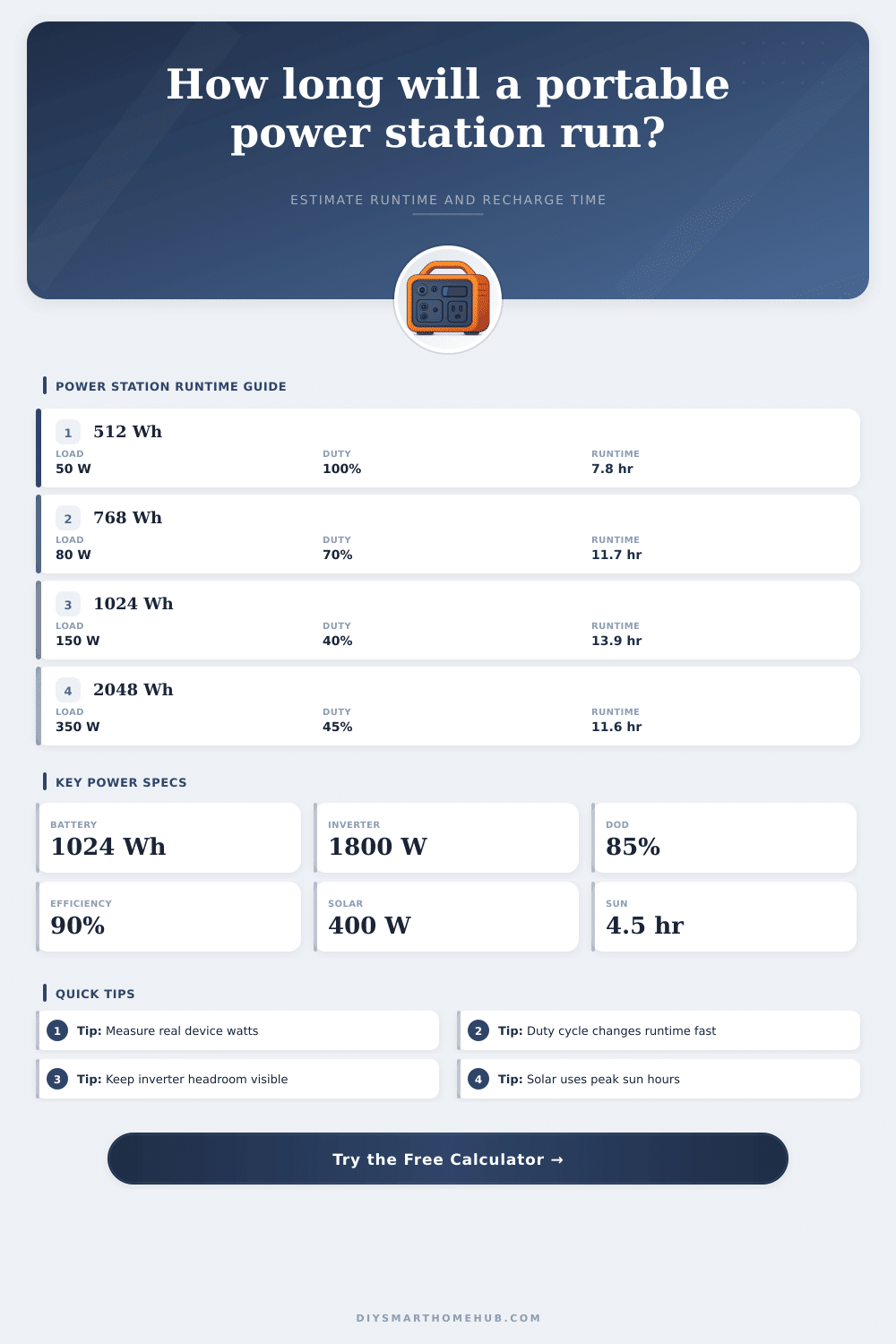
| Router backup | 512 Wh, 600 W | 28 W at 100% duty | 200 W, 4.5 sun hours |
| CPAP overnight | 768 Wh, 800 W | 45 W at 100% duty | 200 W, 4.0 sun hours |
| Fridge outage | 1024 Wh, 1800 W | 150 W at 40% duty | 400 W, 4.5 sun hours |
| Camera NVR | 1229 Wh, 1800 W | 65 W at 100% duty | 400 W, 4.0 sun hours |
| Tiny home basics | 2048 Wh, 2400 W | 350 W at 45% duty | 800 W, 5.0 sun hours |
💡Practical sizing tips
When you use a portable power station, you have to understand how long that portable power station will provides electricity to your devices. While many people look at the total energy that a portable power station provides, there are other numbers that you should consider. For instance, the total energy that the power station provide do not tell you how much energy that you can use.
Additionally, you must also consider how quickly the devices that you are using will drain the energy of a portable power station, and whether or not the inverter that is included in that device is capable of handling the device that you intend to use. The power usage of devices is referred to as a duty cycle, and the duty cycle is a number that is important to take into consideration when you are trying to calculate the length of time that a portable power station will run. For instance, devices like CPAP machines may use a relatively small amount of power, but may run for many hours each day.
How Long Will a Portable Power Station Last
In contrast, appliances like refrigerators may use a relatively large amount of power for short periods of time, but use little power for long periods of time while the refrigerator is rest. Thus, each of these devices may have different duty cycles, which means they will drain the battery of a portable power station at different rates. Considering the duty cycle of each device that you plan to use is essential in calculating the runtime of that portable power station.
Additionally, the inverter capacity of a portable power station is another important parameter to consider. The inverter capacity can tell you the amount of continuous power that the portable power station can provide to your devices. If the devices that you intend to use come close to the inverter capacity, you will use up all of the energy that the portable power station has to offer, and the battery will overheat as a result of the power demands of your devices.
The calculator provided in this blog uses parameters like the battery size of the portable power station, the inverter capacity of that device, the wattage of the devices that will be utilized, and the duty cycle to calculate the usable watt-hours of the battery, as well as the average wattage that the devices will draw. Solar panels are often used to recharge the portable power station. However, the solar panels will not always provide the same amount of power as the devices rated output.
For instance, even if you use the amount of peak sun hours for your location, there will still be a loss of power that occur due to the solar charge controller and the wiring leading to the portable power station. To provide users with accurate estimates of the runtime of a portable power station that is being charged by solar panels, the calculator includes a “practical” efficiency rate for the solar panels that is lower than the theoretical efficiency rate, meaning that the device will take longer to charge than if it were use the theoretical efficiency. Most devices will list the wattage that they output when they are running at full power.
However, this wattage isnt necessarily the amount of power that will be continuously drawn by that device. For instance, a small pump may have a wattage of 800 watts, but may only run for a few minutes at a time. Thus, if you did not account for its duty cycle when you calculated how long the battery of the portable power station will last for that device, the battery will last for less time then you may otherwise expect from the portable power station.
Using a plug-in meter that measures the actual power draw of the devices will allow you to more accurate calculate how long the battery will last. In addition to the devices that may be connected to the portable power station, the inverter within the power station will also use some of the power provided by that battery. The amount of power that the inverter uses even when no devices are connected to the portable power station is referred to as the idle draw of that inverter.
The calculator accounts for this idle draw in calculating the length of time that a portable power station will run. The chemistry of the battery that is used in the portable power station will also impact how long that battery can last, as will the temperature at which the battery remains. For instance, lithium iron phosphate cells, which are commonly used in portable power stations, can handle more cycles than lead-acid batteries, and they can handle cold temperatures better than lead-acid batteries.
However, regardless of the chemistry of the battery, if the environment in which the battery is being used drops below freezing, the battery will lose its full capacity. Thus, if you intend to use a portable power station in a cold space, you may wish to reduce the amount of energy that you estimate that it can provide, or keep that portable power station in a warm area. When you are buying a portable power station, you should consider the type of power loads that you will be using.
For instance, compact portable power stations tend to be used for small loads of devices, such as routers, mobile phones, and LED lights. In contrast, larger portable power stations can handle the cycles of on and off of devices like refrigerators or small pumps. Thus, rather than purchasing the largest portable power station that you can afford, you should purchase a portable power station whose specifications matches the power draw of your devices, the inverter specifications that is required by those devices, and the solar charging requirements of those devices.