Fuse Sizing Calculator
Size a branch, feeder, control-panel, inverter, or motor fuse from running load, continuous-load percentage, motor starting surge, system voltage, conductor ampacity, selected fuse class, and standard ampere ratings.
📌Fuse sizing presets
⚙Fuse sizing inputs
🔍Live fuse checks
🧮Calculated fuse/spec comparison grid
🧰Fuse class comparison grid
Lowest start tolerance; useful where sensitive electronics need quick fault clearing.
Small 600 V class often used in control panels with moderate inrush.
Common motor-friendly behavior with generous short start-surge tolerance.
Compact high-interrupting classes for service, feeder, and equipment protection.
📊Standard fuse ampere sizes
| Range | Common standard sizes | Typical use | Calculator behavior |
|---|---|---|---|
| Small control | 1, 2, 3, 4, 5, 6, 8, 10 A | Controls, sensors, small DC panels | Rounds up to the next listed size after load and surge checks. |
| Branch circuits | 12, 15, 20, 25, 30, 35, 40, 45, 50 A | Appliance, panel, lighting, and low-voltage feeders | Applies 125% to continuous load before selecting a size. |
| Equipment feeders | 60, 70, 80, 90, 100, 110, 125, 150 A | Subpanels, EV controls, inverters, machinery | Compares the selected size with conductor ampacity. |
| Large feeders | 175, 200, 225, 250, 300, 350, 400, 450, 500, 600 A | MCC sections, large DC, switchboards | Flags ratings that exceed the entered conductor ampacity. |
⚡Fuse type reference table
| Fuse type | Voltage rating used | Start tolerance model | Best fit in this calculator |
|---|---|---|---|
| Fast acting control fuse | 250 V | 2.0x selected fuse size | Control transformers, electronics, and non-motor loads with low inrush. |
| Class CC time delay | 600 V | 4.0x selected fuse size | Compact control panels and small motor/control circuits. |
| Class RK5 dual-element | 600 V | 6.0x selected fuse size | Motor loads where starting current should not force oversizing as quickly. |
| Class RK1 or J time delay | 600 V | 5.0x selected fuse size | Current-limiting feeders, machinery, and panel protection. |
| Class T compact high interrupt | 300 V | 3.5x selected fuse size | Battery, inverter, and tight service equipment layouts when voltage-rated. |
| DC rated battery or PV fuse | 600 V DC | 3.0x selected fuse size | PV strings, battery circuits, and DC distribution requiring DC interruption. |
📏Conductor ampacity comparison table
| Conductor ampacity | Often paired fuse range | Continuous load at 80% | Planning cue |
|---|---|---|---|
| 15 A | 15 A max in most simple cases | 12 A | Small controls and light branch loads. |
| 20 A | 20 A max in most simple cases | 16 A | Receptacle-style branch or compact equipment feeds. |
| 30 A | 25 to 30 A | 24 A | Small subpanels, controllers, and compact motor loads. |
| 60 A | 50 to 60 A | 48 A | EV controls, inverters, and shop equipment feeders. |
| 100 A | 80 to 100 A | 80 A | Larger smart panels, cabinets, and feeder protection. |
| 200 A | 175 to 200 A | 160 A | Large DC, service, or motor-control equipment. |
📋Example fuse sizing scenarios
| Scenario | Input load | Start cue | Typical result |
|---|---|---|---|
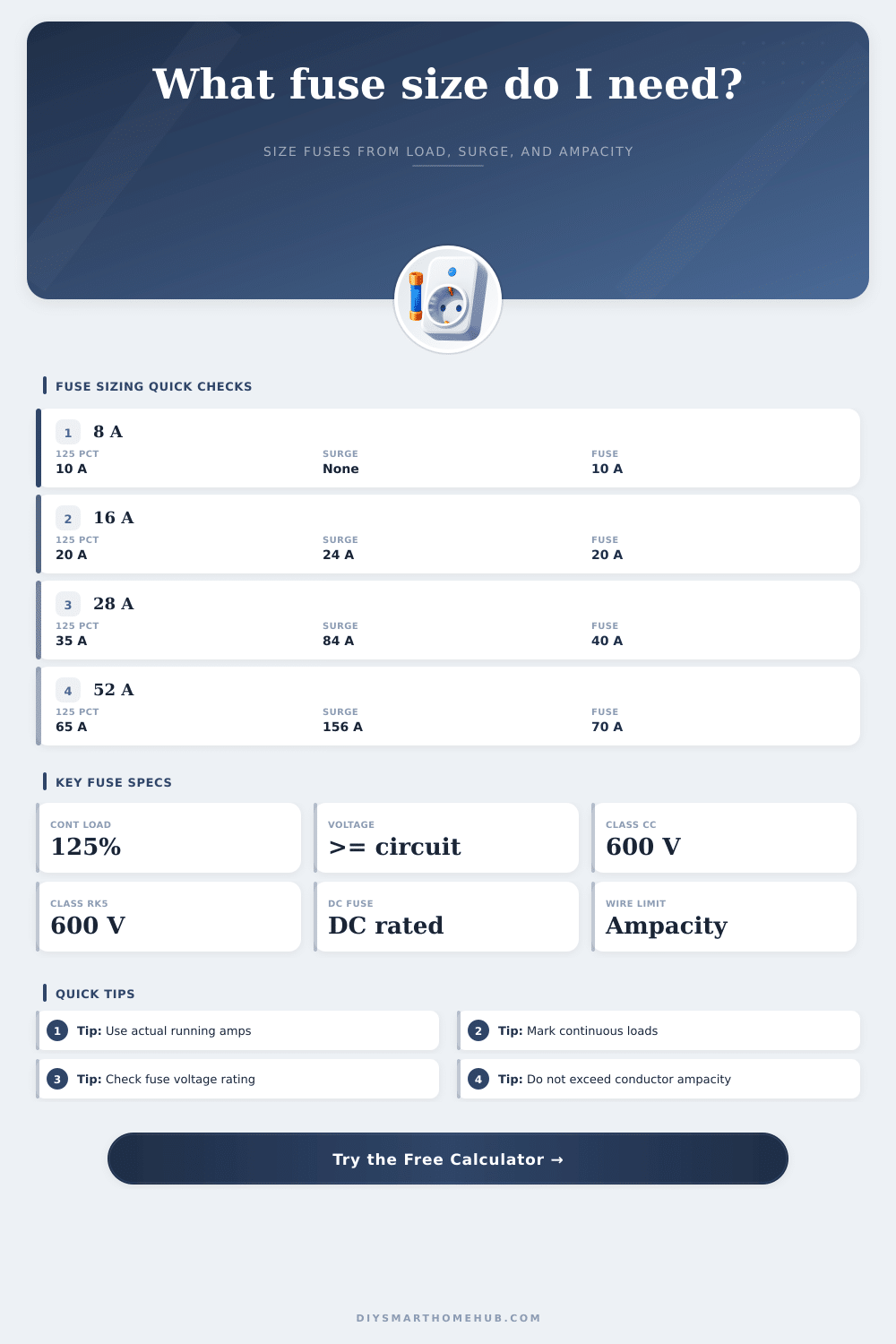
| 12 V automation hub | 8 A continuous | No motor surge | 10 A DC fuse with conductor ampacity above 10 A. |
| PoE switch feeder | 16 A continuous | Low electronic inrush | 20 A fuse after 125% continuous-load sizing. |
| Sump pump circuit | 12 A mixed load | 9 A motor at 7x | Time-delay behavior keeps the result near branch-circuit scale. |
| 48 V inverter input | 115 A continuous | Moderate DC surge | 150 A standard fuse if conductor ampacity supports it. |
| 480 V MCC feeder | 52 A mixed load | 28 A motor at 5x | 70 A class J/RK fuse with voltage and conductor checks. |
💡Fuse sizing tip boxes
In order to determine the correct size of a fuse to use for an electrical circuit, it is necessary to ensure that the circuit will function without failure if that fuse is selected. If the fuse that is selected is too small for the circuit, the fuse will blow while the circuit is in normal operation. If the fuse that is selected is too large, the fuse will fail to provide protection for the circuit wires from overheating.
In order to determine the correct fuse size, it is first necessary to account for continuous loads that will be applied to the circuit. Continuous loads are those loads that will operate for three hours or more, and they continuously generate heats within the wires and fuses that are positioned within the circuit. Because continuous loads generate heat continuously, the continuous load must be multiplied by 125 percent in order to find the correct fuse size; this percentage ensure that the fuse will not fail due to heat buildup within the fuse or wire.
How to Choose the Right Fuse Size
Non-continuous loads dont require multiplication by 125 percent. Another factor to consider is the presence of motors that will be present in the circuit. Motors tend to draw a more higher amount of current when they are starting than they do when they are running.
If a fast acting fuse were to be installed in a circuit that contains motors, the fuse may continually blow when the motors start up; this is referred to as a nuisance trip. To avoid this problem, you should use time delay fuses or dual element fuses in circuits that contain motors. The voltage rating for the fuse must be equal to or greater than the voltage rating for the circuit.
Using a fuse with a voltage rating that is lower than the voltage of the circuit can allow for an arc of electricity to continually travel through the fuse; this arc can damage the fuse and the circuit. Additionally, if those fuses are to protect the DC circuits, you should use fuses that are specifically designated for use with DC circuits; DC circuits do not contain the same zero crossing features as AC circuits. The ampacity of the conductor into which the fuse will be installed will place a limit upon the size of the fuse that can be used.
The fuse should be sized in such a way that it will protect the conductor; therefore, the fuse should have a rating that is lower than the ampacity of the conductor. Using a fuse whose rating is higher than the ampacity of the conductor will allow the conductor to overheat prior to the fuse blowing; overheating of the conductor can lead to the conductor starting to catch fire. The fuse size that is calculated should always be compared to the ampacity of the conductor to ensure that the fuse will not overheat the conductor.
In order to calculate the fuse size, the running load of the circuit, the percentage of the continuous load, the starting surge of the motors, the system voltage, the conductor ampacity, and the type of fuse to be used should be entered into a fuse calculator. The fuse calculator will output the adjusted load for the circuit, the size of the fuse that should be used, the next standard size fuse, and the remaining ampacity for the conductor. Alternatively, reference tables that contain fuse classes and amperage ratings can help to determine the size of a fuse that should be used; these tables will indicate the fuse size that is higher than the load yet lower than the ampacity of the conductor.
It is possible for an individual to make mistakes in the selection of the fuse size for a circuit if any of the factors discussed above are ignored. For instance, an individual may select a fuse size for a circuit that does not account for the 125 percent rule for continuous loads; they may assign fast acting fuses to circuits that contain motors; or they may use a fuse size that is larger than the ampacity of the conductor in which the fuse will be installed. In order to ensure that mistakes are avoided, the fuse size should be higher than the normal operating current of the circuits and the ampacity of the conductor, yet lower than the ampacity of the conductor, and should be able to withstand the surges in current that the electrical equipment to be used within the circuit produces.
One way to determine the fuse size that is to be used within a circuit is to measure the current that the electrical equipment draws when it is running; this actual current can be used to calculate the fuse size. By following these steps, it is possible to calculate the correct fuse size that will prevent the fuse from tripping in response to normal operation of the electrical equipment yet will ensure that the conductors are protected from overheating.