Battery Amp Hour Calculator Inverter
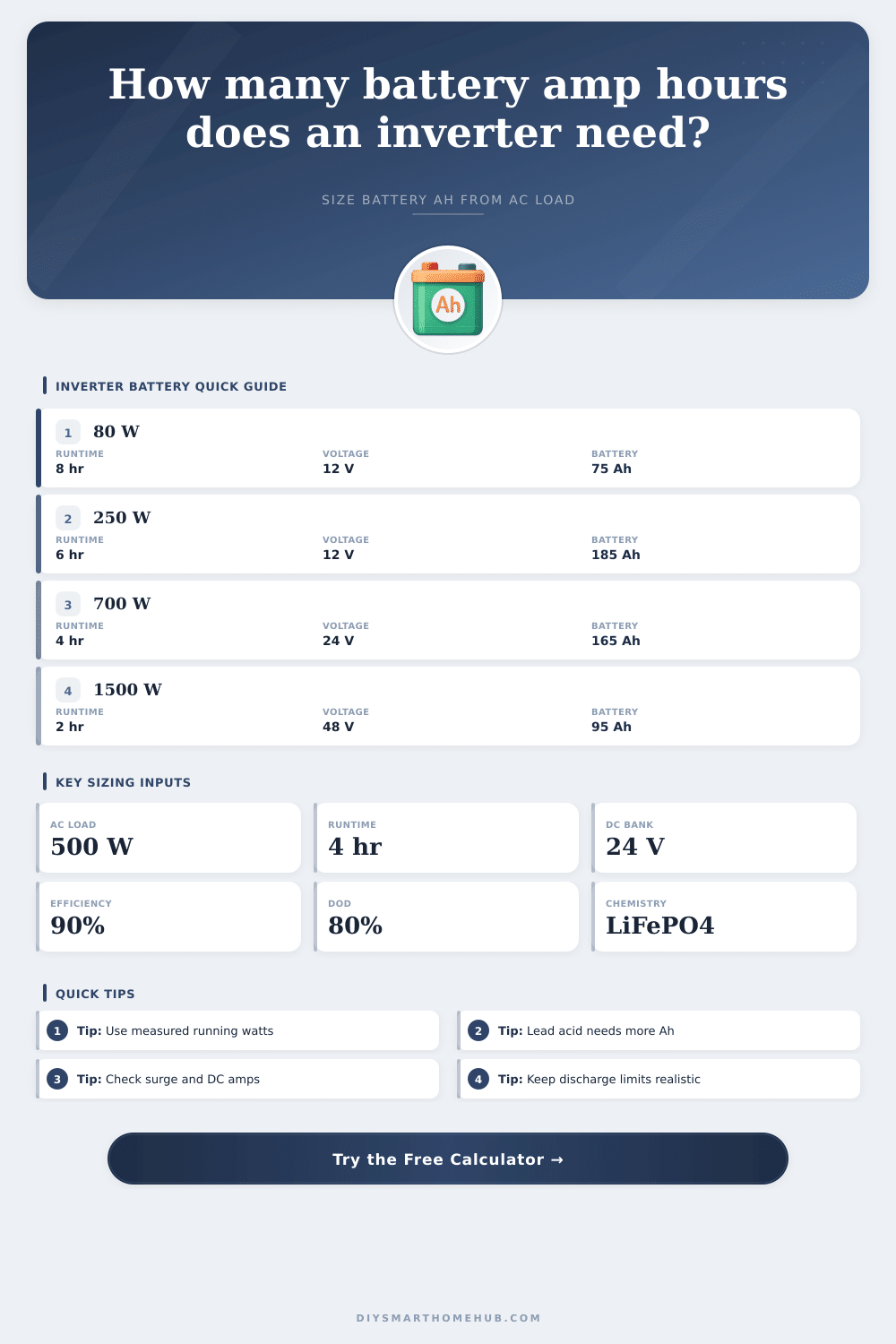
Estimate the battery amp hours, watt hours, DC current, usable capacity, and battery module count needed to run an AC inverter load for a planned runtime.
Full inverter battery breakdown
12 V inverter bank
Best for small loads. Current rises quickly above 600 W, so cable size and BMS current become limiting parts of the design.
24 V inverter bank
A balanced choice for appliance backup, small solar systems, and garage loads because it halves current compared with 12 V.
48 V inverter bank
Better for larger inverters, longer cable runs, and sustained loads where lower DC current improves efficiency and hardware margin.
Battery chemistry
Lithium banks keep capacity better under high load. Lead-acid banks need extra rated Ah because Peukert effect reduces usable capacity.
| Step | Formula | Why it matters | Example |
|---|---|---|---|
| AC energy | AC Wh = load W x runtime h | Runtime is an energy problem first | 500 W x 4 h = 2000 Wh |
| Battery draw | DC Wh = AC Wh / inverter efficiency | Inverter losses come from the battery | 2000 / 0.90 = 2222 Wh |
| Usable reserve | Rated Wh = DC Wh / DoD | DoD keeps part of the battery unused | 2222 / 0.80 = 2778 Wh |
| Amp hours | Ah = rated Wh / battery V | Same Wh needs fewer Ah at higher voltage | 2778 / 24 = 116 Ah |
| Discharge factor | Adjusted Ah = Ah x chemistry factor | Peukert or lithium factor covers high load | 116 x 1.04 = 121 Ah |
| Battery type | Typical usable DoD | Peukert or lithium factor | Best inverter fit |
|---|---|---|---|
| LiFePO4 | 80% to 90% | 1.02 to 1.08 | Frequent backup, deeper cycling, high DC current |
| Lithium-ion NMC | 75% to 90% | 1.03 to 1.10 | Compact packs and portable power stations |
| AGM lead-acid | 40% to 60% | 1.15 to 1.35 | Occasional standby with moderate discharge rate |
| Flooded lead-acid | 35% to 50% | 1.20 to 1.45 | Stationary banks with conservative sizing |
| Gel lead-acid | 40% to 55% | 1.18 to 1.38 | Lower current backup where charging is controlled |
| AC load | 12 V DC amps at 90% | 24 V DC amps at 90% | 48 V DC amps at 90% |
|---|---|---|---|
| 100 W electronics | 9.3 A | 4.6 A | 2.3 A |
| 500 W appliance | 46.3 A | 23.1 A | 11.6 A |
| 1000 W mixed load | 92.6 A | 46.3 A | 23.1 A |
| 2000 W inverter load | 185.2 A | 92.6 A | 46.3 A |
| Scenario | Load and runtime | Suggested voltage | Typical battery target |
|---|---|---|---|
| Internet backup | 60 to 100 W for 8 to 12 h | 12 V | 60 to 120 Ah lithium |
| Camera NVR backup | 120 to 250 W for 6 to 10 h | 12 V or 24 V | 120 to 250 Ah lithium |
| Fridge plus electronics | 250 to 700 W for 4 to 10 h | 24 V | 150 to 400 Ah lithium |
| Pump or motor backup | 600 to 1500 W with high surge | 24 V or 48 V | Check surge and BMS amps |
| Home office backup | 250 to 600 W for 4 to 8 h | 24 V | 100 to 250 Ah lithium |
To select the best battery bank for your inverter system, several different variable must be considered. The battery bank that you select will determine how much energy is available to the device that you have in your system. The battery bank must contain enough energy to power your devices for the time that you require them, but the battery bank also must be sized such that the voltage doesnt drop too low when the devices is operating.
If the battery bank contains too little energy, then your devices will run out of power before the time that you require them. In addition, if the battery bank is sized incorrect, the battery bank may fail altogether or you may be required to replace the battery bank prior to the life cycle of the batteries that are contain within the battery bank. Another variable that you must consider is energy loss.
How to Choose the Right Battery Bank for Your Inverter
Any inverter will lose some of the energy that is contained within the battery bank as it transfers that energy to your devices. The inverter can release the energy that is lost as heat or use it up in the internal processes of the inverter. Therefore, the battery bank will have to provide more watt hours of energy than the total consumption of the energy use by your AC devices.
Should your inverter lose ten percent of the energy that is stored within the battery bank, the battery bank will have to contain extra energy to compensate for this loss of energy. The more energy that the invereter loses, the more energy that the battery bank will have to provide to compensate for that lost energy. Another variable that should be considered is your expected runtime of the battery bank.
The energy that your devices use may not be the same than the energy that you calculate that your devices will use. Devices may not draw a continuous amount of energy. For instance, a refrigerator will cycle on and off to provide cooling to the area, and the pump will only run for short period of time.
If you underestimate the energy that will be used by your devices, you will soon run out of energy from your battery bank. Conversely, if you overestimate the energy that will be used, your battery bank will cost you more money than you would of otherwise spent on purchasing a battery bank with a higher capacity than you need. Another variable that will impact your battery bank and inverter system is the voltage that is selected for the battery bank.
A battery bank with a higher voltage will draw less current to provide the same amount of wattage to your devices. Using smaller cables for the circuit for your devices will reduce the strain on the battery bank. Many people will opt for a 12-volt battery bank because these type of components are common in electrical systems.
However, using a 24-volt or 48-volt battery bank will provide more efficiency for individuals who calculate the current draw that will be required by the device that they have within there system. The chemistry of the batteries that are included within the battery bank is another critical variable. Lead acid batteries will behave differently within the battery bank than lithium batteries.
Lead acid batteries will lose their energy and capacity more quickly if the current draw is high. Therefore, the lead acid battery bank will provide less usable energy to your devices than if it were size for the same amount of energy output. Using lithium batteries will reduce this issue.
The lithium battery bank will be able to support the same devices as a lead acid battery bank even if the capacity of the lithium battery bank is lower. Depth of discharge is another variable that will impact the battery bank and its life cycle. Every battery chemistry has a limit to how deep of a discharge you can use from the battery bank.
If you go below the depth of discharge limit for the battery bank, the life cycle of the battery will be shorten. A conservative depth of discharge will allow for more energy to be drawn from the battery bank. However, an aggressive depth of discharge will allow for you to save money on the purchase of the battery bank but will increase the cost of having to replace the battery bank.
Another important input for creating your battery bank is the concept of surge current. Some devices will draw more power at a specific moment than at any other time. Devices that contain motor will draw more current for a short amount of time than they will draw when the device is operating at a steady rate of power.
The battery bank will have to be able to supply this current to start these devices. If the battery bank cannot provide this current for a short burst of time, the inverter will not be able to start these devices, even if the battery bank contains enough energy to power the devices for a longer period of time. Using these different variables to calculate the energy that will be required by your devices, you can arrive at several different numbers for the battery bank.
These numbers will tell you the amp hours for the battery bank, the watt hours for the battery bank, the current that the devices will draw in continuous use, and how many battery module can be used within the battery bank. These numbers will allow you to create your system, but you will also have to consider the sizes of the cables that will run to the device and the fuses that will be created for the system. A variety of different combination for the voltage and chemistry of the batteries can be tested within an online battery bank calculator.
By testing different combinations of voltage and chemistry for the battery bank, you can more easily determine which battery bank will create a system that is simpler and more efficient for your devices.