Radiator Size Calculator Watts
Estimate radiator watts from room heat loss, volume, insulation, design temperature difference, panel type, and the delta-T correction for your flow and return water temperatures.
Room Heat Loss Inputs
Radiator Output Inputs
Radiator catalog outputs are commonly listed at delta-T 50 C. This calculator corrects the selected panel output to the actual mean water temperature minus room temperature.
Full radiator sizing breakdown
Radiator Spec Snapshot
Panel Type Output Table
| Radiator type | Typical output at delta-T 50 C | Best use | Depth / fit note |
|---|---|---|---|
| Type 10 single panel | About 730 W per meter | Low-load halls, small bedrooms | Very slim, lowest output density |
| Type 11 K1 single convector | About 1,000 W per meter | Bedrooms and compact zones | Moderate depth with rear fins |
| Type 21 P+ double panel | About 1,240 W per meter | Balanced output in shallow spaces | Two panels, one convector layer |
| Type 22 K2 double convector | About 1,640 W per meter | Living rooms and larger zones | Common high-output panel size |
| Type 33 K3 triple convector | About 2,350 W per meter | High-loss rooms with short wall space | Deepest standard panel profile |
| Towel rail radiator | About 520 W per meter | Bathrooms and towel warming | Output varies strongly by rail spacing |
Delta-T Correction Reference
| Flow / return / room | Mean water delta-T | Approx correction | What it means |
|---|---|---|---|
| 75/65/20 C | 50 C | 1.00x | Catalog rating condition |
| 70/50/20 C | 40 C | 0.75x | Modern condensing boiler design |
| 65/45/20 C | 35 C | 0.63x | Larger radiators often needed |
| 55/45/20 C | 30 C | 0.52x | Low-temperature heat pump range |
| 45/35/20 C | 20 C | 0.30x | Needs very large emitters |
Room Heat Loss Guide
| Room condition | Fabric factor used | Ventilation clue | Typical design load |
|---|---|---|---|
| Excellent new build | 0.85 W/m2 C | About 0.35 ACH | 25 to 45 W/m2 |
| Good upgraded room | 1.05 W/m2 C | About 0.45 ACH | 35 to 60 W/m2 |
| Average existing room | 1.35 W/m2 C | About 0.70 ACH | 50 to 85 W/m2 |
| Drafty older room | 1.75 W/m2 C | About 1.10 ACH | 75 to 120 W/m2 |
| Poor or uninsulated | 2.20 W/m2 C | About 1.40 ACH | 100 W/m2 and up |
Common Radiator Size Examples
| Example room | Design heat load | Type 22 at delta-T 50 C | Type 22 at delta-T 40 C |
|---|---|---|---|
| Small bedroom | 750 to 1,100 W | 500 to 700 mm panel | 700 to 900 mm panel |
| Large bedroom | 1,100 to 1,600 W | 700 to 1,000 mm panel | 900 to 1,300 mm panel |
| Living room | 1,800 to 2,800 W | 1,100 to 1,700 mm panel | 1,500 to 2,300 mm panel |
| Open plan zone | 3,000 to 4,800 W | Two medium panels | Two large panels or K3 |
| Glass-heavy sunroom | 2,500 W and up | K2 or K3 preferred | Often needs multiple emitters |
Radiator / Spec Comparison Grid
Watts and BTU/hr
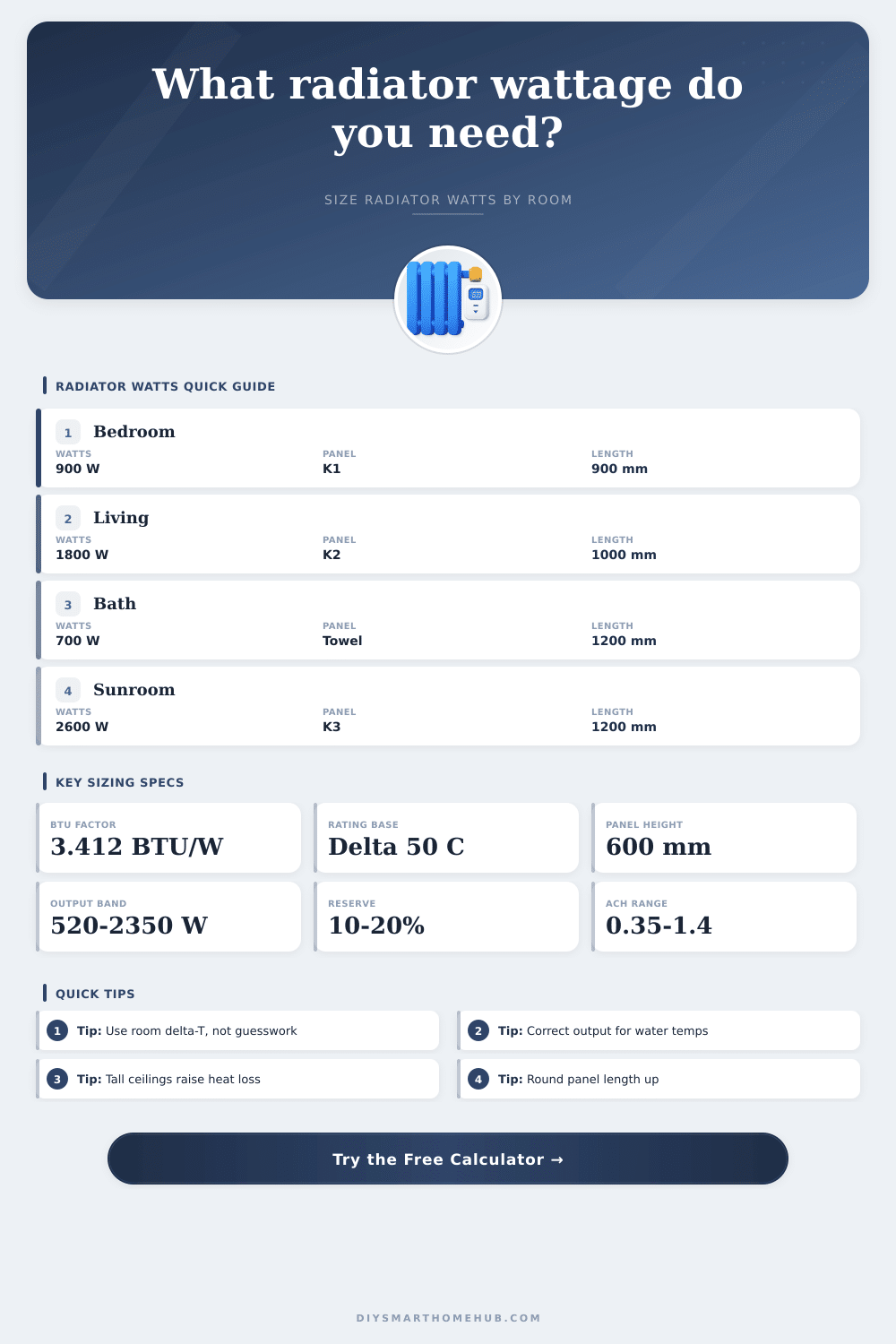
The room heat load is calculated in watts, then converted with watts x 3.412142. This keeps radiator sizing compatible with both metric and BTU/hr product data.
Delta-T correction
A radiator rated at delta-T 50 C produces much less heat on lower water temperatures. The calculator corrects panel output before choosing panel length.
Panel type choice
K2 and K3 panels deliver more watts per meter, which helps when heat loss is high or the wall has limited radiator length available.
Radiator Sizing Tips
To determine the correct size of a radiator, the heat that a room lose has to be balanced with the heat that a radiator can provide. The radiator has to provide enough heat for the room to remain at a comfortable temperature. If the size is too small, the room will not become warm enough, but if it is too large, then the radiators may not be able to effectively provide the heat that is required for the room to remain warm.
In order to determine the size of the radiator that will be needed, you has to first determine the heat loss of the room, since this value will help to determine the type of radiator that will be needed. The heat loss of a room can be determined by examining several factor. Factors that contribute to the heat loss of a room include the difference between the indoor and outdoor temperature, the amount of insulation that the walls and roof have, the amount of air that leaks into the room from outside the building, and the amount of glass that is exposed to the weather outside of the room.
How to Choose the Right Radiator Size
For example, the heat loss of a bedroom that only has one small window will differ from the heat loss of a sunroom that has three wall made of glass. In this scenario, the sunroom may lose more heat than the bedroom, even though the square footage of the two rooms may be the same. Thus, after determining the factors that influence the heat loss of the room, you can examine the heating system that will be used in the room.
The type of heating system that will be used can also influence the amount of heat that is lost by the radiators that are placed in the room. For instance, one factor that influences the heat that is emitted from a radiator is the temperature of the water that passes through the radiator. Radiators are often rated for the amount of heat that they will emit if the water within the radiator reaches a temperature that is 50 C (degrees Celsius) higher than the temperature of the room in which the radiator is located.
However, most moddern heating systems emit heat at lower water temperatures. Thus, if the water within the radiator does not reach the temperature that is represented for that radiator model, the radiator will emit less heat. Additionally, since the two variables are not linearly related to one another, it is impossible to simply guess at the proper size of radiator that will be required to emit the heat that is necessary for the room to be comfortable.
Instead, calculations can be made that take into account both the water temperature and the output of the radiator at those temperatures. Another factor that will impact the amount of heat that is lost by a room are the conditions within that same building. Factors such as how well the building is insulated, how many of the building’s windows are made of glass that is exposed to the outside weather, and how often air exchange within the room will impact the amount of heat that is lost by the room.
For instance, a building that is well-insulated, has draft-proofed windows, and that does not lose as much heat from the building as an older building with single glazing windows will lose less heat. Thus, the factors of the building will impact radiator output. The last factor to consider when determining the size of radiator that will be required for a building is the output of the radiator per meter of radiator, and the size of the radiator that will fit into the room.
For instance, radiators that contain two convectors will output more heat than those with single convectors of the same length. However, the double convector radiator will be deeper than the single convector radiator of the same size. Similarly, triple convectors will contain more heat than double convectors, but may be too deep to fit into certain locations in the room.
Thus, the length of the radiator in meters can be calculated from the number of watts that are required to heat the room. Additionally, another radiator calculator can determine if using multiple radiator of smaller sizes will be better suited to the space in which they will be placed within the room. Another consideration for the size of the radiator is adding a percentage to the calculation.
The reason for adding a percentage is to account for conditions in the room that may not be accounted for in the calculations. For instance, on some days outside temperatures may be lower than the average temperature, and furniture within the room may cover the radiator. Thus, adding a percentage to the calculation ensures that the radiator will provide enough heat to the room to make it comfortable, even if these additional factors are introduced.
Common percentages that are added include 10% and 15%. However, a percentage of 20% may have to be added to account for the exposure of the building to the outside weather. When examining the result of the radiator calculations, there are two main components of heat loss that will be determined.
One component is fabric loss, which is the loss of heat through the walls, the floor, and the ceiling of the room. The other component is the loss of heat through ventilation of the room. Thus, if the ventilation loss is high, it may be better to seal the rooms instead of adding radiators.
However, if the fabric loss is very high, it may be more efficient to add insulation to the building. Finally, yet another factor to consider when choosing the size of the radiator is the water temperature that will be used within the building. For instance, if the water temperature within the building is low, it may be possible to use a radiator with a deeper profile, or that the length of the radiator can be increased.
Additionally, it is also possible to add multiple radiator placements in the room to ensure that the heat is even throughout the room. Thus, while the radiator calculations will indicate the amount of heat that will be required, the size of the radiator will also have to be considered, as well as the water temperature that will be used. Overall, then, if you match the size of the radiator with the heat loss of the room, and if the heat output of the radiator is matched with the water temperatures that will be used within the system, the radiator will function in the room in an appropriate manner.
Its important to remember that alot of things can affect the final result. Youll want to make sure you recieve the correct advice from a professional so you dont make a mistake.