Battery Charge Time Calculator kWh
Estimate how many hours a battery needs to charge from starting SOC to target SOC using battery kWh, charger kW, AC or DC power path, efficiency, battery limit, and taper behavior.
Full charge-time breakdown
AC charger rating
AC charging starts as wall-side power. Battery DC power is approximately AC kW multiplied by charger efficiency, then capped by the battery acceptance limit.
DC charger rating
DC charging is usually stated as output power to the battery. Source energy is still higher than stored energy because conversion and battery losses remain.
Battery acceptance
The battery can be smaller than the charger. When battery max charge kW is lower, the calculator uses that lower DC power for the time estimate.
| Charging path | Power formula used | Energy formula used | Best use |
|---|---|---|---|
| AC wall or Level 2 charger | Battery kW = AC kW x efficiency | Source kWh = battery kWh / efficiency | EV, home battery, power station AC charging |
| DC fast charger | Battery kW = min(charger kW, battery limit) | Source kWh = battery kWh / efficiency | EV fast charging and large DC packs |
| Solar charge controller | Battery kW = controller output kW x efficiency | Array kWh = battery kWh / efficiency | Off-grid battery recharge from PV |
| DC bench charger | Battery kW = DC output kW x efficiency | Supply kWh = battery kWh / efficiency | Small lithium, lab, hobby, and telecom packs |
| SOC range | Typical behavior | Suggested taper factor | Planning note |
|---|---|---|---|
| 0% to 50% | High constant-current region | 1.00x to 1.05x | Charger and battery limits dominate |
| 50% to 80% | Usually near rated power | 1.00x to 1.12x | Good target for quick DC fast sessions |
| 80% to 90% | Voltage-limited taper begins | 1.15x to 1.45x | Time per kWh rises quickly |
| 90% to 100% | Balancing and final absorption | 1.35x to 2.50x | Use only when full capacity is needed |
| Charger type | Common kW range | Efficiency band | Typical battery match |
|---|---|---|---|
| Small AC adapter | 0.05 to 0.35 kW | 82% to 90% | E-bike, tool, UPS, portable packs |
| Portable station AC input | 0.3 to 1.8 kW | 85% to 93% | 0.5 to 3 kWh portable batteries |
| Inverter charger | 1 to 12 kW | 88% to 95% | RV, boat, home backup, rack batteries |
| EV Level 2 AC | 3.3 to 19.2 kW | 88% to 94% | Plug-in hybrid and EV packs |
| EV DC fast charger | 50 to 350 kW | 90% to 96% | Large EV packs with active cooling |
| Battery family | Typical charge C-rate | Example with 10 kWh | Calculator setting |
|---|---|---|---|
| Lead-acid AGM or gel | 0.10C to 0.30C | 1 to 3 kW max | Use a lower battery max kW |
| LiFePO4 home battery | 0.20C to 0.50C | 2 to 5 kW max | Match inverter charger output |
| Portable lithium station | 0.30C to 1.00C | 3 to 10 kW max | Use charger input limit from spec sheet |
| EV traction battery | 0.50C to 3.00C | 5 to 30 kW per 10 kWh | Set battery max kW below peak charger rating |
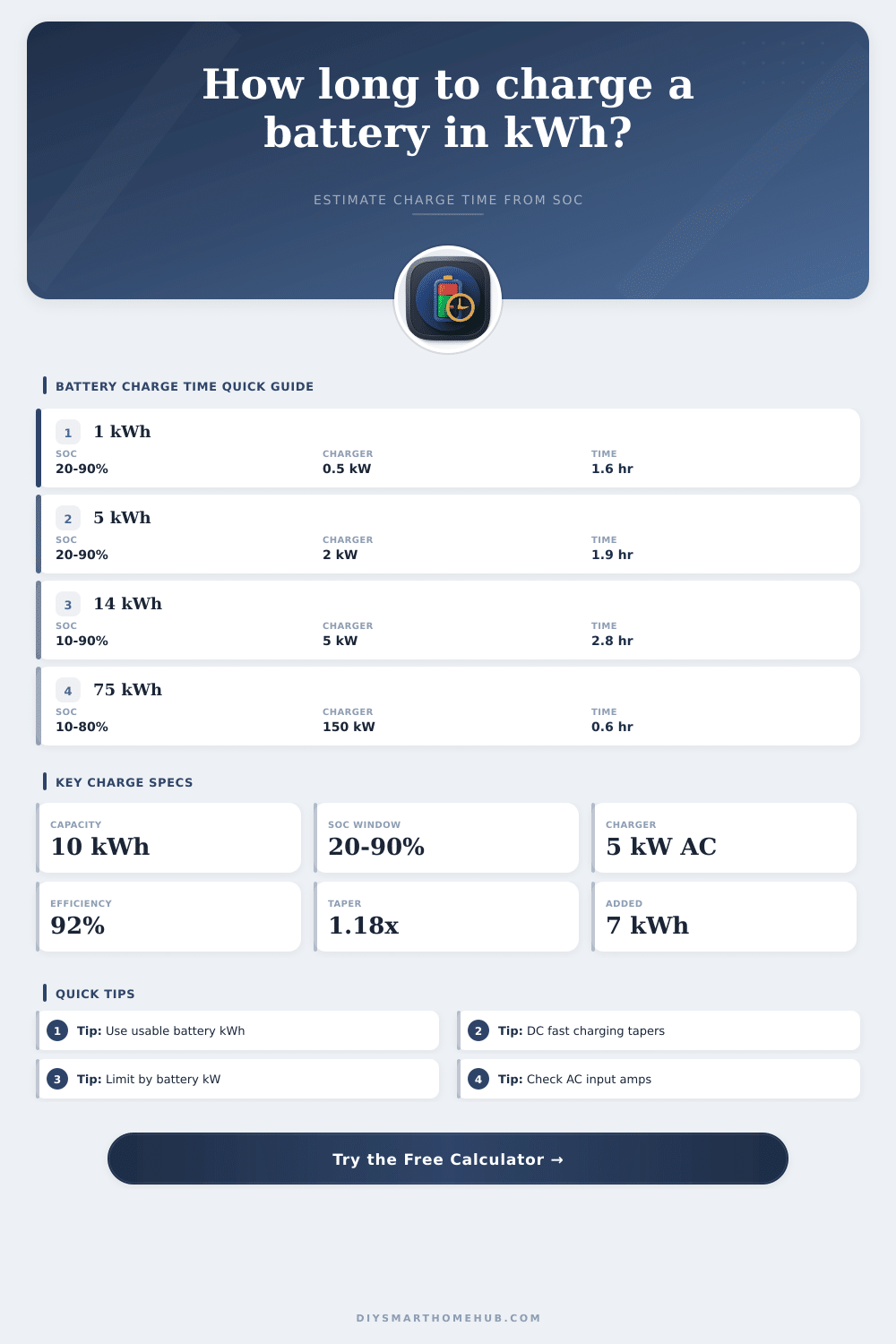
In order to calculate the time that it will take to fully charge a battery, it is first necessary to understand the amount of kilowatt-hours that is required to perform the charge. You can determine the number of kilowatt-hours that are required to be delivered to the battery through the calculation of the batterys capacity, the batterys starting state of charge, and the batterys target state of charge. For instance, if the battery has a capacity of 10 kWh, but the battery currently starts at 20 percent of its state of charge and needs to reach 90 percent of its state of charge, the battery will require 7 kilowatt-hours of energy to reach the target state of charge.
In addition to knowing how much energy is required to reach that target state of charge, it is also necessary to understand how long it will take to deliver that energy to the battery; both of these factors will determines the battery charging time. As with many processes, the component with the lowest power rating in that process limits the speed at which the battery is charged. For instance, even if the battery charger can deliver high rates of kilowatts to the battery, the battery itself may be limited to the amount of kilowatts that it can accept from the battery charger.
How Long It Takes to Charge a Battery
If the battery is unable to accept as much power as is delivered to it, the battery’s limitation to the amount of kilowatts that it can accept will limit the charging rate of the battery. In addition to considering the limitations of each of the components in the battery charging process, it is also important to consider the efficiency of the process. For instance, if the battery charger is only 92% efficient at converting electricity to stored chemical energy in the battery, then the battery will receive less energy from the battery charger than the power that is drawn from the power source; the energy that is lost as heat in the charging process will limit the amount of energy that is stored in the battery.
The state of charge of the battery can also affect the rate at which the battery is charged. Many batteries that contain lithium compounds exhibit different rates of acceptance of electrical current at different states of charge. For instance, many lithium batteries reduce the current that is delivered to the battery as the battery reaches a high state of charge; the reduction of the current limits the rate at which the battery can be charged during the final stages of charging as compared to the initial stages of charging of the battery.
As a result of this differing rate of acceptance of current at different states of charge, manufacturers of batteries include a taper factor in their calculations of the charging times to ensure that the calculations of those times are accurate. Without considering the taper factor, individuals may underestimate the length of time that it will take to fully charge the battery. The chemical composition of the batteries also limits the amount of current that the battery can accept.
For instance, lead acid batteries tend to have relatively low amounts of current that they can accept, while many batteries that contain lithium compounds can accept higher current inputs. Thus, in order to accurately calculate the time that will be required to charge the battery, it is essential to consider and enter the specific amount of current that the battery can accept into the charging calculator. In addition to these factors, there are other factors that can affect the rate at which a battery is charged.
For instance, the batteries efficiency in different temperatures, or the voltage of the battery, may change during the charging process. Thus, in addition to the charging calculator, it may be necessary to consider these factors as well. The use of a battery charging time calculator can help individuals to compare the different charging options and methods available to them.
For instance, it may be possible to determine with the use of a charging calculator whether it is worth the cost of purchasing a battery charger that can deliver more power to the battery than the battery can accept; alternatively, it may be possible to calculate how long it would take to charge the battery if the charging process were to be stopped at 80% of the batterys charge. Because the battery charging calculator considers factors like the efficiency of the battery charger and the taper factor of the battery, the calculator allows individuals to visualize the amount of energy that will have to be drawn from the power source or solar panels in order to fully charge the battery. In this way, the calculator can help individuals understand the various factors that limits the charging process of the battery, as well.
Wait, I actualy forgot to mention that the charger should of been checked too. A lot of people dont realize that the battery charger efficiency can be different than what is on the box. If youre using old cord, the charging time will be longer.
The batteries size and its voltage matters alot when you are trying to calculate things. It is important to recieve correct data to make sure your not wasting time. The process can be quite complex and naturaly it takes some time to learn.
You’ll need to make sure you use the right amount of energy based off the capacity. The modern chargers are better, but they still needs to be used properly. There is a lot of furnitures in the lab that we use to test these, but the battery is the main thing.