Home Generator Calculator
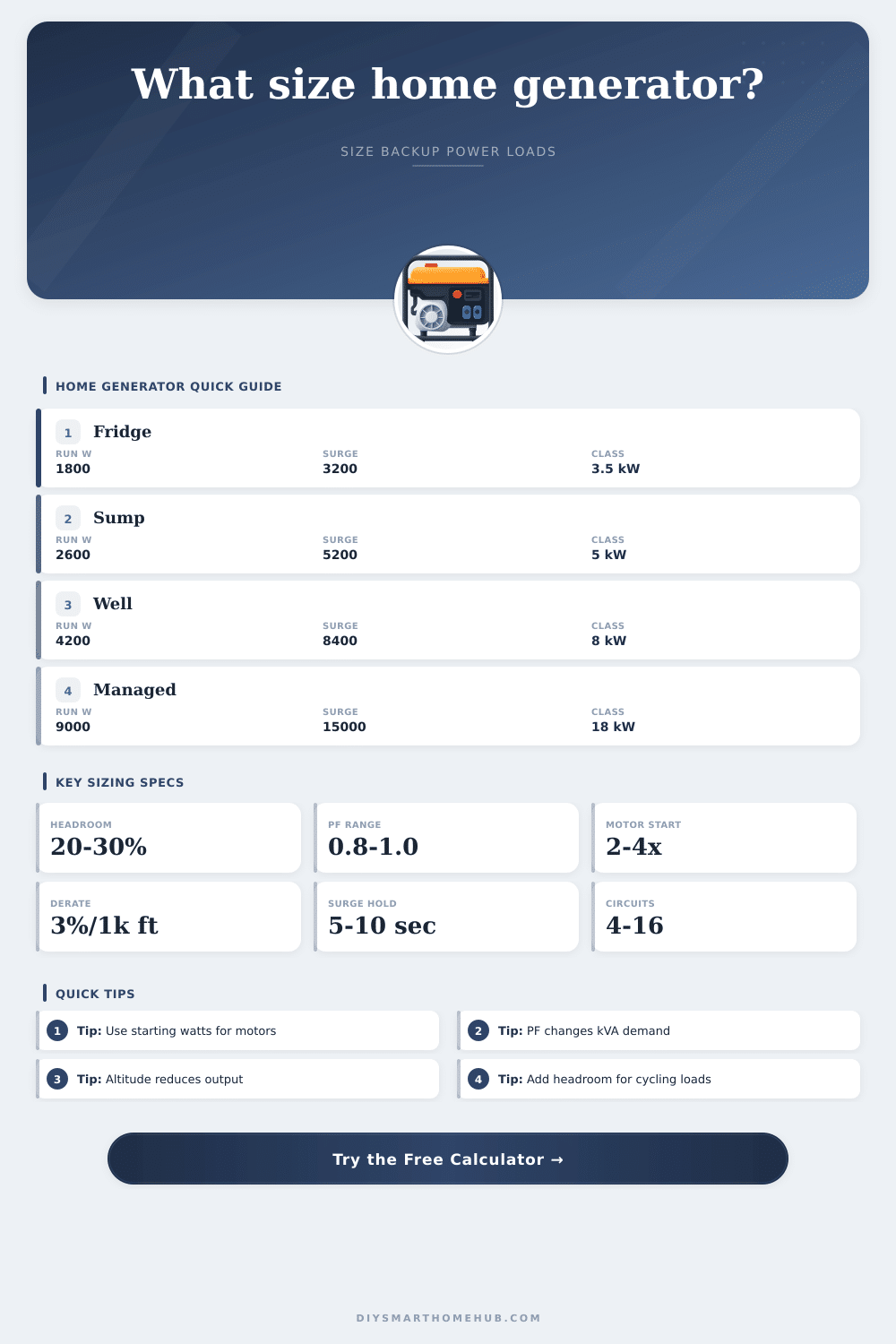
Estimate the generator class needed for essential circuits by combining running watts, added surge watts, motor starting multiplier, power factor, headroom, and site derating.
🏠Real Home Backup Presets
⚙Generator Sizing Inputs
🔌Selected Spec Snapshot
Generator Size Results
💡Generator Sizing Tip Boxes
📊Typical Essential Load Reference
| Load or circuit | Typical running watts | Starting behavior | Planning note |
|---|---|---|---|
| Refrigerator or freezer | 150 to 800 W | 2x to 3x compressor start | Use the nameplate when available because modern inverter compressors vary widely. |
| Sump pump | 700 to 1,500 W | 2.5x to 4x start | Storm backup should leave margin for repeated starts while lights and network loads stay on. |
| Well pump | 1,000 to 2,500 W | 3x to 5x start | Usually the dominant surge load in rural essential-panel sizing. |
| Gas furnace blower | 400 to 1,200 W | 2x to 3x motor start | Controls draw little power, but the blower motor sets most of the surge requirement. |
| Window air conditioner | 800 to 1,800 W | 2x to 4x compressor start | Soft-start units can use a lower multiplier than older compressor units. |
| Router, modem, cameras | 40 to 250 W | Little surge | Low watts but often high priority for connected-home backup planning. |
⚖Generator Class Comparison
| Generator class | Running output | Surge output | Best fit |
|---|---|---|---|
| 3.5 kW portable | 3.5 kW / about 3.9 kVA | 4.5 kW surge | Refrigerator, lights, network, and light appliance rotation. |
| 5.5 kW portable | 5.5 kW / about 6.1 kVA | 6.8 kW surge | Sump pump essentials or a small furnace panel with managed loads. |
| 7 to 7.5 kW portable or inverter | 7.0 to 7.5 kW / about 7.8 to 8.3 kVA | 8.5 to 9.5 kW surge | Pump-heavy essentials, office backup, or small air-conditioning loads. |
| 10 to 14 kW standby | 10 to 14 kW / 10 to 14 kVA | 11 to 16 kW surge | Automatic essential panels with furnace, well, kitchen, and internet loads. |
| 18 to 26 kW standby | 18 to 26 kW / 18 to 26 kVA | 20 to 29 kW surge | Managed whole-home panels where large HVAC or multiple motors may cycle. |
🧮Headroom, PF, and Derating Reference
| Factor | Formula used here | When it matters most | Effect on size |
|---|---|---|---|
| Running kW | (non-motor W + motor W) / 1,000 | Any continuous essential-panel load | Sets the base generator output needed. |
| Surge kW | running W + motor W x (start multiplier - 1) + added surge W | Pumps, compressors, and blowers | Can push the required class above running kW. |
| Power factor | kVA = watts / (1,000 x PF) | Motor-heavy or mixed inductive loads | Lower PF means higher generator current demand. |
| Continuous headroom | running demand x (1 + headroom) | Loads that cycle or grow over time | Keeps the generator from operating at its edge. |
| Site derating | 3% per 1,000 ft + 1% per 10°F above 77°F | High altitude or hot weather | Raises the nameplate class needed for the same load. |
🏘Common Home Backup Scenarios
| Scenario | Essential circuits | Running load | Typical generator target |
|---|---|---|---|
| Fridge, lights, internet | 3 to 5 | 1.5 to 2.5 kW | 3.5 to 5.5 kW if motor starts are modest. |
| Sump pump storm panel | 4 to 6 | 2.0 to 3.5 kW | 5.5 to 7.5 kW depending on pump start draw. |
| Well pump essentials | 6 to 8 | 3.5 to 5.5 kW | 7.5 to 10 kW when surge is controlled. |
| Furnace, kitchen, network | 8 to 12 | 5 to 9 kW | 10 to 14 kW standby or carefully managed portable transfer. |
| Managed whole home | 12 to 20 | 9 to 16 kW | 18 to 26 kW with load-shedding for large HVAC. |
In order to determine if a generator can supplies the electrical needs of a home without overheating or tripping the circuit breaker that are set to supply the power to the appliances in the home, it is necessary to ensure that the generator can supply the electrical load of the home. If the generator are not able to supply the electrical loads that is required of the home, then the generator will not supply power to the appliances in the home. Many individual may believe that calculating the wattage of all appliances in the home will provide a figure that is necessary to determine the size of the generator that should be purchased for the home.
However, the wattage of all appliance will not be sufficient for supply that power to those appliances, as many appliances contain motors that require a surge of power that is between two and four times the running wattage of those motor. If too many appliances with motors are turned on at once, the total wattage of those motors may become too great for the generator to supply. Therefore, it is necessary to calculate the starting multiplier of each motor in the home to ensure that the generator can supply the starting wattage of those motor.
Choosing the Right Generator for Your Home
In addition to calculating the starting wattage of each motor in the home, it is also necessary to factor in the power factor of the generator. The power factor is a factor that determine the amount of current that a generator will have to supply to the electrical load of a home. Homes that contain many appliances that utilize motors or moddern electrical appliances will have a lower power factor then homes that contain only resistive loads, such as electric heaters.
Because the generator must supply more amperage to these electrical load, it is possible for the load to exceed the true power limits of the generator. Therefore, it is necessary to adjust the power factor setting in any calculator that determines the size of the generator that is required for a home. In addition to the power factor of the generator, other factor that will reduce the amount of power that the generator supplies is the altitude and the temperature at which the generator will be operate.
At higher altitudes and in higher temperatures, the generator will be less able to supply power to the home. The performance of the generator will be reduced due to these factor, thus necessitating the application of a derating formula to the calculation of the amount of power that will be supplied by the generator. By applying such a formula, the user will calculate the actual nameplate capacity of the generator.
The small adjustment for these two factor may require the purchase of a larger class of generator than was initialy calculated. Other than the wattage calculations, the number of circuits in the home is another factor that must be considered when purchasing a generator. While it is true that the wattage of all appliances in a home may be within the power of a certain class of generator, it is also possible for a home to not contain enough breaker space or transfer switch capacity for that generator to supply its circuits with power.
It is therefore necessary to ensure that the essential circuit in the home are provided with enough breaker spaces or transfer switch capacity to supply power to each circuit. The essential circuits in the home should be determined in relation to the capacity of the class of generator that is to be purchased. In addition to ensuring that the generator will be able to supply the power to all essential circuit in the home, a buffer must be provided for the generator to provide power beyond that which is required for the homes essential circuits.
This buffer, referred to as headroom, is typically twenty percent of the total power of the generator. This headroom provide additional power to account for the cycles of on and off of electrical load, or for the introduction of new electrical appliances in the future. Thus, headroom should of been applied to the calculation of the total power requirement of the home to ensure that the generator will not operate at maximum power for extended periods of time.
Because every home is different, each home will have different power requirement to supply it’s essential circuits with power. Homes that contain different electrical appliances will require different amount of power to operate those appliances, thus leading to the fact that different homes may require different size generators. For instance, a home that includes only a refrigerator and lights may have different power requirement than a home that also contains a sump pump, furnace blower, and well pump.
Furthermore, the power requirements for these different appliances may require that a generator is sized according to the demands of those appliances during the worst simultaneous moment for that home, rather than according to the average power requirement of the home. Thus, each generator that is purchased must be chosen in relation to the electrical load in a home. Overall, choosing a generator that will supply power to the essential circuits in a home requires that the capability of the generator are matched to the electrical loads of the home.