Smart Coffee Maker Start Time Calculator
Calculate the exact smart plug, built-in timer, or automation start time from brew volume, heat-up time, flow rate, bloom or preheat delay, wake buffer, desired ready time, and thermal hold window.
📌Real Coffee Timing Presets
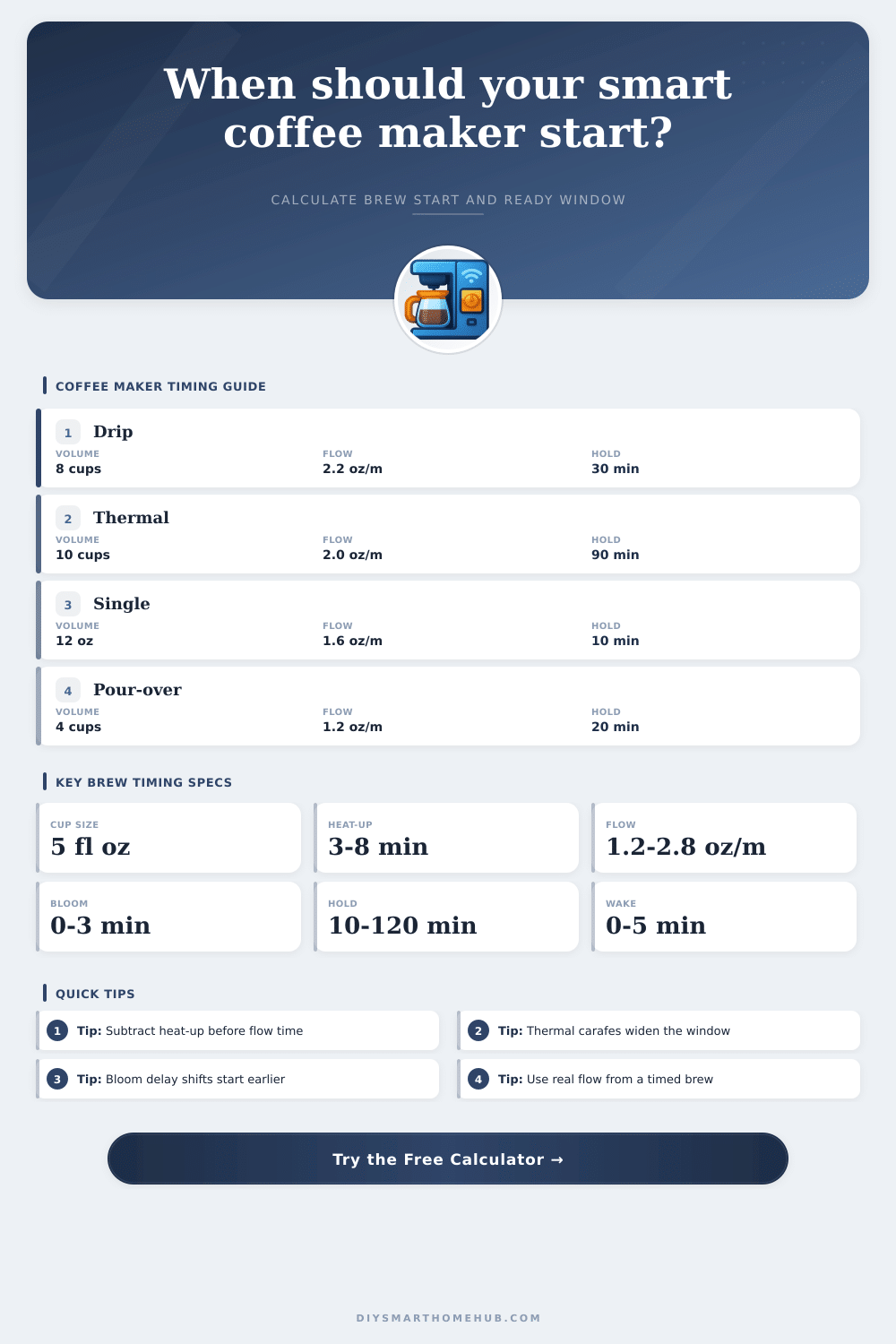
Loaded preset: Weekday Drip Pot. Eight 5 fl oz coffee cups, moderate heat-up, and a 30 minute warming-plate hold window.
⚙Start Time Inputs
📊Coffee Maker Spec Comparison Grid
📋Reference Tables
Maker Profile Timing Defaults
| Profile | Heat-up | Flow | Hold window |
|---|
Preset Start Time Examples
| Preset | Ready | Lead | Start |
|---|
Thermal Hold Window Reference
| Carafe mode | Modeled hold | Use case | Start effect |
|---|---|---|---|
| Open mug | 5 to 10 min | Single cup | Very tight |
| Glass plate | 20 to 40 min | Drip pot | Moderate |
| Thermal carafe | 60 to 120 min | Batch brew | Wide window |
| Espresso cup | 2 to 5 min | Shot timing | Exact finish |
Coffee Volume Conversion Reference
| Planning volume | Fluid ounces | Metric | Timing note |
|---|---|---|---|
| 1 coffee cup | 5 fl oz | 148 mL | Drip markings |
| 8 cup pot | 40 fl oz | 1.18 L | Common morning pot |
| 12 oz mug | 12 fl oz | 355 mL | Single serve |
| 1 liter batch | 33.8 fl oz | 1000 mL | Metric setup |
🚦Timing Notes
In order to prepare coffee that will be ready at a specific time, it is first importance to understand the different stages of the coffee brewing process. Many person may want to use the built-in timer of their coffee machine to ensure that their coffee is ready at a specific time of the day, but if they doesnt understand the coffee brewing process and calculate the amount of time that it will take to brew their coffee, they may end up with coffee that sits on a warming plate for too long, or coffee that is not ready when the individual wake up from sleep. By working backwards from the desired time that coffee is to be ready, it is possible to calculate the start time of the coffee machine that will result in coffee that is ready at the desired time.
The amount of coffee that is to be brewed is one of the main factor that will impact the brewing time of the coffee. The longer that the coffee machine must brew coffee, the more coffee that must be brewed. Thus, a ten-cup coffee maker will require a different start time for coffee brewing than a four cup coffee maker.
How to Make Coffee Ready at a Set Time
Beyond the volumes of coffee that will be brewed, there are additional factors that will contribute to the start time of coffee brewing. The first of these is the heat-up time of the coffee machine. Coffee machine heat up time is the length of time that the coffee machine take to heat the water to the necessary brewing temperature.
The heat up time for coffee makers can differ significant from model to model of coffee maker. For instance, some coffee makers may reach brewing temperatures in just three minutes of operation, while other models may take eight or ten minutes to heat the water to brewing temperature. Factors that contribute to heat up time include both the size of the heating element of the coffee maker, as well as the amount of water that is contained within the coffee maker.
Additionally, if the coffee maker is using cold water as its brewing water, heat up time will increase as a result of these cold brewing waters. Coffee flow rate is another factor that may impact brewing time. Flow rate refers to the rate at which coffee drains from the coffee maker into the carafe.
The grind size of the coffee beans that are used within the coffee maker, as well as the cleanliness of the showerhead of the coffee machine, can impact flow rate. Coffee makers may also include a pause for blooming in their brewing cycle, and such a blooming pause will impact brewing time. Therefore, flow rate may vary between coffee makers, but measuring the flow rate of ones own coffee maker will allow for accuracy in calculate brewing time.
Another factor that may impact brewing time is the use of a bloom delay for the coffee brewing process. Bloom delay refers to the amount of time that the coffee maker may take to allow water to soak into the coffee grounds before brewing begins. While many coffee makers include this amount of time to improve the brewing process for the coffee, such a time delay will shift the brewing schedule for that coffee maker.
Additionally, if smart plugs are used to control the coffee maker, additional brewing time may be required to account for the blooming time of the coffee machine. Coffee makers that is connected to smart plugs may require one or two minutes of brewing time to allow the coffee maker to start up and brew coffee. Another factor that may impact brewing time is the length of the hold window for brewed coffee.
The hold window is the length of time that brewed coffee remains fresh and drinkable after brewing. The length of the hold window is not a safety margin that may be built into the brewing schedule, but is the limit on the freshness of brewed coffee. For instance, coffee that is brewed into a thermal carafe will remain fresh for longer than coffee that is brewed into a glass carafe that is placed upon a warming plate.
Therefore, the use of a thermal carafe will allow for more flexibility in the time at which brewed coffee are poured into cups. Many people who attempt to brew coffee for their homes may make mistakes in brewing schedules. For instance, an individual may set their coffee machine such that brewed coffee is ready when they enter the kitchen, but they may desire for the coffee to sit for a few minutes to allow it to taste even more better.
Similarly, those that ignore the hold window for their brewed coffee may find that the coffee tastes bitter or flat after pouring it into their coffeepot. Thus, they should of consider the brewing schedule as the start of a window during which brewed coffee can be fresh and delicious. External variables may also impact brewing time.
For instance, the altitude of the brewing location can impact the boiling point of the water that is brewed by the coffee maker. If brewing water boils at a different temperature than at the individuals home, brewing time may be affected. Additionally, if the water that is used within the coffee maker is hard water, it may form a scale within the coffee maker that reduces the flow rate at which brewed coffee exit the coffee maker.
Additionally, if coffee beans is ground within the coffee machine, the particle size of those beans may alter brewing time. Thus, refining brewing schedules over several days may account for these external variables. Finally, the reference tables that is included in coffee makers may assist in calculating brewing time.
These reference tables include the default settings for brewing time of the coffee makers and carafes of different types, as well as the length of the hold window of brewed coffee. These tables can be used as a starting point for calculating brewing time for individual coffee maker, but may need to be adjusted according to the measurements of coffee machine components of each individual. Once an individual has established the start time for brewing coffee at their home, it is possible to set the coffee machine the night prior to the desired brewing time.
Thus, brewed coffee will be ready when the individual wake up from sleep.