Robot Mop Water Refill Calculator
Estimate how much water a robot mop will use from moppable area, wet flow rate, pad passes, tank capacity, mop pace, and real coverage efficiency.
🧽Refill presets
⚙Mop and tank inputs
Full formula breakdown
📊Robot mop/spec comparison grid
📘Reference tables
Water flow settings
| Mode | Flow | Best surface | Water effect |
|---|
Tank size planning
| Tank | Typical robot | Usable water | One-pass range |
|---|
Pass and efficiency factors
| Condition | Passes | Efficiency | Planning note |
|---|
Preset scenario outcomes
| Scenario | Area | Water | Refills |
|---|
💡Planning tips
Robot mops is designed to clean floor without any manual labor from the person. However, many people find that the water capacity for robot mops become the limiting factor in its performance. The amount of water that the robot mop can hold in it tank will determine the area that it can clean before the individual must refills the tank.
The robot mop will likely run out of water while trying to clean the kitchen or hallways. Additionally, the water levels will cause unevenly streaks on the floor. To avoid these problem, individuals must understand the variables that affect the water consumption of a robot mop.
How Much Water Your Robot Mop Uses
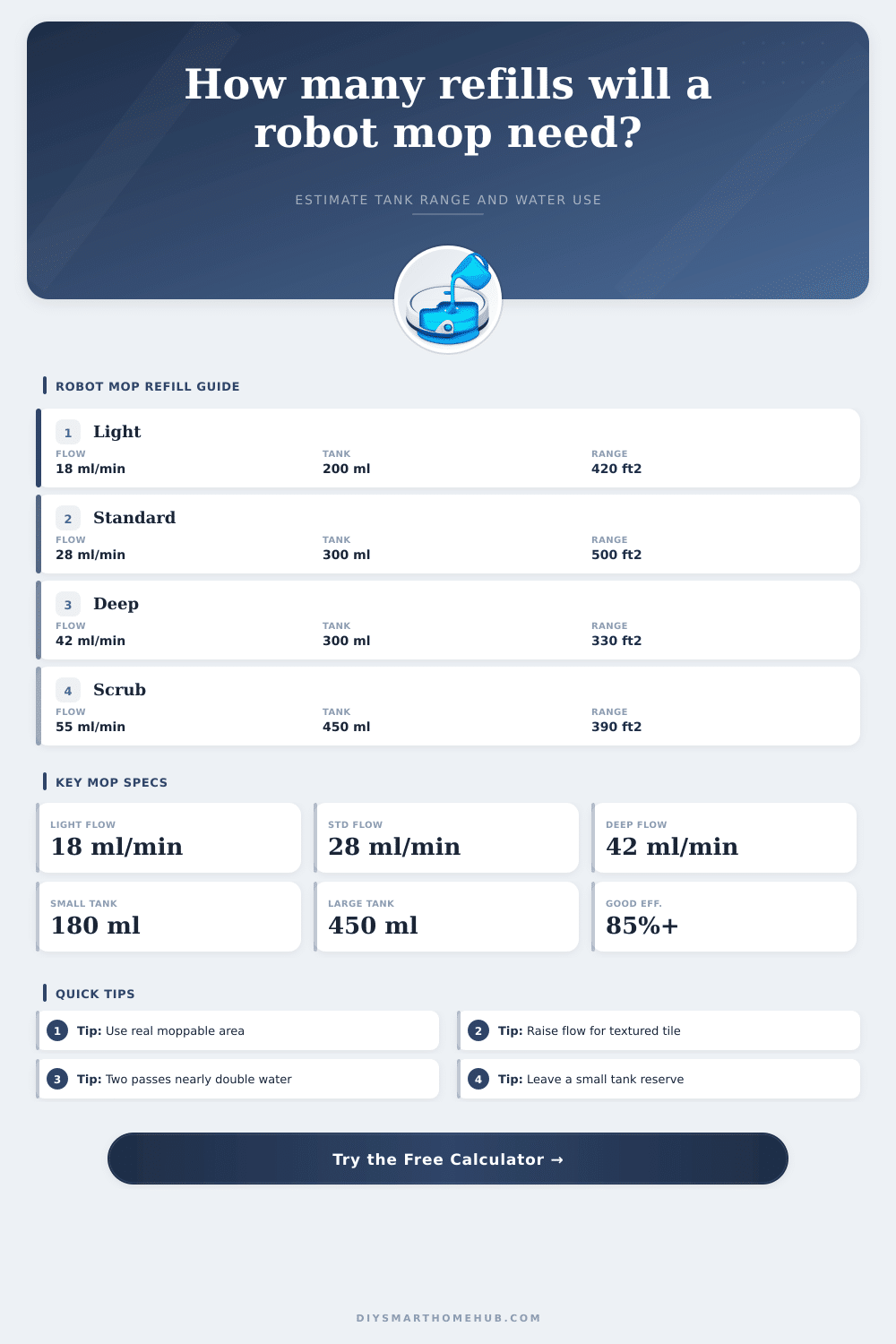
The flow rate at which the robot mop dispense water on the floor is one of the variables that will impact the water consumption of the robot. The flow rate will determine the amount of water that the robot dispense on the floor while operating. For example, if the setting for the flow rate is lowered, the robot will dispense less water than if the flow rate is highly.
A low flow rate is appropriate for performing a light dusting of the floor. A high flow rate will be required for floors like textured tile or areas with dried spills on the floor. The flow rate will determine the amount of water the robot needs for every minute of operations.
Another of the variables is the tank size of the robot. For most robot mops, the amount of water that the robot dispense is less than the total tank capacity. Robot mops will stop dispensing water before the tank is emptied of all water.
The calculator allows for this by considering that there is a small volume of water that should remain in the tank. For individuals who own models with small tanks, there will be a need to refill the tank more often than those who has a model with a larger tank. Another of the variables is the coverage efficiency of the robot.
Most robot mops will turn around corners made by the legs of chair and will often travel the same path twice. This will increase the distance that the robot mop travels. As a result of the increased distance traveled, there will be an increase in the amount of water that is use during the operation of the robot.
If there are alot of obstacles in the room, the coverage efficiency will be more lower. A lower coverage efficiency will use more water during operation. The number of passes that the robot makes with the mop will increase the amount of water used.
One pass use a certain amount of water. Two passes will use twice as much water. If the individual makes two passes to remove pet hair or other sticky substance from the floor, the robot will use more water.
If the robot creates a second pass, the water that is used in that pass can be different from the first pass, but the total amount of water that is used will be greater than the amount used for only one pass. The coverage rate of the mop determines the speed at which the robot will wet the floor. The faster the robot mops cover the floor, the less amount of time the mop spends on the floor.
This will result in the amount of water used by the robot to be less than if it was moving at a slower coverage rate. For instance, robot mops with vibrating pads will take more time to wet the floor than those with fast coverage rate. For best results, the mop coverage rate should be set to match the specification of the individual’s model of robot mop.
The refill count for a robot mop will show the number of times that the individual must refill the robot. If the refill count is zero, then there is enough water in the tank to complete the task. If the refill count is two or three, the individual must refill the tank for the robot mop twice or three times.
This will allow the individual to decide whether the individual should move the docking station closer to the robot or if the individual should adjust the flow rate of the robot. The type of floor that the robot mop will clean will affect the flow rate at which the water is dispense on the floor. For example, for sealed hardwood floors, it is appropriate to use a low flow rate.
However, for textured porcelain floors, there will be the need for a higher flow rate to ensure that the mop head covers the stains. As there are different flow rate for different types of floors, it may help the individual to calculate the amount of water needed for each room in the house. When calculating the area to be wetted by the robot mop, the individual should only measure the hard floor area.
If there are rugs or furniture in the room, the robot will not wet those areas. The area should only account for the hard floor. If the entire area of a room is measured, the calculation will be inaccurate for the amount of water the mop will use.
By calculating the area for the hard floor only, the individual can be sure that the amount of water to be added to the tank will be sufficient. The refill count is not a set number. The refill count will change according to the settings that the individual sets on the robot mop.
For instance, if the individual performs a deep clean with a high flow rate and two passes with the mop head, there will be more water used than during a light vacuuming of the house. The calculator allows the individual to change settings before the operation of the robot mop. By doing so, the individual can ensure that the robot will be able to complete the task without any puddles of water on the floor caused by insufficient water for the tank.