Robot Vacuum Cleaning Time Calculator
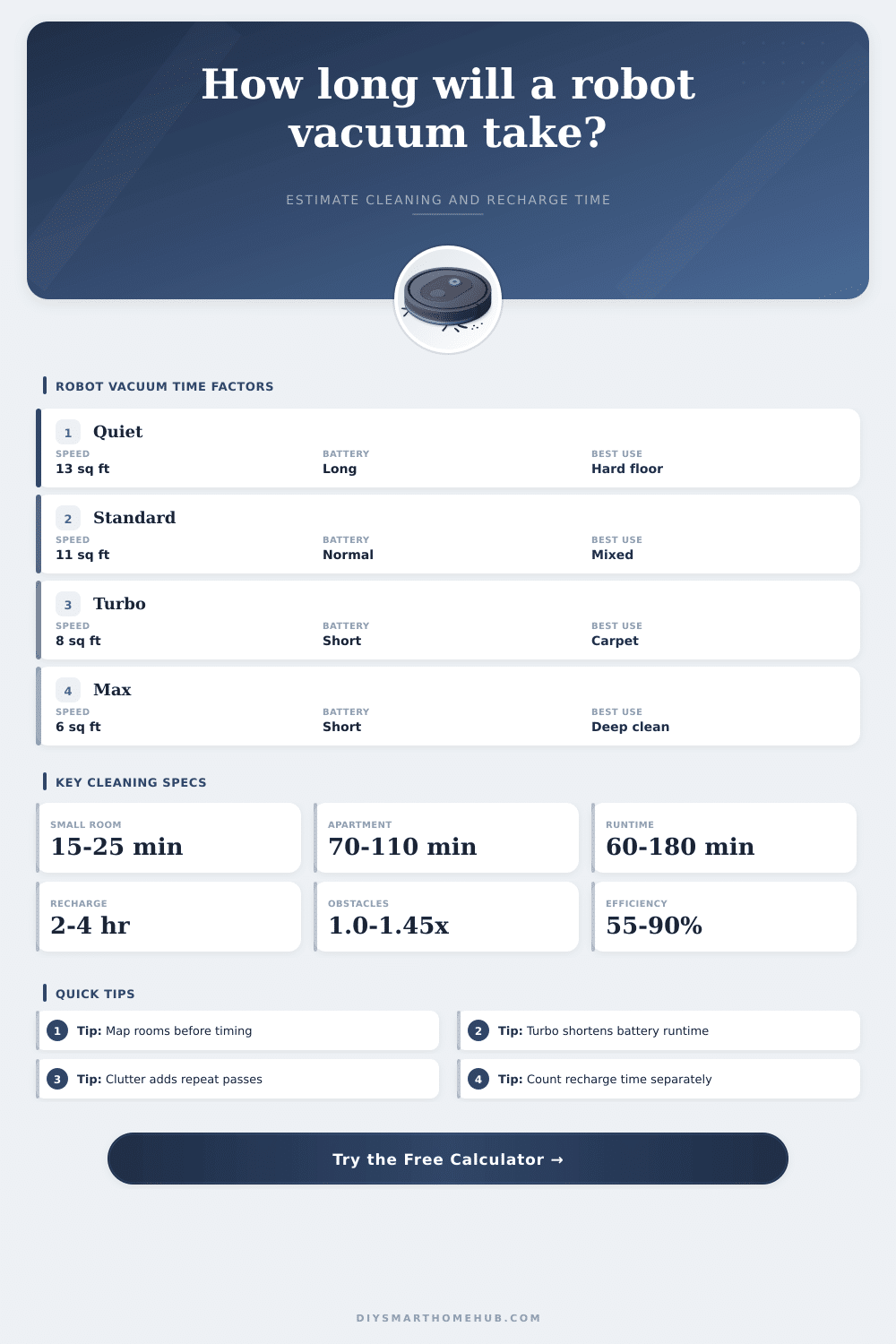
Estimate active vacuuming time, dock-to-dock elapsed time, effective coverage rate, and recharge cycles from floor area, suction mode, obstacles, navigation efficiency, and battery runtime.
📌Quick robot vacuum presets
Each preset fills the same formula fields, then recalculates. Adjust the cleanable area, robot type, and runtime to match your actual map.
📏Cleaning area and robot inputs
📈Robot vacuum cleaning time results
🤖Robot vacuum spec comparison grid
📊Suction mode speed reference
| Suction mode | Base active speed | Runtime multiplier | Best planning use |
|---|
🛋Obstacle and surface factors
| Factor | Multiplier | What it represents | Calculator effect |
|---|
🔋Battery and recharge planning table
| Runtime class | Usable cleaning | Recharge cycle | Typical read |
|---|
🏠Common robot vacuum timing scenarios
| Scenario | Cleanable area | Estimated active time | Recharge read |
|---|
💡Robot vacuum timing tips
A robot can finish the vacuuming portion in under two hours but still report a much longer job when a recharge-and-resume cycle is included.
Room labels, no-go zones, under-furniture clearance, and closed doors matter more than the home's listed square footage for time estimates.
When using a robot vacuum, it is helpful to know when the robot will finish its designated job of vacuuming the area. The time that the robot will take to complete its job is depend on several different variables. These variables includes the type of floors in the house, the layout of the furniture in each room, the suction setting of the robot, and the method in which the robot navigate the rooms of the house.
Many people dont account for these variables when purchasing a robot vacuum. These variables will impact the time that the robot takes to complete its job. The speed at which a robot vacuum completes its job will not be constant throughout the floors that it is assigned to clean.
What Affects How Long a Robot Vacuum Takes
The robot may move quick on hardwood floors when using a quiet mode for the robot’s operation. However, the robot will move more slow on carpet floors. Additionally, if the robot vacuum finds clumping or other obstacle within the floors that it is supposed to clean, it will move more slowly to avoid those obstacles.
Furthermore, the suction mode of the robot will decrease the battery life if it are high. Therefore, depending on the suction mode the human operator selected, there may be a need for the robot to perform its job in several cycle to fully clean each area. One factor that affects how long the robot will take to perform its job is the concept of coverage efficiency.
Coverage efficiency is a variable that measures the percentage of the floor area that the robot cleans as compared to the total area of the floors that the robot pass over during its operation. A well-modeled and efficient mapped robot may clean 75 or 80% of the floors in a single pass. However, a robot that maps the floors randomly may not be able to clean as much of the area in a single pass as the other types of robots.
Furthermore, if the coverage efficiency is low, it means that the robot may spend more time cleaning the same area that it has already cleaned. Thus, there will be areas of the floors that the robot does not clean during that pass of the vacuuming job. Another factor that can impact the amount of time that the robot takes to complete its job is the type of floors and the number of obstacle within those floors.
If the floors that are to be vacuumed are comprised of hardwood flooring and contain little furniture, the robot will be able to maintain its programmed speed. However, if rugs or other types of obstacle are placed within those floors, the robot will have to slow down and potentially change its map of the floors. Battery life and suction setting are additional variables to consider in determining the total time that the robot will take to complete the job.
The time that should be accounted for includes the amount of time that the robot will spend finding its charging dock, the time it will take to charge, and the time it will take to re-enter the map that it had while operating on the floors. Depending on the size of the floors and the suction modes the operator used, there may be the need for the robot to complete two or three cycle of recharging in order to successfully complete the job. Robot models has different suction modes that can have an impact on the outcome of the operation.
For example, if a quiet mode or eco mode is selected for the robot, it will be able to clean at a faster rate and with less depleted battery life than if it was using a turbo mode or a max mode for its suction operation. Turbo modes will increase the suction strength of the robot when it is on carpet or when there is pet hair in the areas that it is supposed to vacuum. However, using these modes will reduce the battery life of the robot as well as increase the drag that the robot will experience when performing its job.
Furthermore, the type of mapping and navigation system that is programmed into the robot will also have an impact upon the amount of time that it will take for the robot to complete its job. Basic models that use random patterns to map the floors may end up with less even coverage of those areas. Thus, it may take the robot more time to complete its job than one that uses a mapping system such as LiDAR or a series of camera that map out the areas of the floors and clean them in straight rows.
Home environments are not always representative of the specifications that is published for those models of robot vacuum cleaners. Variables such as doorways, rugs, and cords can impact how fast the robot can complete its job. By adjusting the modeled area to only account for the area that the robot can reach, the estimate of the time to complete its job will be more accurate.
Some of the most common mistake that people make with robot vacuum cleaners is to ignore the different variables that impact the time that the robots take to complete their jobs. For instance, if individuals assume that the vacuuming job will be completed in a short amount of time, they may have not accounted for the fact that the floors have thick carpets and many piece of furniture that will slow the robot down. Additionally, they may not have accounted for the time that it will take for the robot to recharge, if its battery life is short and it will require two or three cycles of vacuuming and recharging to complete the job.
Therefore, the most important and practical way to estimate the amount of time that the robot will take to complete its job is to use the same variables as the human operator to create an estimate. This estimate can serve as a planning window for the humans in the house. The estimate will reveal to the human how long the robot will be busy with its job.
For instance, if the estimate reveals that the robot will require two recharge cycles, the human will know that the robot will not be available for the remainder of that afternoon. If the estimated time for the job is shorter, there is a short window of time during which the job can be plan. By using the robot on a regular basis, individuals can begin to recognize and note the different patterns of how the robot will perform within each floor of the human’s home.
For instance, bedrooms that have hardwood floors may require only one cycle to complete the vacuuming job. However, living areas may have a variety of different floor types thus requiring more time to complete the same job. Floors that have even mapping models will even take less time to complete the job than those that have poorly-modeled maps.
Thus, with experience with the robot, individuals will understand how different setting and obstacles will impact the time that it will take for the robot to complete its job.