Smart Dehumidifier Tank Emptying Calculator
Estimate how often a dehumidifier bucket will need emptying from rated pints per day, usable tank volume, starting RH, target RH, moisture load, runtime, and compressor duty cycle.
📌Real dehumidifier presets
⚙Tank and humidity inputs
Dehumidifier settings
Live tank estimate
This preview updates from the same formula as the result cards.
A full calculation will appear below.
Tank emptying results
📊Dehumidifier spec comparison grid
📘Tank volume reference
| Tank label | Usable pints at 92% | Approx liters | What it usually means |
|---|---|---|---|
| 6 pint compact bucket | 5.5 pt | 2.6 L | Bedroom unit that can fill quickly during high RH spikes. |
| 10 pint bucket | 9.2 pt | 4.4 L | Small to mid-size dehumidifier with daily emptying in many rooms. |
| 14 pint bucket | 12.9 pt | 6.1 L | Common 35 to 50 pint unit tank size. |
| 18 pint large bucket | 16.6 pt | 7.8 L | Better for basements, but still limited during wet weather. |
| Continuous drain | Tank ignored | Drain line | Collection still matters for pump sizing and condensate routing. |
🌡RH load and duty cycle reference
| Condition | RH spread | Profile factor | Typical duty cycle | Calculator effect |
|---|---|---|---|---|
| Sealed bedroom | 5% to 12% | 0.72x | 20% to 45% | Long interval, often one tank every day or two. |
| Normal living area | 8% to 18% | 0.90x | 35% to 60% | Tank interval follows runtime schedule closely. |
| Damp basement | 12% to 25% | 1.10x | 55% to 85% | Large units may still need morning and evening emptying. |
| Laundry or bathroom | 18% to 35% | 1.28x to 1.38x | 45% to 90% | Short wet spikes can fill small tanks unexpectedly. |
| Leak dry-out | 25% or more | 1.65x | 80% to 100% | Manual bucket emptying becomes the bottleneck. |
⏱Emptying interval examples
| Adjusted collection | 8 pint tank | 12 pint tank | 16 pint tank | Smart alert cue |
|---|---|---|---|---|
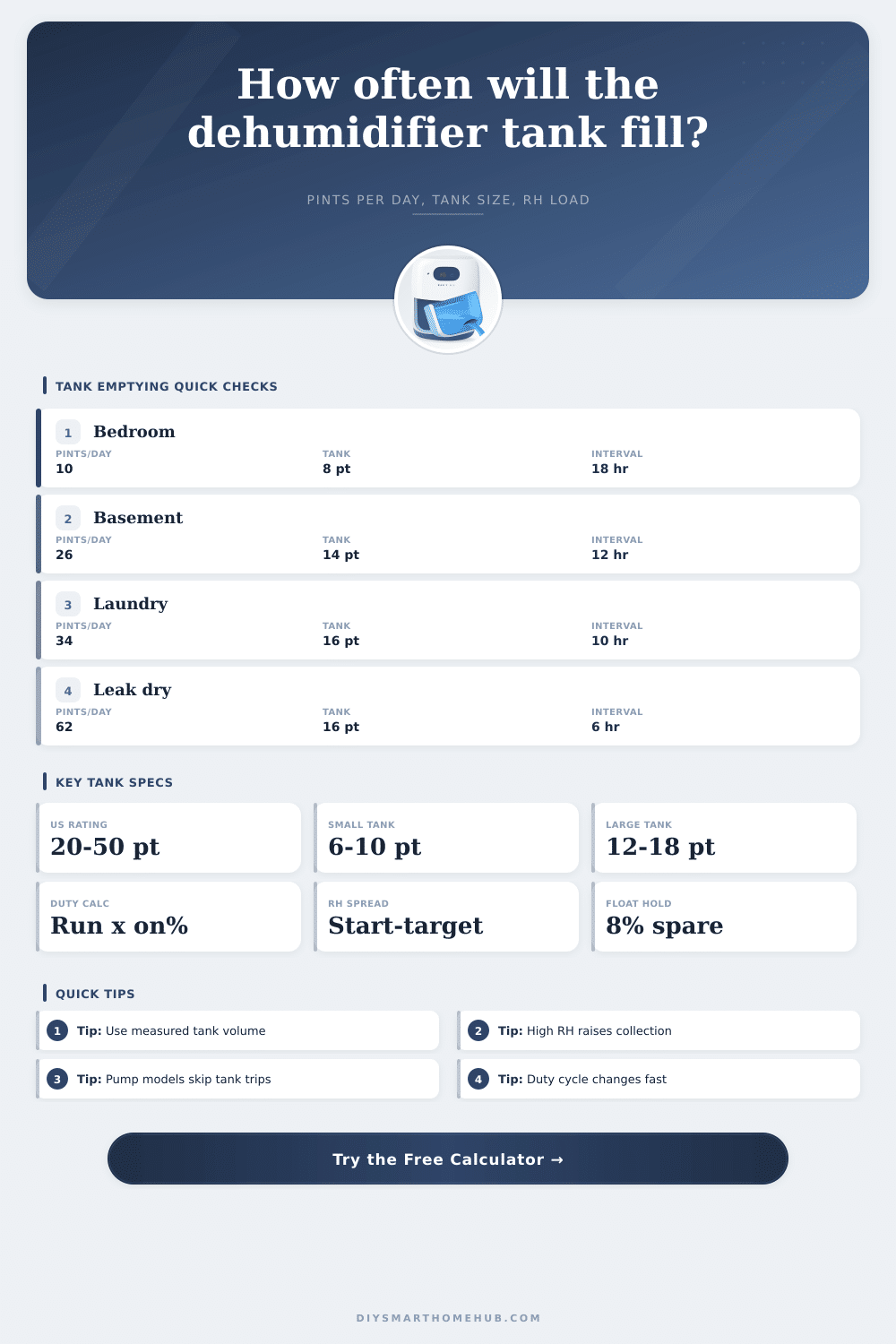
| 8 pints/day | 22.1 hr | 33.1 hr | 44.2 hr | Daily check is usually enough. |
| 16 pints/day | 11.0 hr | 16.6 hr | 22.1 hr | Set a twice-daily reminder. |
| 28 pints/day | 6.3 hr | 9.5 hr | 12.6 hr | Bucket trips can interrupt overnight running. |
| 40 pints/day | 4.4 hr | 6.6 hr | 8.8 hr | Use drain mode if available. |
| 60 pints/day | 2.9 hr | 4.4 hr | 5.9 hr | Tank is not practical for wet dry-out work. |
🔍Dehumidifier class comparison
| Class | Rated removal | Common tank | Best calculator use | Watch point |
|---|---|---|---|---|
| Small room unit | 20 to 22 pt/day | 6 to 10 pt | Bedrooms, closets, offices, mild RH spreads. | Small buckets stop the unit before morning. |
| Mid-size portable | 30 to 35 pt/day | 10 to 14 pt | Living rooms, apartments, light basement use. | Duty cycle rises sharply in humid weather. |
| Large portable | 45 to 50 pt/day | 12 to 18 pt | Basements and garages with smart plug monitoring. | High collection can outpace the bucket. |
| Built-in pump model | 35 to 50 pt/day | Tank plus pump | Estimate condensate per day for pump planning. | Tank interval only matters if pump is disabled. |
| Whole-home unit | 70+ pt/day | Drain only | Use pints/day output, not bucket trips. | Compare daily condensate to drain capacity. |
A dehumidifier are an appliance that collects water from an air. The dehumidifier stores the collected water from the air in a bucket attach to it. Due to the fact that the dehumidifier collect the water from the air, the bucket of the dehumidifier should be emptied out.
Otherwise, the dehumidifier will stop working once the bucket becomes full of the collected water. The frequency with which you should empty the bucket depends upon several factor, such as the humidity levels in the area in which the dehumidifier is placed, the size of the area in which the dehumidifier is placed, and the length of time that the compressor in the dehumidifier are running. If the bucket fill with collected water quick, the dehumidifier will shut off more frequent.
How Often to Empty a Dehumidifier Bucket
In contrast, if the bucket is slowly fill with collected water, the dehumidifier will run for longer periods of time until it shuts off. Dehumidifiers is often advertised with a capacity that indicates the amount of pint of water that the dehumidifier will remove from the air each day. However, they typically obtain this number under controlled and standardized testing conditions of the dehumidifier.
In the actual room in which the dehumidifier is running, the amount of water that will be collected will change based off the humidity of the room both before and after the dehumidifier begin to operate. For example, if the humidity in the air is already close to the humidity that the dehumidifier is programmed to target, the compressor will shut off more often, and less water will be collected from the air. In contrast, if the humidity of the air is significantly different than the humidity that the dehumidifier targets, the compressor will run more often, and more water will be collected.
Another factor that can impact the dehumidifier is the size of the bucket into which the water is collect. The size of this bucket is not necessarily the same as the capacity of the bucket to hold water. Within the dehumidifier is a float switch that turns off the dehumidifier prior to the bucket filling with water beyond its capacity.
Thus, the usable capacity of the bucket is less than the total capacity of the bucket. Therefore, the size of the bucket do not necessarily indicate the length of time that it will take to empty that bucket. Finally, another factor that can impact the rate at which the bucket fills is the duty cycle of the dehumidifier.
The duty cycle is a measure of the percentage of time that the compressor of the dehumidifier is running. Many dehumidifiers will keep the fan running even when the compressor is not running. Thus, the fan may be on while the compressor is off.
If the compressor runs for a large percentage of the time, the dehumidifier will be able to collect water quick and the dehumidifier bucket will fill quick. However, if the compressor runs for a small percentage of the time, the dehumidifier will collect the water slow and the bucket will fill slow. The moisture load in the room can also impact how often the bucket will fill.
The moisture load of a space is the amount of water that is entering the air in that space. For instance, a laundry room will have a high moisture load due to the amount of water that is released from the wet clothes. The dehumidifier in that laundry room will, therefore, fill its bucket quick.
In contrast, a bedroom that is sealed from the remainder of the house will have a low moisture load for that space. Thus, the dehumidifier in that sealed bedroom will have slow fill rate for its water collection bucket. The temperature of the air that is being dehumidified can also impact the rate at which the dehumidifier collects water from the air.
Warm air can hold more water than cold air. Therefore, a dehumidifier that runs in warm air will collect more water than one that is running in cold air, even with the same level of relative humidity in the air. Because warm air contain more actual water than cold air, the bucket will fill at a faster rate in warmer temperatures.
Instead of use the bucket to collect the water that is condensed out of the air, you can opt to use a drain hose. With the drain hose, the condensed water will flow out of the dehumidifier through a hose rather than in the bucket. With a bucket, the dehumidifier must be emptied regular.
For instance, if the bucket fills every six hour, it will have to be emptied many time each day. However, if the bucket fills every twenty-four hours, the bucket will only have to be emptied once each day. These factor will help you to understand whether you need a larger bucket, a hose to drain the water, or even a differant moddern model of dehumidifier altogether.