Smart Thermostat Setback Savings Calculator
Estimate setback savings from degree-hours, setback duration, HVAC runtime, kWh equivalent, and thermal load. The model compares a normal setpoint to an adjusted heating or cooling setpoint using energy-only formulas.
Use heating mode when the setback temperature is lower than the normal heating setpoint. Use cooling mode when the setup temperature is higher than the normal cooling setpoint. The calculator converts the temperature gap and hold duration into avoided degree-hours.
Live formula preview
Thermostat setback results
Full calculation breakdown
These are calculation references for setback math. Use equipment data or measured runtime whenever it is available.
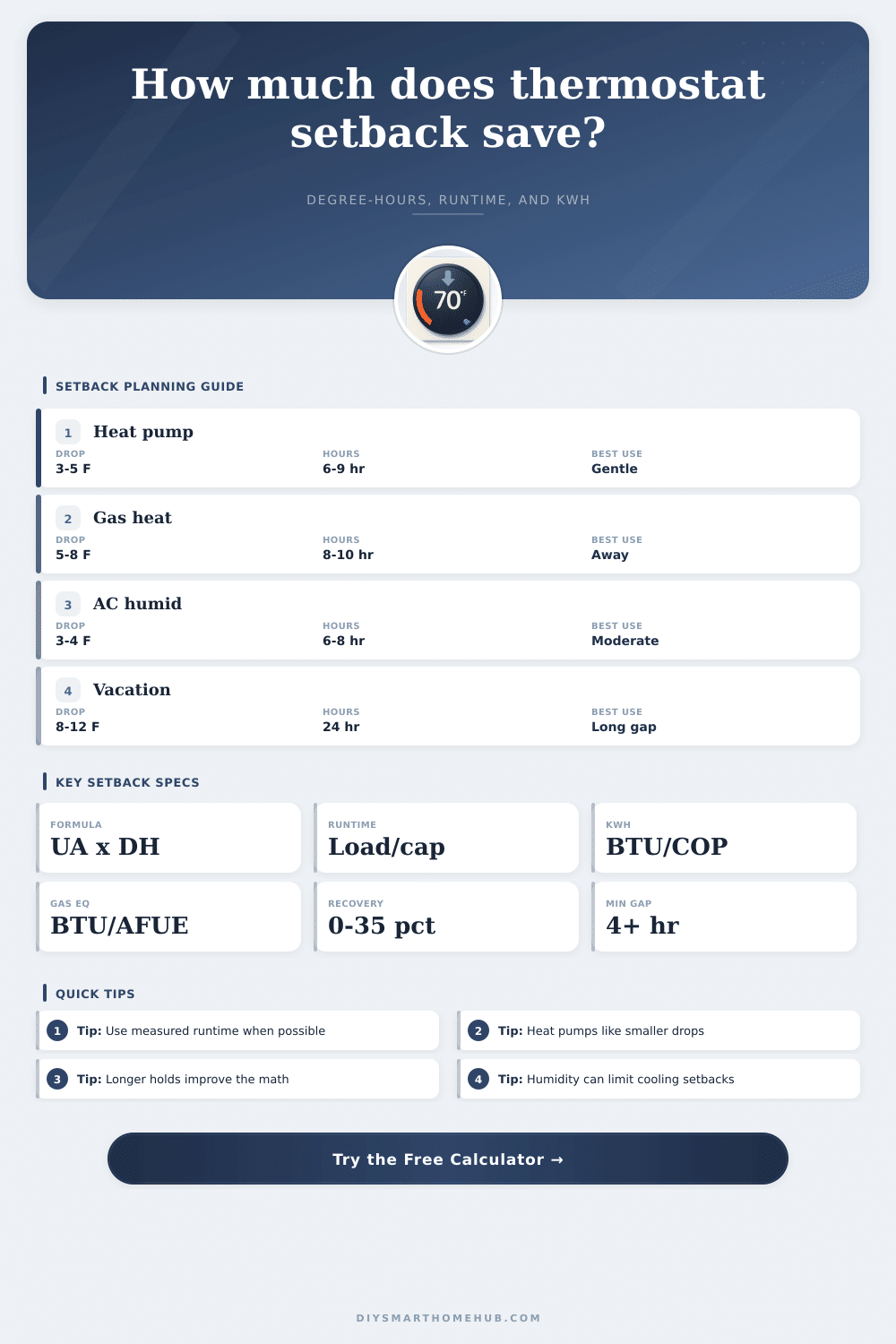
| Setback use case | Depth to test | Useful hold duration | Degree-hour formula | Runtime note |
|---|---|---|---|---|
| Weekday heating away period | 5 F to 8 F | 7 h to 10 h | Depth x hours x days | Usually strong for furnace or boiler systems |
| Ducted heat pump heating | 3 F to 5 F | 6 h to 9 h | Use smaller depth if auxiliary heat may start | Recovery penalty can erase aggressive setbacks |
| Cooling setup in humid climate | 2 F to 4 F | 5 h to 8 h | Setup depth x occupied-away hours | Latent load can reduce the practical result |
| Night setback or setup | 3 F to 6 F | 6 h to 8 h | Depth x sleep hours x nights | Works best when comfort band is acceptable |
| Vacation or long unoccupied period | 8 F to 12 F | 24 h to 168 h | Large degree-hour total | Recovery is a smaller share of total hold time |
| Work-from-home schedule | 1 F to 3 F | 2 h to 5 h | Small degree-hour total | Often limited by short duration |
| Envelope type | UA intensity range | What it means | Setback behavior |
|---|---|---|---|
| Very efficient new home | 0.12 to 0.22 BTU/h per sq ft-F | Low heat transfer through shell | Fewer runtime hours saved for same setback |
| Upgraded existing home | 0.22 to 0.35 BTU/h per sq ft-F | Insulation and air sealing improved | Moderate thermal load reduction |
| Average existing home | 0.35 to 0.55 BTU/h per sq ft-F | Common planning range for mixed stock | Setbacks show clearly in runtime |
| Leaky or older home | 0.55 to 0.90 BTU/h per sq ft-F | Higher conduction and infiltration | Large thermal load, but comfort recovery matters |
| Poorly insulated zone | 0.90 to 1.30 BTU/h per sq ft-F | Garage apartment, porch conversion, or weak shell | High degree-hour savings potential |
| HVAC system | Heating conversion | Cooling conversion | Recovery sensitivity | Best setback pattern |
|---|---|---|---|---|
| Gas furnace with central AC | Thermal BTU / AFUE | Thermal BTU / COP | Low to moderate | Regular weekday heating setbacks |
| Ducted heat pump | Thermal BTU / COP | Thermal BTU / COP | Moderate to high | Smaller setback with smart recovery |
| Dual fuel heat pump | Heat pump share plus furnace share | Thermal BTU / COP | High in cold recovery | Moderate depth and longer hold time |
| Inverter mini split | Thermal BTU / COP | Thermal BTU / COP | Moderate | Gentle setup, long unoccupied windows |
| Boiler with separate AC | Thermal BTU / AFUE | Thermal BTU / COP | High for radiant mass | Longer, shallower heating setbacks |
| Electric resistance heat | Thermal BTU / COP 1.0 | Thermal BTU / COP | Low | Deep setback if comfort recovery allows |
| Example scenario | Area | UA | Setback | Calculated signal |
|---|---|---|---|---|
| 1,000 sq ft efficient heat pump apartment | 1,000 sq ft | 0.24 | 4 F for 6 h | Low thermal load, gentle runtime reduction |
| 1,800 sq ft gas furnace weekday schedule | 1,800 sq ft | 0.38 | 7 F for 8 h | Strong degree-hour total over 250 days |
| 2,400 sq ft dual-fuel cold-climate home | 2,400 sq ft | 0.45 | 5 F for 9 h | High load with recovery penalty to watch |
| 850 sq ft cooling-only mini-split zone | 850 sq ft | 0.32 | 3 F for 7 h | Moderate cooling runtime avoided |
| 3,000 sq ft leaky farmhouse | 3,000 sq ft | 0.72 | 8 F for 10 h | Large thermal load and strong runtime swing |
A smart thermostat setback occur when the temperature are lowered in the house when the individuals are either sleeping or away from the house. When the smart thermostat setback occurs, the heating or cooling system in the house dont have to run as often, and the temperature of the house changes by a few degree prior to the individuals returning to the house. The cost that is save on the utility bill is calculated with the concept of degree-hours.
Degree-hours are calculated by multiplying the difference in the temperature within the house by the length of time that the difference in temperature exist. Degree-hours are avoided by utilizing a smart thermostat setback, and the avoided degree-hours represent the work that the heating and cooling system does not have to perform. The inputs that are required for the calculator are importance because they describe the house and the smart thermostat setback that will be performed.
How a Smart Thermostat Setback Saves Energy
For instance, the floor area of the house and the UA intensity of the house are two parameter that describe the physical characteristics of the house. A new house is typically constructed with a tight building envelope, meaning that it has a low UA intensity. Houses that are constructed with original windows may have high UA intensity values.
Other parameter that are described by the thermostat setback include the depth of the setback in the smart thermostat and the length of time that the thermostat holds the temperature (the hold duration). The deeper the setback and the longer the hold duration, the more degree-hours that will be avoid. The type of HVAC system for the house will determine how the degree-hours are translate into an estimation of the energy that will be saved by utilizing the setback.
For instance, gas furnaces typically have an efficiency of around 90%. However, heat pumps move more unit of heat for each unit of electricity than gas furnaces. Lastly, dual-fuel heating and cooling systems utilize both heat pumps and gas furnaces.
The outdoor temperature of the house determines which type of HVAC system that is use. Each of these systems have variable associated with them that the calculator translates into a figure in kilowatt-hours (kWh) that can be used to compare different thermostat setback schedules. Another factor that impact the energy savings with a smart thermostat setback is the recovery penalty.
The recovery penalty occurs when the HVAC system must run longer to reach the desired temperature within the house after the setback end. The longer that the HVAC system must run to heat the house to the desired temperature, the higher the recovery penalty. Factors that contribute to a higher recovery penalty are higher levels of thermal mass within the house and higher humidity within the house.
For these reasons, individuals should of use a recovery penalty of either 8 or 15 percent to ensure that the figure that the calculator calculates is realistic. Hold durations that are longer are more efficient if the setback is to be perform for the entire day. This is because the recovery penalty only needs to be accounted for once in a cycle of cooling or heating.
Thus, the longer that the smart thermostat is set to provide heating or cooling for the house, the more efficiently that the process will be. For these reasons, a smart thermostat setback that lasts for all day will save more energy than a setback that last for only two hour. Short setbacks will not save as much energy due to the energy that is required to overcome the recovery penalty.
The tightness of the envelope of the house impacts the depth of the setback with the smart thermostat. Houses that have a tight building envelope have a low UA value. Thus, they will save less energy during a setback than houses that have a leaky building envelope.
Houses with a leaky building envelope have a high UA intensity. Therefore, they experience higher level of avoided degree-hours during a setback. However, the drafty nature of these houses may lead the individuals within the house to abandon the setback altogether.
Cooling setbacks in houses in humid climates have additional constraint that must be accounted for. For instance, if the setback is to be used for cooling, the temperature of the house will be raised. This will reduce the sensible load within the house (the air that is cooled), but it will not reduce the latent load (the moisture within the air).
Thus, if the humidity level in the house are high, the depth of the setback for cooling will have to be smaller. For these reasons, individuals should use a recovery penalty of 25% for a smart thermostat setback that is used for cooling in a humid region of the country. This value is more accurately for the impact of humidity on the smart thermostat than an 8% recovery penalty.
There are two reference table on the page that provide information about typical setback depths and hold durations. These tables provide starting point for individuals to decide on the depth and hold durations for their smart thermostat setback schedules. If the individual know the runtime of the HVAC system for the house for the previous season, that runtime can be compared to the output of the calculator.
If these two values are not similar, then the house may have a leaky building envelope or the HVAC system may be oversized for the heating or cooling load. The calculator can be run twice to determine the impact of changing the hold duration. For instance, the smart thermostat setback may be test with a hold duration of six hours versus ten hours.
After the individual determines the hold durations for the smart thermostat setback, the schedule can be performed for a month. The utility bill for that month can be compared to the utility bill that the same house generated during the same month of the previous year. This will indicate whether the smart thermostat schedule is effective.
Its value is limited by the comfort of the house and the high recovery penalty for the HVAC system.