Air Changes Per Hour Calculator
Convert room volume and delivered airflow into ACH, equivalent clean-air ACH, CFM needed for a target, and airborne contaminant purge time. Use it for bathrooms, bedrooms, workshops, classrooms, offices, air purifiers, ERVs, exhaust fans, and balanced ventilation checks.
🎯Real ventilation presets
⚙Room volume and airflow inputs
ACH calculation results
📊Live ventilation snapshot
🔧Fan and clean-air comparison grid
📘ACH targets and reference values
| Reference use | ACH or airflow anchor | What it means | Calculator use |
|---|---|---|---|
| Residential minimum check | 0.35 ACH or 15 CFM/person | Common minimum ventilation reference for homes | Compare outdoor ACH, not recirculated CADR |
| ASHRAE 62.2-2022 dwelling formula | 0.03 CFM/ft² + 7.5 CFM x bedrooms+1 | Whole-dwelling mechanical ventilation estimate | Use target airflow card for whole-house CFM |
| Office breathing-zone example | 5 CFM/person + 0.06 CFM/ft² | Typical office outdoor-air planning reference | Convert resulting CFM to ACH for the room |
| CDC ventilation aim | 5 or more ACH | Dilution and filtration goal for many occupied spaces | Use clean-air ACH when filtration is included |
| Strong purge mode | 8 to 12 ACH | Short-duration clearing using exhaust, window fan, or high CADR | Use purge time result to compare settings |
📏Conversion and formula table
| Conversion | Formula | Example | Use in calculator |
|---|---|---|---|
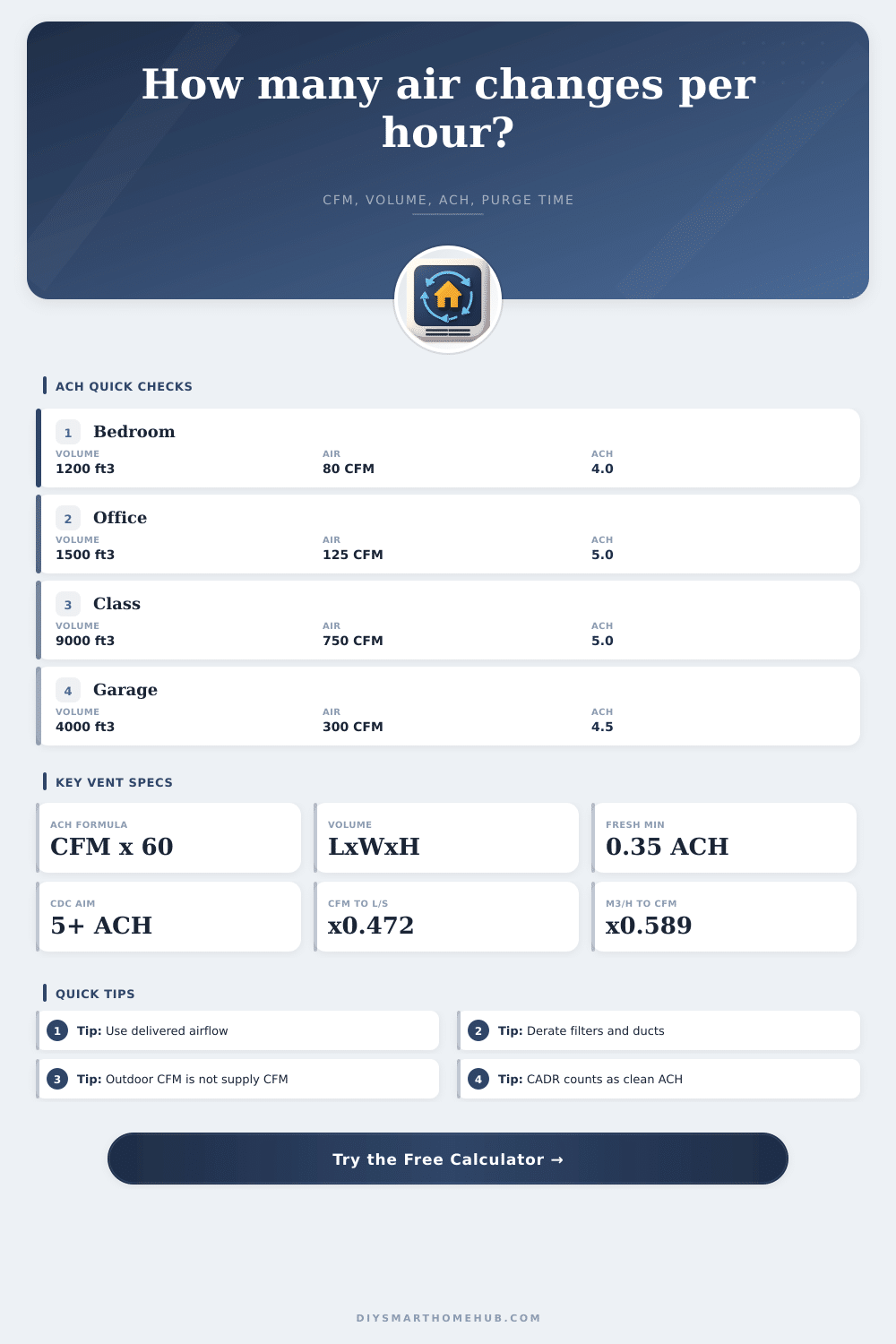
| ACH from CFM | ACH = CFM x 60 / ft³ | 120 CFM in 1,200 ft³ = 6 ACH | Main delivered ACH result |
| CFM from target ACH | CFM = ACH x ft³ / 60 | 5 ACH in 1,500 ft³ = 125 CFM | Target airflow result |
| Metric flow | 1 CFM = 0.4719 L/s = 1.699 m³/h | 100 CFM = 47.2 L/s | Metric unit display |
| Metric volume | 1 ft³ = 0.0283168 m³ | 2,000 ft³ = 56.6 m³ | Room volume conversion |
| Purge time | minutes = -ln(1 - removal) x 60 / ACH | 99% at 5 ACH = 55 min | Particle removal result |
🏠Common room and device comparison
| Room or zone | Typical volume | Airflow example | Approximate ACH |
|---|---|---|---|
| Small bathroom | 400 ft³ / 11.3 m³ | 50 CFM exhaust | 7.5 ACH before duct derate |
| Bedroom | 1,000 to 1,500 ft³ | 100 to 150 CFM CADR | 4 to 9 clean ACH |
| Two-person office | 1,400 to 2,000 ft³ | 60 to 150 CFM outdoor or CADR | 2 to 6 ACH |
| Two-car garage | 3,600 to 5,000 ft³ | 250 to 500 CFM fan | 3 to 8 ACH |
| Classroom | 8,000 to 12,000 ft³ | 500 to 1,000 CFM clean air | 3 to 7.5 eACH |
🔍Fan/spec comparison table
| Air device type | Spec to use | Derate to consider | ACH interpretation |
|---|---|---|---|
| Bathroom exhaust fan | Delivered exhaust CFM | Duct length, elbows, grille, backdraft damper | Outdoor-air ACH for that room |
| ERV or HRV | Measured supply or exhaust CFM | Balancing, filters, frost control, low-speed mode | Outdoor ACH for the connected zone |
| Portable HEPA purifier | CADR in CFM | Speed setting, filter loading, placement bypass | Equivalent clean-air ACH, not outdoor ACH |
| Central fan with MERV filter | Recirculated CFM x filter efficiency | Runtime, duct leakage, filter pressure drop | Filtered eACH only while fan runs |
| Window or box fan | Measured or estimated outdoor CFM | Open path, wind, screen loss, pressure balance | Outdoor ACH when flow path is real |
Air changes per hour is important because the air changes per hour will determine how much fresh air will be replacing the air in the room that the peoples who are in that room use. Each breath that a person take in the room contains old air; the more fresh air that is present in the room, the more pleasant the air will be for the occupants of that room. Furthermore, if an exhaust fan are installed in the room, or if a portable air cleaner is purchased, the individual might wonder how effective that device will be in removing the contaminants from the air.
Effectiveness, in this case, will be related to the size of the room that is to be cleaned, the amount of air that must move through that room, and whether that air is to be cleaned of contaminants (as with a HEPA filter) or simply move from one location within the room to another. Air changes per hour can be calculated by entering the dimensions of the room that is to be cleaned, as well as the airflow that the fan and/or air cleaner to be used within that room is to be delivered. The length, width, and height of the room are required to calculate the total amount of air that must be moved in relation to the size of the room.
How Air Changes Per Hour Work
Additionally, the delivered airflow is an important field in that the airflow that will be delivered to the area to be cleaned will determine the rate at which the air will be changed. A derate field allows users to account for the fact that the airflow that is delivered to the area will likely be less than the airflow that is indicated on the device; such losses can occur due to the ducts through which the air passes and the dirty filters that may capture some of the air. The field for clean-air efficiency will indicate the portion of the delivered air that will be effective at removing particles from the air; this field will help an individual to understand whether the air is to be cleaned or merely moved within the room.
The fields for outdoor air and filtered air are separate from each other. Each of the outdoor air field is used to calculate the amount of air that will come into the room from outside the building, which helps to lower the amount of carbon dioxide in the room and to remove odors from the room. Additionally, the fields for filtered air (as with HEPA filters) will calculate the amount of particles that is removed from the room; these fields will not factor into the outdoor air calculations.
Each of these fields must be separated; otherwise, the ventilation and filtration rates can not be considered separately. For instance, if the goal is to reduce the risk of the spread of the Coronavirus, or to stop a workshop from smelling like a specific substance, the ventilation and filtration rates must be considered separately. One of the results that can be obtained through the calculator is the purge time.
Purge time will calculate the length of time that is necessary to reach the desired percentage of air to be removed from the room. For instance, if an individual designs a small bathroom in the calculator, small amounts of air can be set to be exhausted by the exhaust fan, and the purge time will calculate that it will take less than ten minutes to remove the air from the small bathroom. However, if the room is larger in size, it will take longer for the same amount of air to be exhausted.
Additionally, short periods of time with high flow rate of air will only work if the amount of air is able to be exhausted at such a high rate for as long as the purge time calculates. Real rooms are different than those that are assumed in the calculations that the calculator performs. For instance, real rooms may contain furniture, doors that are open, and air may be moved in different ways throughout the room.
The derate field can be used to account for these differences. For instance, if the duct run is long or if the filter is dirty, the derate should be adjusted upward to account for the fact that less air will reach the exhaust fan. Different spaces require different air change rates.
For instance, bedrooms may require different air change rates than a workshop area where an individual may use a variety of solvent and other adhesives. Additionally, classrooms and meeting rooms may require both ventilation and filtration. Thus, the reference tables can help to provide examples of the air change rates that may be required in different spaces.
Care must be taken with the conversions between units. For instance, some exhaust fans will display ratings in cubic feet per minute, but other fans may be measured in liters per second or cubic meters per hour. Therefore, the calculator will internally convert the units of measurement, but the user must use the same system of units for both the volume of the air that is to be changed and the airflow of the exhaust fan that will be used.
It is possible to make a mistake with airflow. For instance, the highest number that is printed on the box of the exhaust fan is not necessarily the airflow that will be delivered to the area to be cleaned; the airflow will be less due to the elbows in the ducting system, the flex ducts in which the air moves, and the blocked grilles. The derate field can be used to account for this airflow.
For instance, if an individual measures the airflow that is exhausted by the exhaust fan with an anemometer, the number that is displayed will be entered in the airflow field and the derate will be set to zero. If no anemometer is available, a derate of ten or fifteen percent can be used. Filtration only works while the device is running.
For instance, if an individual uses a high-efficiency filter within the central heating and cooling system of the building, fewer units of clean air will be delivered to the building if the system only runs for twenty minutes each hour. Thus, the airflow and derate fields can be adjusted to account for the amount of time that the device will be running; otherwise, the air will not be effective filtered. Similarly, if the portable units are turned down to reduce the amount of noise that they generate, or if the individual decides to forget to turn the portable unit on, the air will not be effectively filtered.
The decision of the target air-change rate for a space is a matter of judgment. For instance, the minimum standards for residential ventilation suggest an air change rate of one-third air change per hour to balance humidity and odors in the residential space. However, targets of four to six changes per hour are common in locations like offices and classrooms.
Therefore, the target air-change rate can be any rate, and the calculator will determine the necessary amount of additional airflow to reach that rate. The target air-change rate can be used to determine how many air changes will occur in any given room. For instance, if an individual sets a target of four air changes per hour in the small bedroom in the calculator, the air will likely be sufficient for an individual who is sleeping in the bedroom.
However, in a classroom or a meeting room in which many individuals are sitting for long periods of time, a higher rate of air changes per hour will likely be required. Thus, although the calculator can calculate the number of air changes per hour in a space, it will not make the decision of whether that amount of air change is sufficient for the specific use of that space.