Humidity Ratio Calculator
Calculate psychrometric humidity ratio from dry-bulb temperature, relative humidity, and pressure, then convert the result to grains per pound, grams per kilogram, dew point, and target moisture removal.
📌Real home and HVAC presets
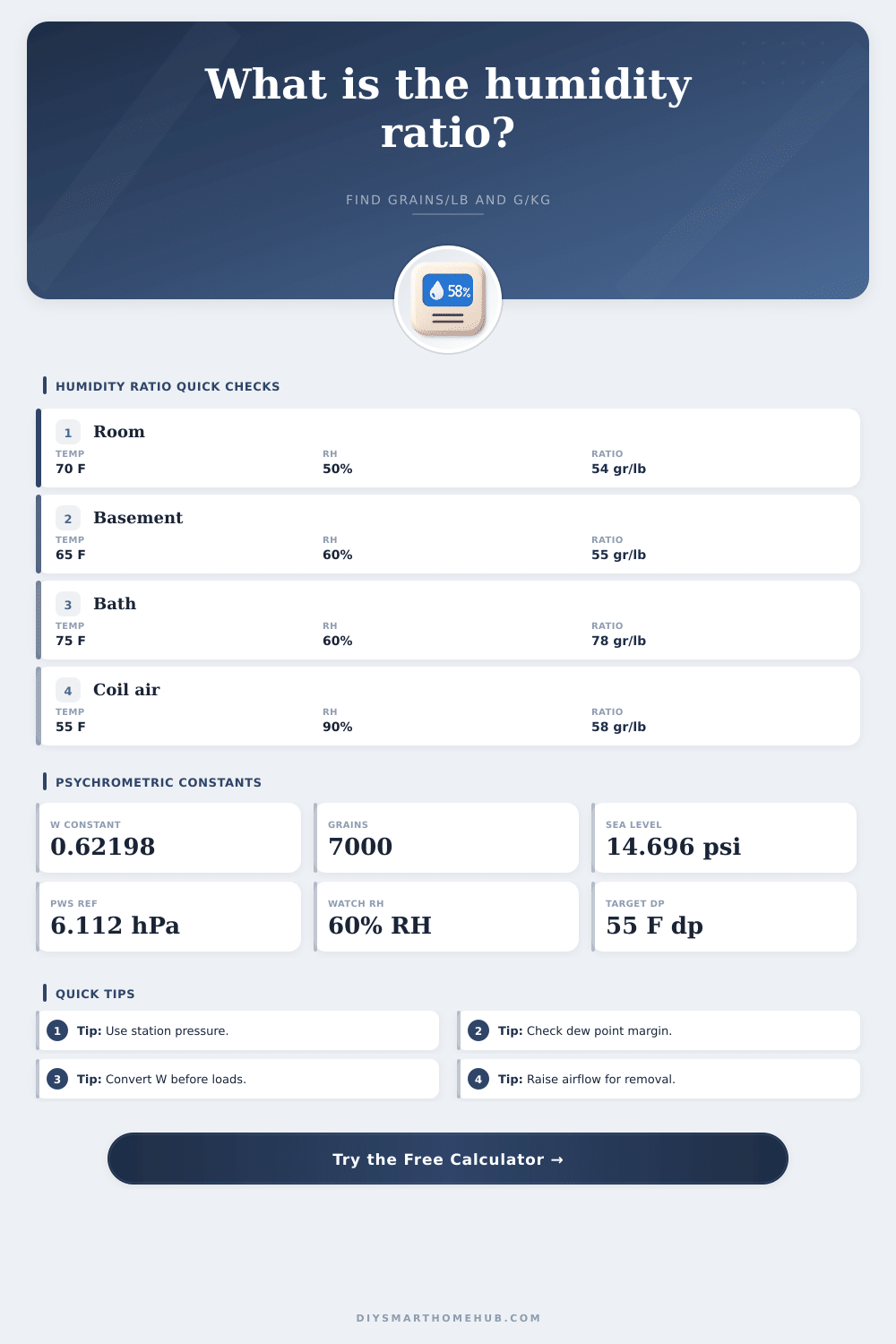
Presets are starting points only; humidity ratio is pressure-sensitive, so use station pressure when you have it.
💧Calculator inputs
⚙Formula snapshot
📊HVAC/spec comparison grid
📘Reference tables
Values use the same humidity ratio formula at standard sea-level pressure unless a pressure column says otherwise.
| Air condition | Dry bulb | RH | Vapor pressure | Humidity ratio | Grains/lb |
|---|---|---|---|---|---|
| Dry winter room | 68 F | 40% | 0.933 kPa | 5.78 g/kg | 40.5 |
| Typical comfort | 70 F | 50% | 1.249 kPa | 7.77 g/kg | 54.4 |
| Humid comfort | 75 F | 60% | 1.775 kPa | 11.09 g/kg | 77.6 |
| Warm outdoor air | 90 F | 60% | 2.885 kPa | 18.23 g/kg | 127.6 |
| HVAC state | Typical range | W range | Grains/lb | What to compare |
|---|---|---|---|---|
| Return air comfort | 70 to 75 F, 45 to 55% RH | 6.9 to 10.2 g/kg | 48 to 71 | Dew point vs windows and ducts |
| Coil leaving air | 52 to 58 F, 85 to 95% RH | 7.2 to 9.1 g/kg | 50 to 64 | Supply air drying ability |
| Basement air | 60 to 68 F, 60 to 75% RH | 7.0 to 11.0 g/kg | 49 to 77 | Moisture load over target RH |
| Outdoor ventilation | 85 to 95 F, 45 to 70% RH | 15.9 to 24.5 g/kg | 111 to 171 | Ventilation latent load |
| Altitude | Standard pressure | 72 F, 50% RH | Change vs sea level | Use case |
|---|---|---|---|---|
| 0 ft | 14.696 psi | 8.32 g/kg | Baseline | Coastal homes |
| 2500 ft | 13.42 psi | 9.12 g/kg | +10% | High valleys |
| 5000 ft | 12.23 psi | 10.02 g/kg | +21% | Mountain cabins |
| 7000 ft | 11.34 psi | 10.82 g/kg | +30% | High elevation homes |
| Delta W | Grain drop | 1000 ft3 room | 400 CFM stream | Meaning |
|---|---|---|---|---|
| 1 g/kg | 7 grains/lb | 0.075 lb water | 1.8 lb/hr | Small trim |
| 2 g/kg | 14 grains/lb | 0.150 lb water | 3.6 lb/hr | Noticeable drying |
| 4 g/kg | 28 grains/lb | 0.300 lb water | 7.2 lb/hr | Strong dehumidification |
| 6 g/kg | 42 grains/lb | 0.450 lb water | 10.8 lb/hr | Large latent load |
📝Preset result comparison
| Preset | Temp and RH | Pressure basis | Humidity ratio | Dew point |
|---|
💡Practical psychrometric tips
Weather reports often normalize pressure to sea level. Humidity ratio needs actual local air pressure, so altitude-estimated pressure is better than a sea-level barometer for mountain homes.
Relative humidity changes with temperature. For ventilation, dehumidifier, and coil checks, compare humidity ratio or grains per pound before deciding how much moisture must be removed.
The humidity ratio is a measurement of the amount of water vapor that is present in an air. The humidity ratio is different than the relative humidity of the air. While many peoples use the relative humidity as a means of describing the amount of moisture that is contained in the air, the relative humidity is actualy only a representation of the percentage of the maximum possible moisture that is present in the air at the existing temperature.
The humidity ratio, in contrast, provides a more direct means of measuring the amount of water vapor that is contained within a specific mass of air. To calculate the humidity ratio of the air, you must enter the dry bulb temperature, the relative humidity, and the station pressure or the altitude at which the air exists into a calculator. The station pressure and the altitude of the air are two of the factors that must be considered in the calculation of the humidity ratio.
What Is Humidity Ratio and Why It Matters
The station pressure and the altitude of the air change the total mass of the air that exists within the atmosphere. At sea level in the atmosphere, the air pressure is higher than at altitudes above sea level. At high altitudes, the air pressure is lower, which means that the air is less dense and contains less mass.
As a result, the humidity ratio will be higher at high altitudes with the same percentage of relative humidity, because there is less mass of dry air that can mix with the water vapor at high altitudes. Thus, it is necessary to enter the station pressure or the altitude into the calculator to determine the humidity ratio for the specific location of the air sample. The humidity ratio of the air is dependent upon several different types of inputs into the calculator.
The dry bulb temperature is the temperature of the air, as displayed on a thermostat. The relative humidity is the fraction of the moisture that is contained within the air compared to the maximum amount of moisture that it could contain at that air temperature. Finally, the station pressure and altitude determine the total mass of air, and the humidity ratio will change based off these different variables.
For instance, if the dry bulb temperature, the relative humidity, or the station pressure are altered, the humidity ratio will also change. Cooler air can contain less water vapor than warmer air. For instance, a room that is maintained at sixty-five degrees with a relative humidity of fifty percent will have a lower humidity ratio than a room that has a temperature of seventy-two degrees with a relative humidity of fifty percent.
The calculator will provide several different types of outputs based upon the calculation of the humidity ratio. For instance, grains per pound and grams per kilogram is both units that can be used to express the humidity ratio. Additionally, the calculator will also determine the vapor pressure within the air, the dew point of the air, the surface margin of the air compared to some other surface, and the humidity ratio itself.
The humidity ratio is a helpful measurement for the management of moisture within a building. Additionally, the humidity ratio is more useful for controlling a dehumidifier than the relative humidity. Dehumidifiers dont react to the relative humidity percentage that may be displayed on a sensor on the wall of the area in which the dehumidifier is located.
Instead, the dehumidifier removes water from the air based upon the humidity ratio of the incoming air compared to the desired humidity ratio of the air within the space. Furthermore, it is also helpful to use the humidity ratio to compare different types of air. For instance, if ventilation air is brought into a building that has a high humidity ratio due to the afternoon heat of the outside, there will be more moisture added to the building than if ventilation air from a dry day is brought into the building.
Another way in which the humidity ratio helps individuals understand different aspects of air is in relation to the comfort levels of individuals at different altitudes. At high altitudes, such as seven thousand feet above sea level, the air pressure is lower than at sea level. This lower air pressure results in a higher humidity ratio of the air at the same percentage of relative humidity.
Thus, if an individual moves from one area to another that is at a high altitude, such as from a coastal area to a mountain area, it is possible that the dehumidifier that was working effectively at the initial location may no longer be effective at the new location. This is due to the change in the humidity ratio of the air due to the altitude change. Thus, a humidity ratio calculator can be used to determine the humidity ratio that should of been entered into the dehumidifier prior to purchasing any new equipment.
Finally, another use for the humidity ratio is in determining how much moisture can be removed from the air within a space. The humidity ratio is one measurement of excess moisture within the air. Another value can be entered into the calculator to determine how much airflow is available for removing that excess moisture from the air.
Based upon the humidity ratio and the available airflow within the space, it is possible to determine the number of pounds of moisture that will need to be removed from the air each hour. Thus, the humidity ratio can also be used to calculate the pounds of moisture per hour, which is another important value for indicating how much moisture needs to be removed from the air within a space.