Home Wind Turbine Calculator
Estimate tower wind speed, rotor output, monthly energy, home-load offset, and useful battery charging from a residential wind turbine setup.
📌Real home wind presets
Presets are starting points only. The estimate is most reliable when average wind speed comes from a measured site, nearby anemometer, or mapped wind resource at a known height.
📏Calculator inputs
📊Wind turbine results
📦Selected turbine spec grid
📘Residential wind speed guide
| Hub wind | Resource quality | Typical outcome | Planning note |
|---|
⚙Turbine class comparison
| Class | Rated power | Rotor range | Best fit |
|---|
🏔Height and exposure factors
| Exposure | Shear exponent | Energy behavior | Common site |
|---|
📋Preset scenario comparison
| Scenario | Turbine | Hub wind | Monthly energy |
|---|
💡Wind calculation tips
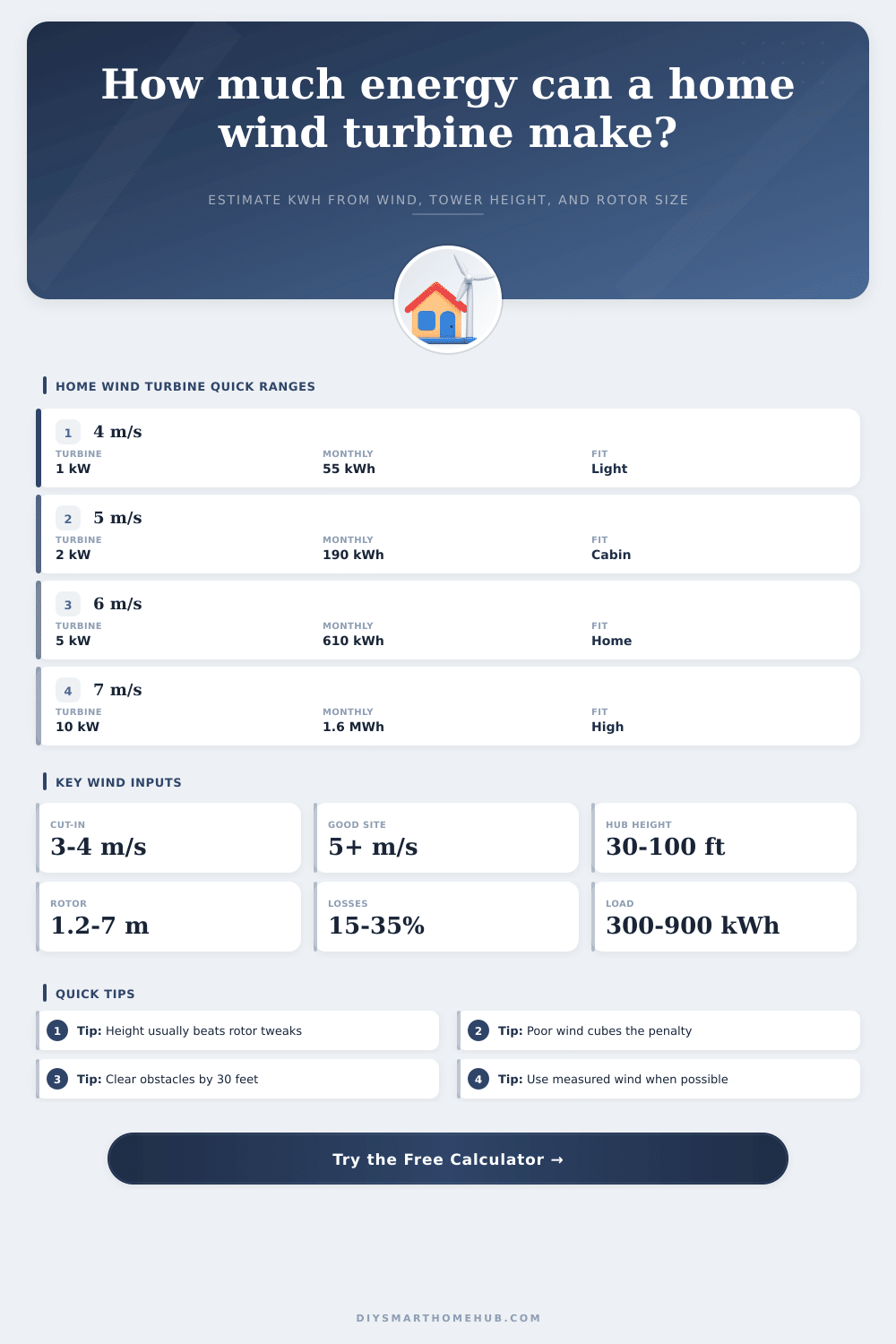
A home wind turbine transforms the moving air into electricity. A home wind turbine will produce different amount of electricity based off several specific factors. These factor includes the height of the turbine tower, the quality of the wind that passes over the turbine blade, and the design of the overall turbine model.
By using a calculator, you can estimate the amount of electricity that your home wind turbine can produce. This calculator utilize the information regarding the details of your site to account for wind shear and the power coefficients of the turbine. One of the major factor that will impact the amount of electricity that your turbine can produce is the speed of the wind.
How Much Electricity a Home Wind Turbine Can Produce
The faster that the wind move, the more electricity the turbine can produce. A slight increase in wind speed will lead to a much larger increase in the amount of energy that the wind turbine’s rotor can produce. A location with an average wind speed of five meters per second will produce less energy then a location with an average wind speed of six meters per second.
The calculator account for this by obtaining the wind speed that is measured at your site and adjusting for the height of the turbine tower. The calculator also apply the power coefficient of the turbine to this wind speed to determine the energy output of the rotor. Another factor that may impact the amount of energy that is produced is the height of the turbine tower.
Increasing the height of the turbine tower will usually produce more energy than increasing the size of the turbine’s rotor. This is due to wind shear, which slows the wind near the earth’s surface. For instance, increasing the height of the turbine tower at a ridge will have greater benefit than increasing the height of the turbine tower located in a backyard in a suburban area.
The calculator allow settings to account for wind shear at a specific location, such as open shoreline, rural ground, or suburban terrain. The size of the turbine’s rotor will also impact the amount of energy that is produced by the turbine. The size of the rotor’s diameter will allow the wind turbine to capture more wind.
However, the size of the rotor is limit by the rated wind power of the turbine and the speed at which the rotor begins to produce energy. The calculator makes use of the specifications of the different class of turbines. The size of the rotor that is entered into the calculator is limited by the efficiency of the turbine in converting the captured wind into electricity.
Another factor in the production of the turbine’s energy is the amount of turbulence that exist at the site. The movement of the wind around the obstacles on the land, such as trees, rooftops, and other building, creates turbulence. The rapid movement of the wind around these obstacles creates areas of turbulence.
The calculator accounts for the impact of this turbulence on the energy output of the turbine. The energy output will be reduced if the turbine is exposed to turbulence caused by these obstacle. The amount of electricity that the turbine can output is also reduced by system losses.
System losses include those caused by the inverter, the wiring of the turbine, and the controllers. If the system use batteries, additional losses are created by the charging and discharging of those batteries. A dropdown menu within the calculator ask for the system losses for the system.
Depending on the answers that are provided for whether the system feeds into the 电网 or uses batteries, a total system loss will be applied to the total electrical output of the turbine. The net average output of the turbine is determined after these system loss are accounted for. The calculation of the monthly energy and the load offset will display the amount of electricity that the turbine will provide to your home.
The calculator will divide the amount of energy that is calculated by the electrical load of the home. This will indicate the fraction of the electricity that is used by the home that is provided by the wind turbine. In addition to this value, the capacity factor of the turbine is displayed.
The capacity factor measure the relationship between the energy output of the turbine and the rated electrical output of the turbine. The capacity factor will be low if the electrical output of the turbine is low. This does not necessarily mean that the turbine is defective; it just means that the wind resources available at the site are not as strong than they could be.
The battery charging estimates will be provided for systems that make use of batteries to store the energy produced by the turbine. The daily amp-hour that is displayed is based on using a 48-volt battery bank. This is an estimate of the electrical storage that the system could provide on an average day.
However, the efficiency of the batteries will be less than this value; the battery will lose some of the stored energy in the charging and discharging of the batteries. The calculator cannot perform a site assessment. However, you can obtain the long-term wind data at the site with an anemometer placed at the turbine.
Long-term data will be more accurate than the modeled adjustment in the calculator. A determination of the local permitting rule can also be made for the site. These local permitting rules will dictate the maximum height of the turbine tower and the setback of the turbine tower from the structure.
The exposure and the turbulence settings in the calculator can be guess as to the conditions at the site. A walk through the area with a handheld anemometer or the use of a map that displays areas of wind activity can help to provide a better understanding of the available wind resources at the site. The amount of energy that a home wind turbine can produce is contingent upon two factor: the speed at which the wind moves through the area and the ability of the turbine tower to reach the wind turbine blades to the wind.
These factor will determine the capabilities of the system. The calculator can assist in understanding these factors to provide an idea of the amount of energy that the turbine can produce during a typical month.