Wind Turbine RPM Calculator
Estimate rotor RPM, generator RPM, blade tip speed, electrical frequency, blade-pass frequency, and swept area from rotor diameter, wind speed, tip speed ratio, and drive ratio.
📌Real Wind Turbine RPM Presets
⚙Rotor And Generator Inputs
Wind Turbine RPM Results
🧮Live RPM Spec Grid
📊TSR And RPM Reference
| Rotor style | Common TSR band | RPM behavior | Best calculator setting |
|---|---|---|---|
| Savonius drag rotor | 0.8 to 1.5 | Very slow, torque-heavy rotation | Use low TSR and many magnet poles. |
| Multi-blade water pump | 1 to 3 | Slow RPM with strong starting torque | Pair with direct drive or low speed-up ratio. |
| Darrieus vertical axis | 3 to 5 | Moderate RPM after self-starting | Use midrange TSR and check cyclic loads. |
| Three-blade electric HAWT | 6 to 8 | Efficient small turbine speed range | Start with TSR 6.5 to 7.5. |
| Two-blade fast HAWT | 7 to 10 | High RPM for a given diameter | Watch tip speed, balance, and sound. |
| Bench or trainer rotor | 3 to 8 | Depends on load and blade profile | Use measured TSR when test data exists. |
🌬Diameter, Wind, And RPM Examples
| Rotor diameter | Wind speed | Target TSR | Calculated rotor RPM |
|---|---|---|---|
| 0.8 m / 2.6 ft | 5 m/s / 11.2 mph | 5.0 | 597 rpm |
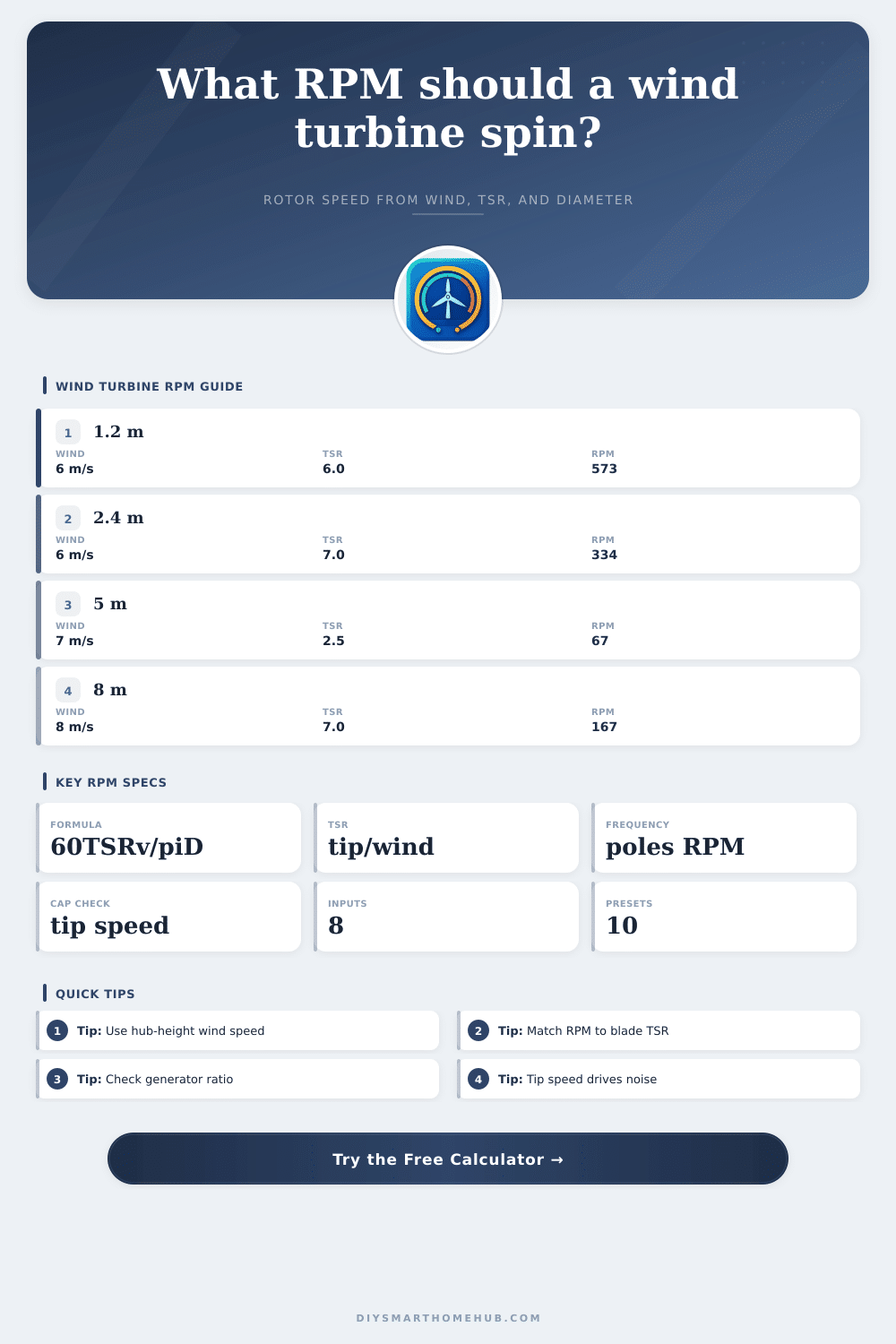
| 1.2 m / 3.9 ft | 6 m/s / 13.4 mph | 6.0 | 573 rpm |
| 2.4 m / 7.9 ft | 6 m/s / 13.4 mph | 7.0 | 334 rpm |
| 5.0 m / 16.4 ft | 7 m/s / 15.7 mph | 2.5 | 67 rpm |
| 8.0 m / 26.2 ft | 8 m/s / 17.9 mph | 7.0 | 167 rpm |
⚡Generator Ratio And Frequency Table
| Rotor RPM | Drive ratio | 12-pole frequency | Planning note |
|---|---|---|---|
| 80 rpm | 1:1 direct | 8 Hz | Useful for low-speed permanent magnet alternators. |
| 160 rpm | 1:1 direct | 16 Hz | Common small direct-drive charging range. |
| 250 rpm | 2:1 speed-up | 50 Hz | Generator sees 500 rpm before rectification. |
| 330 rpm | 3:1 speed-up | 99 Hz | High electrical frequency, check controller limits. |
| 600 rpm | 1:1 direct | 60 Hz | Small fast rotor range for micro alternators. |
📝Common Small-Wind RPM Scenarios
| Project scenario | Input anchor | Primary RPM result | Secondary check |
|---|---|---|---|
| Remote sensor trickle charger | 1.0 m, 5.5 m/s, TSR 5 | 525 rpm rotor speed | Tip speed about 28 m/s. |
| Garden battery turbine | 2.4 m, 6 m/s, TSR 7 | 334 rpm rotor speed | 2:1 ratio gives 668 generator rpm. |
| Quiet shed charger | 3.2 m, 6 m/s, TSR 5.5 | 197 rpm rotor speed | Lower TSR keeps tip speed modest. |
| Water pump rotor | 5 m, 7 m/s, TSR 2.5 | 67 rpm rotor speed | 12 blades give 13.4 Hz blade pass. |
| Home tower turbine | 8 m, 8 m/s, TSR 7 | 167 rpm rotor speed | Tip speed about 56 m/s. |
🚦Tip Speed And RPM Cap Bands
| Tip speed band | Approx mph | RPM meaning | Calculator cue |
|---|---|---|---|
| Under 30 m/s | Under 67 mph | Slow, quiet, training or pump rotors | Often fine for low-speed experiments. |
| 30 to 55 m/s | 67 to 123 mph | Normal small electric turbine zone | Good target for many DIY rotors. |
| 55 to 75 m/s | 123 to 168 mph | Fast rotor, sound and balance matter | Use a real overspeed control plan. |
| Over 75 m/s | Over 168 mph | Aggressive for small homemade rotors | Reduce TSR, RPM, or design wind. |
💡Calculation Tips
Wind power is create when the wind rotates the blade of a wind turbine. The faster that the blades of a wind turbine rotate, the more electricity that the wind turbine will produce. Should the blades of a wind turbine rotate too slow, the generator may not reach the voltage that is necessary to power a battery or an inverter.
Should the blades of a wind turbine rotate too fast, the tips of the blades will create noise, the bearings will wear out quick, and the strong gust of wind that may occur may damage the assembly of the turbine. Thus, determining the correct rotational speed for the rotor is essential for creating a small wind turbine that can efficient produce energy. The rotational speed for a small wind turbine can be determined through the relationship between the velocity of the wind and the diameters of the blades of the turbine.
How to Find the Right RPM for a Small Wind Turbine
The tip speed ratio, or TSR, is the measurement of how many times farther the tip of the blade travels in a revolution compared to the distance that the wind travels in the same length of time. If the tip speed ratio is high, it means that the blades is traveling at a relatively high rate of speed in comparison to the wind. High tip speed ratios is efficient at producing energy from the rotational movement of the turbine blades.
Low tip speed ratios produce more torque with the turbine blades but are not as efficient at producing energy. The behavior of the lift and drag force that act upon the airfoil-shaped blades creates the relationship of the tip speed ratio to the amount of energy that is produced from the blades. Thus, small wind turbines have different shaped blade to water pumps that also have airfoil blades.
The diameter of a small wind turbine’s rotor plays a crucial role in the rotational speed at which the rotor achieves its maximum performance. The circumference of a turbine’s rotor is directly related to its diameter; the larger the diameter of the rotor, the larger the circumference of that rotor. As a result, the area that is swept by the rotating blades increase with an increased rotor diameter.
The increased distance that the tips of the blades must travel, however, indicates that the rotational speed of a rotor with a large diameter will be lower than a small diameter rotor if the tip speed ratio are to remain the same. Thus, even small change to the diameter of a rotor will have an effect upon the rotational speed (RPM) of that rotor. The calculator makes it easy to enter the diameter of the proposed rotor, the wind speed in the area, and the tip speed ratio that is targeted by the small wind project to calculate the RPM without remembering the formula for that calculation.
Another important requirement for small wind projects is that the blades of the rotor be matched with the correct generator. Small wind turbines typically use permanent magnet alternator that require a minimum RPM to produce the voltage necessary for batteries or inverters. In instances where the rotor is too slow for the alternator, a belt or gearbox can be added between the rotor and the alternator to allow the alternator to reach the necessary RPM.
Gearboxes and belts increases the RPM of the generator and the electrical frequency of the generator. By adjusting the gearbox, the same small wind turbine’s rotor can be paired with different alternators. Additionally, small machines has different electrical frequencies that are required by their charge controllers.
Electrical frequency must be matched to those requirements to avoid the charge controller failing to power any battery. The tip speed of the blades of a small wind turbine will affect the performance and the practical aspect of those small turbines. Small wind turbines with high tip speeds will make more noise and have higher vibrations in their operation; additionally, if those turbines are not balanced correct, those high tip speeds will make the imbalance of the turbine more noticeable.
High tip speeds also indicate diminishing returns in the amount of power that the turbines will produce, so a limit is set to the tip speeds of those turbines. The calculator reports the tip speed to the user to permit comparison with the tip speeds at which small wind turbines are proven to work. Wind speed is not constant.
The RPM calculations are made with average wind speeds, yet the actual wind speed will change. In gusts of wind, the rotational speed of the blades will increase in speed. Therefore, overspeed protection is necessary for small wind turbines that are not “very small.” Overspeed protection prevents the blade assembly from suffering damage due to increased rotational speed due to gusts of the wind.
However, as with blade diameter, rotational speed is calculated with the assumption of the wind speed at which the small wind turbine will be located; the overspeed protection system will need to be able to handle speeds beyond that calculated value. Thus, the baseline rotational speed can be determined and used to calculate the overspeed protection requirement for the small wind turbine. The number of blades that are included in a small wind turbine will affect the RPM of the rotor.
Fewer blades will allow the blades to travel at higher tip speed; they will create less resistance against the movement of the air molecules around the turbine. Rotor blades that have more blades will exhibit higher starting torque but will be smooth in the rotational movement of the rotor. This smoothness in movement is beneficial for small wind turbines with no gearbox or belt system between the blades and the generator.
Additionally, if the rotational speed at which the blades pass a certain point on the turbine tower matches the natural frequency at which that tower vibrates, the tower will also experience high vibration. Therefore, the blade-pass frequency and the RPM should be checked together to ensure that there will be no vibration in the tower upon installation of the small wind turbine. The swept area of a small wind turbine do impact the RPM of the turbine.
The larger the swept area, the more wind will be intercepted by the blades. Swept area does not, however, impact rotational speed in a way that dictates the RPM. Two rotors of similar swept areas can have different diameter.
Swept area and diameter both impact rotational speed. Swept area does, however, impact the amount of energy that a small wind turbine can capture. Thus, the two characteristics should always be separated in small wind turbine projects.
The tables that are provided to users in the article list the typical tip speed ratio for small wind turbines of different types. These tables were created through field experience of the types of small turbines and at what tip speed ratios they operate most efficient. For instance, Savonius rotors has a relatively low tip speed ratio but high starting torque that allows those turbines to start without any rotational speed.
Two-blade turbines have relatively high tip speed ratios because with fewer blades, there is less friction between blades that can slow the rotation of the rotor. Two-blade rotors do, however, require even more careful placement to prevent vibrations in the same manner as three-blade rotors. These suggested tip speed ratios can be adjusted for specific generators or small wind turbine sites.
The RPM of small turbines is very sensitive to changes in wind speed. An increase in the wind speed will increase the RPM at which the small wind turbine will rotate. For instance, a 20 percent increase in the wind speed will cause the blades of the small wind turbine to rotate at a 20 percent increased RPM.
High rotational speed will produce alot of energy from the small wind turbine but can also cause noise. Additionally, because areas with small wind turbines will experience high winds, it is important to plan around these high RPM requirements. The difference in the wind speed at the blades of a small wind turbine and the wind speed reported in weather reports must be considered.
Small wind turbines may have an anemometer placed at the hub of the rotor. Small wind turbines typically will have their blades placed so that the rotational speed is calculated based on the wind speed at the blades. This wind speed will be higher than the wind speed at ground level that a weather station measures.
Thus, the wind speed at which the blades of the small wind turbine will reach will be entered into the calculator. The rotational speed of the blades will impact the performance of small wind turbines. Small wind turbines with rotational speeds within the workable range for the components of the project will exhibit efficient performance with few adjustments to the components.
If rotational speed are outside of the workable range for the project, it will be immediately apparent that the project will require either the change of the rotor or the change of the generator. Thus, the rotational speed of small wind turbines will make it immediately apparent which component should be changed for best performance of the entire small wind turbine project.