Wind Turbine Torque Calculator
Estimate rotor torque from diameter, wind speed, RPM, Cp, drivetrain efficiency, and air density, then compare the result with TSR and loading references.
⚙Real Turbine Presets
Presets use plausible small-wind dimensions and operating points. Adjust Cp and RPM to match your rotor curve, generator load, and blade pitch.
📐Calculator Inputs
Torque and Rotor Load
Enter turbine data to estimate shaft torque and operating quality.
📊Live Spec Grid
📈Torque Curve Table
| Wind speed | Wind power | Shaft power | Torque at RPM | Use this row for |
|---|---|---|---|---|
| --- | --- | --- | --- | Calculate to fill |
📘Reference Tables
| Rotor family | Typical Cp | Useful TSR | Torque character |
|---|---|---|---|
| 3-blade HAWT | 0.30 to 0.45 | 5 to 8 | Efficient, moderate torque |
| 5-blade rotor | 0.25 to 0.38 | 3 to 5 | More starting torque |
| Savonius VAWT | 0.10 to 0.22 | 0.8 to 1.5 | High torque, slow speed |
| Darrieus VAWT | 0.20 to 0.35 | 3 to 6 | Needs control at speed |
| Water-pump rotor | 0.15 to 0.30 | 1 to 3 | Very high torque, low RPM |
| Torque formula | Equation | Input sensitivity | Practical note |
|---|---|---|---|
| Wind power | 0.5 x rho x A x V^3 | Very high wind effect | Use measured hub wind |
| Aero power | Wind power x Cp | Cp must be realistic | Betz limit is 0.593 |
| Shaft power | Aero power x efficiency | Losses reduce torque | Generator drag matters |
| Shaft torque | Power / angular speed | Lower RPM raises torque | Check drivetrain rating |
| TSR band | Meaning | Likely symptom | Adjustment to test |
|---|---|---|---|
| Below target | Rotor is loaded down | High torque, low RPM | Reduce electrical load |
| Near target | Rotor operating well | Best power capture | Hold similar loading |
| Above target | Rotor spins too freely | Lower torque, noise risk | Add controlled load |
| Far above target | Overspeed condition | Stress and noise rise | Use braking or furling |
Torque estimates are planning values. Real output depends on blade airfoil, pitch, alternator curve, turbulence, controller behavior, and yaw alignment.
💡Torque Tips
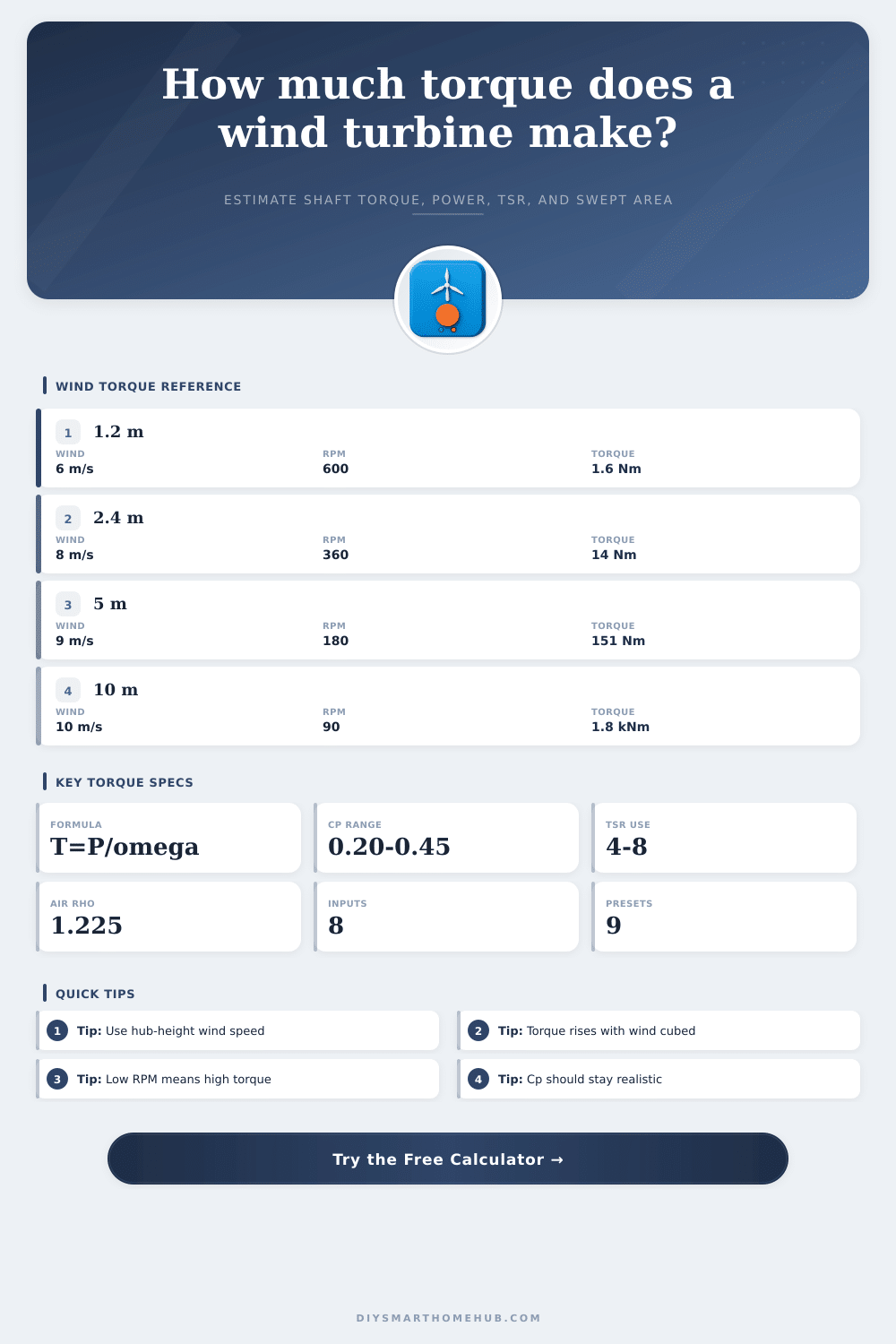
The torque that is produce by a wind turbine is a measure of the twisting force that the rotor of the turbine will produce. The torque of the wind turbine can depend on several different variable. For example, the torque can depend upon the diameter of the rotor, the speed of the wind, the rotational speed of the rotor (known as the RPM of the rotor), the power coefficient of the rotor, the efficiency of the machine, and the density of the air.
Each of these values can be enter into the calculator to determine the torque that the wind turbine can produce. The diameter of the rotor is one of the critical factor for the turbines. The diameter of the rotor is largely responsible for the area that is covered by the rotor as it turn.
What Affects Wind Turbine Torque
Thus, if the diameter of the rotor is increased, the area that is covered by the rotor increase. The swept area increase by the square of the diameter of the rotor. Thus, doubling the diameter of the rotor will result in four times the swept area by the rotor.
However, the wind provide the power that increases with the cube of the speed of the wind. Thus, increasing the speed of the wind will have a more significant impact upon the torque of the wind turbine then altering the diameter of the rotor. The power coefficient of the rotor (often written as Cp) is another factor that can impact the amount of torque that the rotor produces.
The power coefficient is a measure of how effective the rotor can convert the energy of the wind into mechanical work. The rotor will never be able to convert all of the energy of the wind into mechanical work; thus, the coefficient will always be a value less than one. For example, three bladed rotors tend to have a power coefficient between 0.30 and 0.42, while vertical axis rotor may have lower values for that coefficient.
Thus, it is important to select a value for this factor that represents the efficiency of the rotor so that the calculated value for the torque of the rotor is realistic. The rotational speed (often referred to as the RPM) of the rotor is also another factor that impact the torque of the rotor. For example, torque is equal to the power divided by the rotational speed (RPM).
Thus, increasing the rotational speed of the rotor will decrease the amount of torque that is produced by the rotor. Conversely, decreasing the rotational speed will increase the amount of torque that is produce. Thus, altering the RPM will alter the amount of torque that is produced by the rotor.
This relationship between these two variable is one of the reasons that the RPM of the rotor can be manipulated within the calculator. Finally, the efficiency of the machine will impact the amount of torque that is produce by that machine. Efficiency is a value that represents the amount of energy that is lost between the rotor and the final output of the machine.
Energy can be lost due to a variety of factors that include friction within the bearings of the machine, energy loss in the gearbox that connects the rotor to the generator, and energy losses within the generator itself. Since efficiency will reduce the total amount of power that is available, a lower efficiency will result in a lower torque value created by the wind turbine. Therefore, it is important to use a realistic value for efficiency in the calculator, since changing the efficiency will change the resulting torque of the turbine.
The tip speed ratio can tell you if the rotor is turning at the correct speed for the blade design. Each design of rotor will have a certain range of tip speed ratio at which it can operate most effective. If the tip speed ratio is too low for the design of the rotor, the rotor will stall.
If the tip speed ratio is too high, the rotor will begin to act like a paddle and create noise. The calculator can determine the tip speed ratio of a wind turbine given its diameter, RPM value, and the wind speed. Using this parameter, if the calculated value is outside of the expected range for the design of the rotor, then the rotor is not operating at its most efficient speed.
Air density is another variable that has an effect upon the torque that is create by the wind turbine. This is due to the fact that the mass of the air that pass through the rotor creates the torque. Air density change with the changes in temperature and altitude.
For instance, hot air is less dense than cold air, and air at high altitude is less dense than air at sea level. Thus, less dense air will result in the turbine creating less power and, therefore, less torque. A custom value for air density can be enter into the calculator to reflect the area where the wind turbine will be designed to operate.
The value for torque that the calculator calculates is only a planning value for the wind turbine. The actual torque that the turbine creates may be different due to a variety of environmental factor. For instance, the turbulence in the air created by trees or other environmental factor will have an effect upon the torque of the turbine.
Additionally, the controller for the rotor can change the pitch of the blade to reduce the amount of torque created by the blades in the case of a gust of wind. Thus, the value for torque calculated by the calculator should be treated as the target for the torque of the wind turbine. Finally, the calculator can be used to compare different style of rotors or even to compare different condition of operation.
For instance, the calculator can be used to compare the torque created by a five-blade rotor to that of a three-blade rotor. Additionally, it is also possible to calculate the effect that different wind speed will have upon the created torque. Thus, the calculator can help in making decision regarding the design of the rotor or wind turbine altogether.