Wind Turbine Swept Area Calculator
Estimate the swept area of horizontal-axis, vertical-axis, Savonius, and shrouded micro wind turbines, then translate that area into available wind power and practical electric output.
📌Real turbine presets
⚙Turbine inputs
Calculation breakdown
📊Wind turbine spec grid
🌬Rotor swept area reference
| Turbine style | Swept-area formula | Useful input | Planning note |
|---|---|---|---|
| Horizontal-axis propeller | Area = pi x diameter squared / 4 | Blade-tip circle diameter | Most small home and off-grid turbines use this circular model. |
| Darrieus or H-rotor VAWT | Area = rotor width x rotor height | Maximum width and blade height | Best for straight-blade vertical-axis swept rectangles. |
| Savonius drag rotor | Area = rotor width x rotor height | Outer bucket width and height | Use a lower Cp because drag rotors extract less energy. |
| Annular or large hub rotor | Area = outer circle minus blocked center | Outer diameter and blockage percent | Useful for turbines with oversized hubs, guards, or centerbody losses. |
| Ducted or shrouded turbine | Area = inlet diameter circle adjusted by blockage | Duct inlet diameter | Use the actual inlet capture area rather than blade diameter alone. |
⚡Wind power density table
| Average wind | Metric speed | Raw wind power | At 30% Cp and 85% efficiency |
|---|---|---|---|
| 8 mph | 3.6 m/s | 28 W per sq m | 7 W electric per sq m |
| 10 mph | 4.5 m/s | 55 W per sq m | 14 W electric per sq m |
| 12 mph | 5.4 m/s | 97 W per sq m | 25 W electric per sq m |
| 15 mph | 6.7 m/s | 185 W per sq m | 47 W electric per sq m |
| 20 mph | 8.9 m/s | 436 W per sq m | 111 W electric per sq m |
📐Common rotor size examples
| Project scale | Rotor dimension | Swept area | Typical smart-home role |
|---|---|---|---|
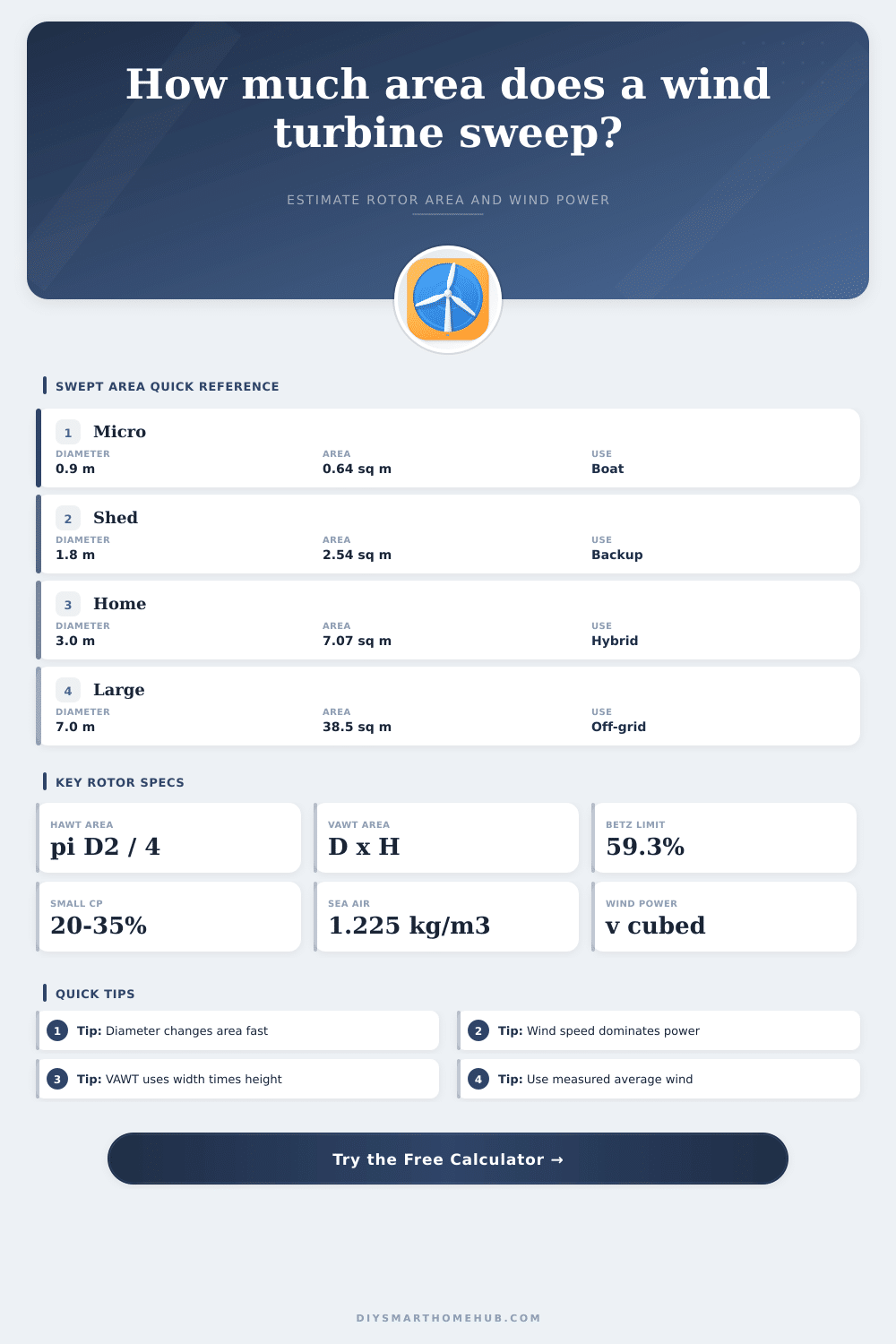
| Marine or RV micro turbine | 0.8 to 1.2 m circular rotor | 0.5 to 1.1 sq m | Battery maintenance and low-power monitoring loads |
| Balcony or roof Savonius | 0.6 m wide x 1.2 m tall | 0.72 sq m | Demonstration, sensors, and small DC loads |
| Shed hybrid turbine | 1.8 m circular rotor | 2.54 sq m | Solar-wind hybrid backup for cameras or gateways |
| Home 1 kW class turbine | 2.4 to 3.0 m circular rotor | 4.5 to 7.1 sq m | Supplemental charging where the site has steady wind |
| Small off-grid property | 5.5 to 7.0 m circular rotor | 23.8 to 38.5 sq m | Meaningful battery charging in open, windy terrain |
🌡Air density adjustment table
| Condition | Density used | Power vs standard air | When to choose it |
|---|---|---|---|
| Cold dense air near sea level | 1.292 kg/m3 | About 105% | Cold coastal or winter sites with dense air |
| Standard sea-level air | 1.225 kg/m3 | 100% | Baseline calculations and manufacturer-style comparisons |
| Warm lowland air | 1.184 kg/m3 | About 97% | Warm climates close to sea level |
| Highland site, 1,000 m | 1.112 kg/m3 | About 91% | Hills and plateaus where air is thinner |
| Mountain site, 2,000 m | 1.007 kg/m3 | About 82% | High elevation where the same rotor captures less power |
✅Swept-area calculation tips
Swept area are a term that describes how much air a wind turbine can reach. Swept area is the primary factor in determining the amount of energy a wind turbine can produce. The more air that pass through the rotor of the wind turbine, the more energy that can be captured.
The geometry of the turbine blade determine the amount of swept area that the turbine can produce. If the swept area that a wind turbine create is large, it means that the wind turbine can reach more air. If the wind turbine can reach more air, then it can produce more energy.
How Swept Area Affects Wind Turbine Power
Horizontal axis wind turbines has a circular swept area, defined by the length of the blades. However, vertical axis wind turbines have a rectangular swept area. For example, Savonius rotors are tall and narrow, so there swept area is rectangular instead of circular.
You can use a calculator to determine the swept area of the rotor by entering the width and heights of the rotor. Wind speed is another critical factor in the production of energy by a wind turbine. The power that the wind delivers is proportional to the cube of the velocity of the wind.
If a site produce wind at twelve miles per hour, it will contain eight times more energy than a site with six miles per hour of the same wind turbine. This measurement must be taken at the hub height of the wind turbine because the speed of the wind at this height is more accurate than the speed at ground level. The density of the air also impact the energy produced by a wind turbine.
Air density change with the temperature and the elevation of the wind turbine. Cold air molecules is heavier than warm air. Therefore, when the wind turbine operate in an environment of high air density, it produces more energy.
Using the calculator, you can select various densities of the air to determine how the energy that the swept area can produce change with changes in elevation or changes in the climate of that area. Small wind turbines has a power coefficient between 20 and 35%. The theoretical limit to the coefficient of performance of a wind turbine is 59%.
The lower coefficient for small wind turbines is due to the fact that the blades of the real turbines lose energy at their tip, and they do not always have the blades set to the perfect angle to the moving air. The central hub, the cage, and the duct of the wind turbine can block the swept area of a wind turbine. Any blocking of the swept area will impact the amount of air that the blades can push against.
Including the percentage of the blockage in the calculator will ensure that the production of the wind turbine isnt under-estimated when calculating the raw power of the wind at the site. Once you have calculated the swept area, you can calculate the raw power and the amount of electricity that will reach the battery. Most people look at the nameplate kilowatts of the name of the wind turbine when they purchase one.
However, the nameplate kilowatts is not a complete measure of the energy output of a wind turbine. Two wind turbines may display the same nameplate kilowatts, but one might have a larger swept area than the other. Therefore, before comparing the two turbines, you should compare the swept area of each of the turbine.
Turbulence impact the energy produced by the wind turbine. In order to ensure maximum energy output from the blades, there should be clear space in front of the rotor. Obstacles like trees, roofs, and buildings will create turbulence in the air around the turbine.
Turbulence will make the air choppier, and thus, will reduce the energy that the turbine can produce. To avoid this issue, people often place the turbines on the tallest available towers to ensure that they are well above these obstacle. Maintenance are essential for keeping a wind turbine functioning properly.
Over time, the blades will vibrate. The build-up of dust, ice, or damage to the blades causes this vibration. These can all impact the balance of the turbine, leading to the vibrations of the turbine.
Vertical axis turbines are more tolerant of turbulence than horizontal axis turbines. However, vertical axis turbines does not have the same efficiency as horizontal axis turbines. Therefore, when purchasing a turbine, you must make a decision between these two categories based off the location of the turbine and the desired amount of energy output from the turbine.
The swept area of the wind turbine is the starting point of all calculations of the energy that it will produce. However, the swept area by itself is not a guarantee of the energy production of the turbine. The swept area by itself will tell you the amount of wind that the machine can reach.
However, it will also help you to calculate the amount of electricity that the machine will produce. However, other factor must also be considered. Once you have calculated the swept area of the wind turbine, you can determine whether or not the wind turbine is appropriate for the area in which you would like to place the turbine.