Wind Turbine Blade Tip Speed Calculator
Estimate blade tip speed, tip speed ratio, target RPM, swept area, blade-pass frequency, and Mach margin for small wind turbine rotors.
📌Real rotor presets
⚙Rotor inputs
Calculation Breakdown
🧮Spec grid
📊Tip speed ratio reference
| Rotor style | Common TSR range | Speed character | Calculator cue |
|---|---|---|---|
| Savonius drag rotor | 0.8 to 1.5 | Slow, high drag | Low TSR is normal for this style. |
| Multi-blade pump rotor | 1 to 3 | High starting torque | RPM can be low while torque is useful. |
| Darrieus vertical axis | 3 to 5 | Moderate lift rotor | Use a midrange target TSR. |
| Three-blade electric HAWT | 6 to 8 | Efficient small turbine range | Actual TSR should sit near the blade design target. |
| Two-blade fast HAWT | 7 to 10 | Fast, noise-sensitive | Check speed cap before raising RPM. |
🌬Tip speed bands
| Tip speed | Approx mph | Mach number | Practical reading |
|---|---|---|---|
| Under 30 m/s | Under 67 mph | Under 0.09 | Quiet, slow, and common for training or pump rotors. |
| 30 to 60 m/s | 67 to 134 mph | 0.09 to 0.17 | Typical small electric turbine operating range. |
| 60 to 80 m/s | 134 to 179 mph | 0.17 to 0.23 | Fast rotor zone where balance and acoustic limits matter. |
| Over 80 m/s | Over 179 mph | Over 0.23 | Use braking, furling, pitch, or lower RPM control. |
⚖Diameter and RPM examples
| Rotor diameter | Rotor RPM | Tip speed | Common fit |
|---|---|---|---|
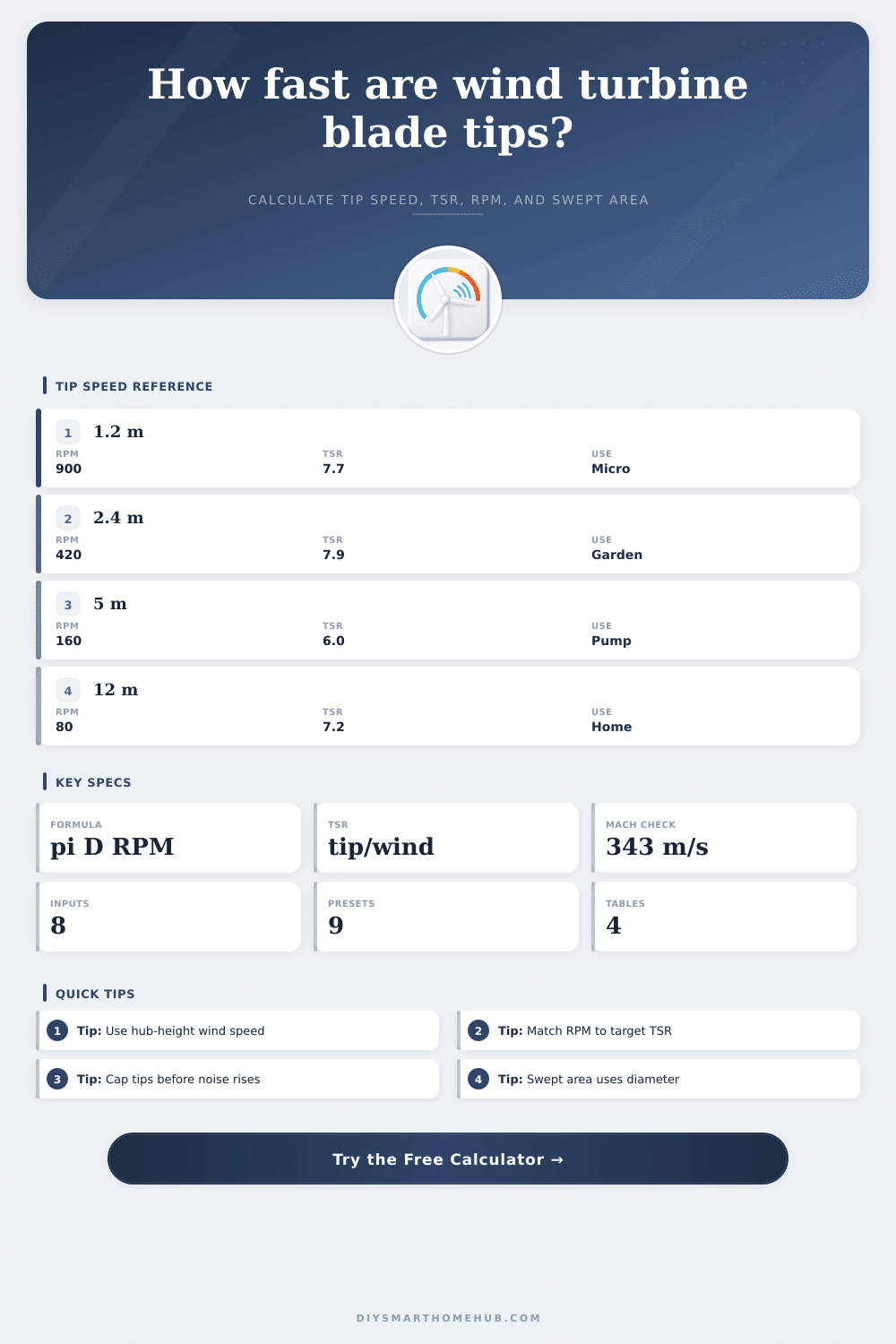
| 1.2 m / 3.9 ft | 900 rpm | 56.5 m/s | Micro test rotor or small roof experiment. |
| 2.4 m / 7.9 ft | 420 rpm | 52.8 m/s | Garden battery turbine or small smart-energy test. |
| 5 m / 16.4 ft | 160 rpm | 41.9 m/s | Water pump rotor or low-speed farm rotor. |
| 8 m / 26.2 ft | 130 rpm | 54.5 m/s | Home tower rotor with active RPM limiting. |
| 12 m / 39.4 ft | 80 rpm | 50.3 m/s | Larger small-wind field turbine. |
🏠Common small-wind scenarios
| Scenario | Input anchor | Primary result | Secondary result |
|---|---|---|---|
| Single-sensor turbine monitor | 1.2 m, 900 rpm | 56.5 m/s tip speed | 3.4 Hz blade pass with 3 blades. |
| Garden battery rotor | 2.4 m, 420 rpm | 52.8 m/s tip speed | 4.4 m2 swept area. |
| Quiet shed power rotor | 3.2 m, 220 rpm | 36.9 m/s tip speed | 8.0 m2 swept area. |
| Water pump rotor | 5 m, 160 rpm | 41.9 m/s tip speed | 32 Hz blade pass with 12 blades. |
| Home tower rotor | 8 m, 130 rpm | 54.5 m/s tip speed | 50.3 m2 swept area. |
✅Calculation tips
A small wind turbine consist of blades that will rotate in the wind. The diameter of the rotor, the rotation rate of the rotor, and the speed of the wind can determine the speed of the blades of a small wind turbine. The speed of the tips of the blades is the most important measurement of the small wind turbine.
If the tip speed is too low relative to the wind speed, the blades wont be able to capture all of the energy from the wind. If the tip speed of the blades is too high relative to the wind speed, the blades will create too much noise and the blades will wear more quick. The relationship between the tip speed of the blades and the wind speed is referred to as the tip speed ratio, or TSR.
How Blade Speed, Rotor Size and Wind Affect Small Wind Turbines
This number is critical in the relationship of a small wind turbine because changing the tip speed ratio will change the efficiencies of the small wind turbine. The diameter of the rotor is one of the first decision a small wind turbine builder must make. The diameter of the rotor will determine the area that the small wind turbine blades will sweep.
A larger diameter will allow the small wind turbine to sweep a larger area. Therefore, increasing the diameter of the rotor will increase the tip speed of the blades. A person that desire to create a quiet small wind turbine may opt for a small diameter.
A person that desires to pump water may opt for a wide rotor that turn at a low number of revolutions per minute (RPM). The RPM of the rotor is not a determined number. The RPM can change due to the use of a controller, a brake, or due to the electrical load created by a battery bank.
A calculator can be used to determine the tip speed that can be created at a given RPM. Additionally, a calculator can also be used to determine the RPM that will achieve a given tip speed ratio. Knowing the RPM can help a small wind turbine builder to determine whether or not the RPM that is required for the desired number of revolutions is realistic based on the wind speeds that will be experienced at the installation site of the small wind turbine.
The wind speed is one of the vital factors in a small wind turbine. The wind speed at the height of the rotor may not be the same as the wind speed that is reported in the weather report for the area. Trees, buildings, and the roughness of the ground can all contribute to a reduction of the wind speed close to the ground.
Raising the tower of a small wind turbine will expose its blades to higher wind speeds. Therefore, the wind speed has to be accurate in the calculations of the tip speed ratio. Many people finds that the actual speed of the wind at the blades is higher than that which they record.
The tip speed ratio is not the same for every small wind turbine that is created. Each type of small wind turbine has a different tip speed ratio. Slow multi-blade farm rotors tend to have tip speed ratios between 1 and 3.
Moddern three-blade electric turbines has tip speed ratios between 6 and 8. Two-blade turbines that are created to reach high speeds have tip speed ratios of 9 or 10. However, if the tip speed ratio is too high, the small wind turbine will create too much noise.
A calculator can help to show the tip speed ratio of a small wind turbine and its components to ensure they is within the typical range for that type of rotor. Noise is one of the major considerations in the building of small wind turbines. The more the tip speed increase, the more noise the small wind turbine creates.
At around 60 meters per second, the whooshing sound that is created by the blades of a small wind turbine increases quickly. At 80 meters per second, the tip speed of the blades is approaching one quarter of the speed of sound. Additionally, any small imperfection in the blade will create noticeable tones.
A calculator can assist the small wind turbine builder in ensuring that the blade and small generator does not reach a speed that would create too much noise for the area in which it will be installed. The swept area of a small wind turbine is another critical measurement. Power is proportional to the swept area of a small wind turbine.
If the diameter of a small wind turbine is doubled, the swept area will not double; rather, it will quadruple. Therefore, the diameter of the rotor has a large effect upon the performance of a small wind turbine. Thus, the diameter is another of the most important decisions of a small wind turbine builder.
A calculator will assist in determining the swept area of a small wind turbine and can help to compare the swept areas of different sizes of small wind turbines. Another measurement of a small wind turbine is the blade-pass frequency. Blade-pass frequency is the number of times that the blades of a small wind turbine pass a fixed point.
For instance, a three-bladed small wind turbine that is spinning at 400 RPM will have the blades pass a fixed point at the small wind turbine over 20 times each second. Such high frequencies can cause small vibrations in the small wind turbine and small windows in the surrounding building. Therefore, the blade-pass frequency can be calculated prior to installing the small wind turbine.
Small small wind turbines can experience various complications in their operation that is beyond the predictions of a small wind turbine calculator. Small wind turbines can experience turbulence from the trees in the area, ice can form upon the blades of the small wind turbine which will alter its balance, and small wind turbine controllers may limit the RPM of the blades. Each of these variables may have an impact upon the lifespan of the small wind turbine.
However, these variables are outside of the calculations that are performed by a small wind turbine calculator. A small wind turbine builder can use a small wind turbine calculator to quickly determine the variables of the small small wind turbine. However, to ensure the small wind turbine will last for a long time, the actual wind speed at the site at which the small wind turbine will be installed should of actually be measured with a tape measure and a notepad.
If both the calculations made by the calculator of the variables of the small small wind turbine are in agreement with the actual measurements of the wind speed at the area for which the small wind turbine will be installed, the small wind turbine will last for a long time and remain quiet during its operation.