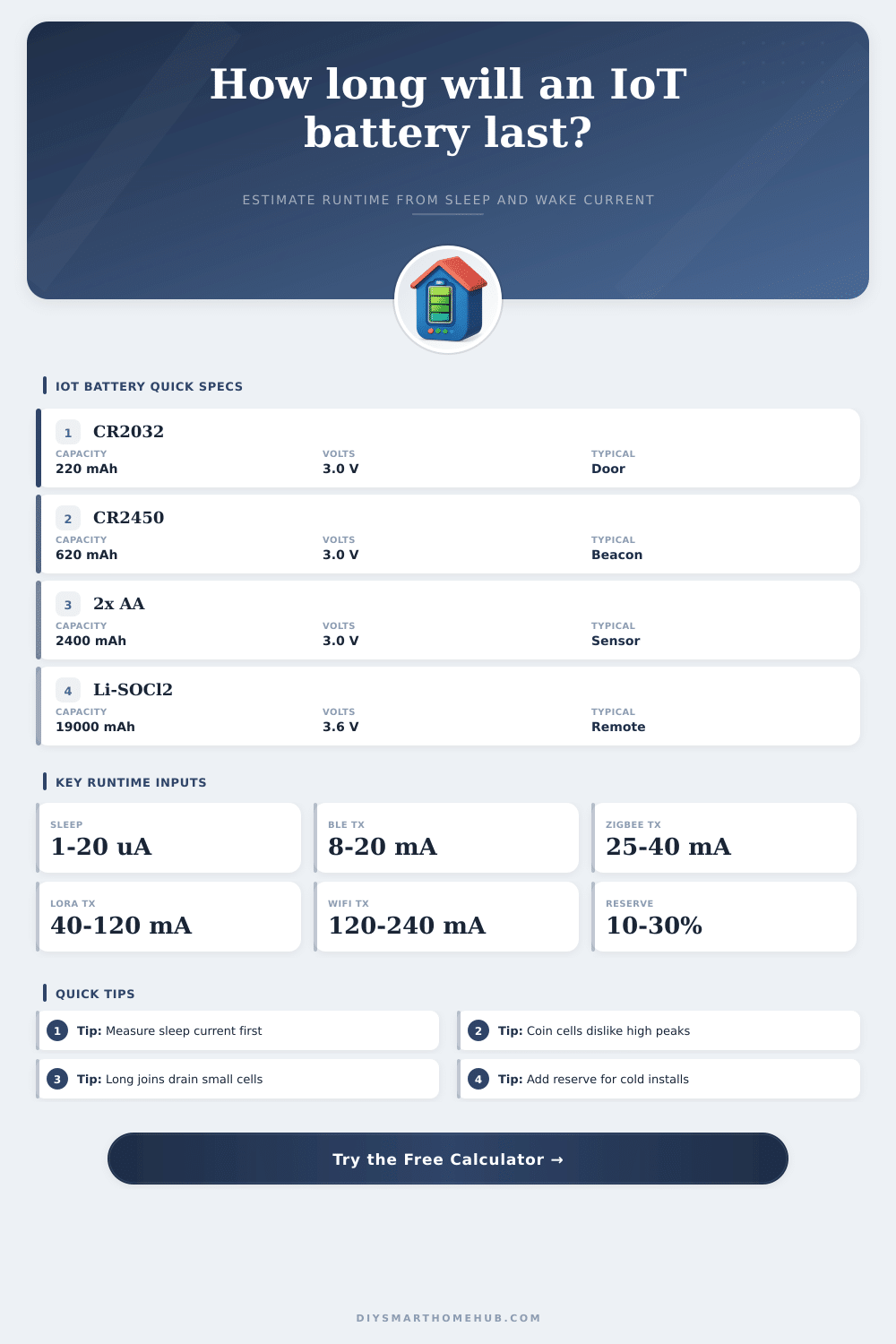
IoT Battery Life Calculator
Estimate coin cell, AA, lithium, and rechargeable sensor runtime from sleep current, wake duration, protocol overhead, usable capacity, reserve, and self-discharge.
| Battery pack | Nominal voltage | Typical capacity | Usable planning factor | Best IoT fit |
|---|---|---|---|---|
| CR2032 coin cell | 3.0 V | 220 mAh | 60% to 75% | Very low pulse door, button, and temp sensors |
| CR2450 coin cell | 3.0 V | 620 mAh | 65% to 80% | Beacon tags and sensors needing more pulse margin |
| 2 x AAA alkaline | 3.0 V | 1000 mAh | 55% to 70% | Indoor sensors with moderate radio bursts |
| 2 x AA alkaline | 3.0 V | 2400 mAh | 55% to 70% | Motion, contact, and environmental sensors |
| 2 x AA lithium primary | 3.0 V | 3000 mAh | 75% to 90% | Cold spaces and higher peak current sensors |
| Single 18650 Li-ion | 3.6 V | 3200 mAh | 75% to 90% | Rechargeable WiFi and ESP32 nodes |
| 500 mAh LiPo pouch | 3.7 V | 500 mAh | 75% to 88% | Small rechargeable trackers and prototypes |
| D-cell Li-SOCl2 | 3.6 V | 19000 mAh | 80% to 92% | Remote LoRaWAN, meter, and field sensors |
| Radio profile | Typical active current | Added wake overhead | Protocol tax | Common use |
|---|---|---|---|---|
| Bluetooth LE beacon | 8 to 20 mA | 10 ms | 3% | Advertisements, tags, simple sensors |
| Zigbee / 802.15.4 | 25 to 40 mA | 35 ms | 6% | Door, motion, leak, and room sensors |
| Thread / Matter sensor | 18 to 35 mA | 45 ms | 8% | IPv6 sensor reporting with sleepy end devices |
| Z-Wave sensor | 25 to 45 mA | 55 ms | 7% | Contact sensors, locks, and motion devices |
| LoRaWAN uplink | 40 to 120 mA | 120 ms | 12% | Long-range outdoor and utility nodes |
| WiFi wake and publish | 120 to 240 mA | 900 ms | 18% | Leak, camera-adjacent, and ESP devices |
| LTE-M burst | 180 to 350 mA | 3000 ms | 25% | Mobile trackers and remote metering |
| NB-IoT burst | 200 to 500 mA | 5000 ms | 30% | Low-frequency cellular field telemetry |
| Preset | Battery | Wake pattern | Main current | Planning note |
|---|---|---|---|---|
| Zigbee door sensor | CR2032 | Every 15 min | 30 mA for 90 ms | Sleep current decides multi-year runtime |
| Thread temp sensor | 2 x AAA | Every 10 min | 24 mA for 150 ms | Good match for sleepy end devices |
| BLE beacon tag | CR2450 | Every 0.17 min | 12 mA for 8 ms | Frequent short wakes are still efficient |
| LoRaWAN soil node | Li-SOCl2 D | Every 60 min | 85 mA for 900 ms | Large primary lithium supports long field life |
| WiFi leak sensor | 2 x AA lithium | Every 360 min | 180 mA for 2200 ms | Rare wakes help offset high WiFi current |
| NB-IoT tracker | 18650 Li-ion | Every 720 min | 320 mA for 6000 ms | Attach time often dominates the math |
| Wake interval | Cycles per day | Duty-cycle effect | Best suited for |
|---|---|---|---|
| 10 seconds | 8,640 | Sleep current matters less than wake current | BLE beaconing and presence tags |
| 1 minute | 1,440 | Short radio overhead becomes visible | Responsive room sensors |
| 5 minutes | 288 | Balanced reporting for many home sensors | Temperature, humidity, leak heartbeat |
| 15 minutes | 96 | Sleep current usually dominates | Door checks and slow environmental data |
| 1 hour | 24 | Great for long-life remote nodes | Soil, utility, and freezer sensors |
| 12 hours | 2 | Self-discharge can become important | Trackers, meters, and sparse telemetry |
To design battery-powered sensors for the Internet of Things, you must always consider that the battery will eventually runs out of energy. Consequently, you must determine how long the battery will last before it runs out of an energy. Based off that calculation, you must determine how to change the design of the sensors to ensure that the battery life matches the intended life of the product.
The majority of the energy loss from a battery-powered sensor occur in the sleep state of the sensor. Even when the sensor’s microcontroller is sleeping, there are still small amounts of currents that are drawn from the battery to supply power to the regulator and sensor circuits. The longer that the sensor is in this sleep mode, the more these small amount of current drain the battery.
How to Make IoT Sensor Batteries Last Longer
Consequently, it is essential to consider the sleep current of the sensor; increasing the sleep current from two microamp to eight microamps will cut the runtime of a coin cell battery in half. These considerations of sleep current often overshadow consideration of the transmit power of the sensor, as the transmit power draw the most current off the battery when measured on an oscilloscope, but the background current is what draws current continuous while the sensor is sleeping. The behavior of the sensor while it is active can also impact the life of the battery.
For instance, when the radio is initially turned on, it may remain in an active state for longer than the initial amount of time that it was measured as active. The additional time required to complete protocol handshakes add to the active time of each report that the sensor sends. Consequently, if a sensor wakes more frequently, it will drain the battery at a fasterer rate then a sensor that wakes less often.
The chemistry of the battery can also dictate the behavior of the battery. For instance, alkaline cells lose there capacity quickly if they are asked to provide short burst of high power. In comparison, primary lithium cells can handle those short bursts of high power and maintain their capacity even if the temperature of the battery change.
In calculating the battery life, it is essential to include a percentage of the batterys capacity as a reserve. This reserve percentage accounts for the temperature of the battery, how quickly the battery age, and that the last 10 percent of the battery is often unusable. If you dont account for these percentages, the sensor will last less time than calculated.
Another factor that can impact battery life is the protocol that is used to communicate with the sensors. For instance, Bluetooth beacon technologies are quick in performing their tasks and draw little current from the battery. Cellular and Wi-Fi technology, however, remain active for hundreds of milliseconds and draw mucher current from the battery.
Consequently, protocols like Bluetooth and Zigbee will last the sensor battery much longer then protocols like Wi-Fi. For instance, a door sensor that utilizes Zigbee technology may last for years with a CR22032 battery, but if that same sensor used Wi-Fi technology, it may only last for the months. One additional factor that can impact battery life is the phenomenon of self-discharge.
Self-discharge occur even when the sensor is not being used. For primary lithium battery cells, the self-discharge rate is low. For rechargeable battery packs, however, if they are often stored at high temperatures, the self-discharge rate is high.
Self-discharge should of been considered in the calculations for battery life. Finally, there are additional variables in the real world that may impact the life of the sensors battery. For instance, if a door made of metal is used in the sensor system, it will decrease the efficiency of the antenna.
The antenna may have to work harder to transmit the signals to the receiving devices, thus drawing more current. The batteries can also experience temperature swings that alter the chemistry of the battery and the sleep current of the sensor. Additionally, when the sensor experiences firmware updates or network rejoins, it will use a considerable amount of the sensor’s battery in a short span of time.
These additional variables should be considered in the calculation of battery life. The workflow that you should use to design battery-powered sensors for the Internet of Things will require measuring the sleep current of the sensor once it is built. In addition to measuring the sleep current of the sensor, it is also essential to use a radio profile that matches the sensor that will be used with the sensor.
A battery pack should also be purchased that has a higher pulse rating than the current draw of the sensor. Finally, you should adjust the interval at which the sensor will report to the network until the battery life calculation meet the requirements for the sensor. Each of these variable can impact the battery life of the sensor; consequently, they must be adjusted prior to shipping the sensor in prototype form.
The intention of these calculations is to arrive at a battery life estimate that is defendable to customers and the manufacturing team.