Solar Cable Length Calculator
Estimate solar PV cable voltage drop, maximum one-way run, array current, cable loss, and the smallest listed wire size that stays within your selected drop target.
| Cable Size | Copper Ohms / 1000 ft | Ohms / km | Typical PV Use |
|---|---|---|---|
| 14 AWG | 2.525 | 8.284 | Short portable panel leads |
| 12 AWG | 1.588 | 5.210 | Small RV and shed strings |
| 10 AWG | 0.999 | 3.277 | Common module homerun cable |
| 8 AWG | 0.6282 | 2.061 | Longer low-voltage PV runs |
| 6 AWG | 0.3951 | 1.296 | Combiner to controller feeder |
| 4 AWG | 0.2485 | 0.815 | High-current array feeder |
| 2 AWG | 0.1563 | 0.513 | Long ground-mount feeder |
| 1/0 AWG | 0.0983 | 0.322 | Large low-voltage solar trunk |
| 2/0 AWG | 0.0779 | 0.256 | Very long high-current feeder |
| Solar Segment | Common Target | Why It Matters | Calculator Input |
|---|---|---|---|
| Panel pigtail extension | 1% to 3% | Small arrays have little voltage margin | Use actual one-way lead length |
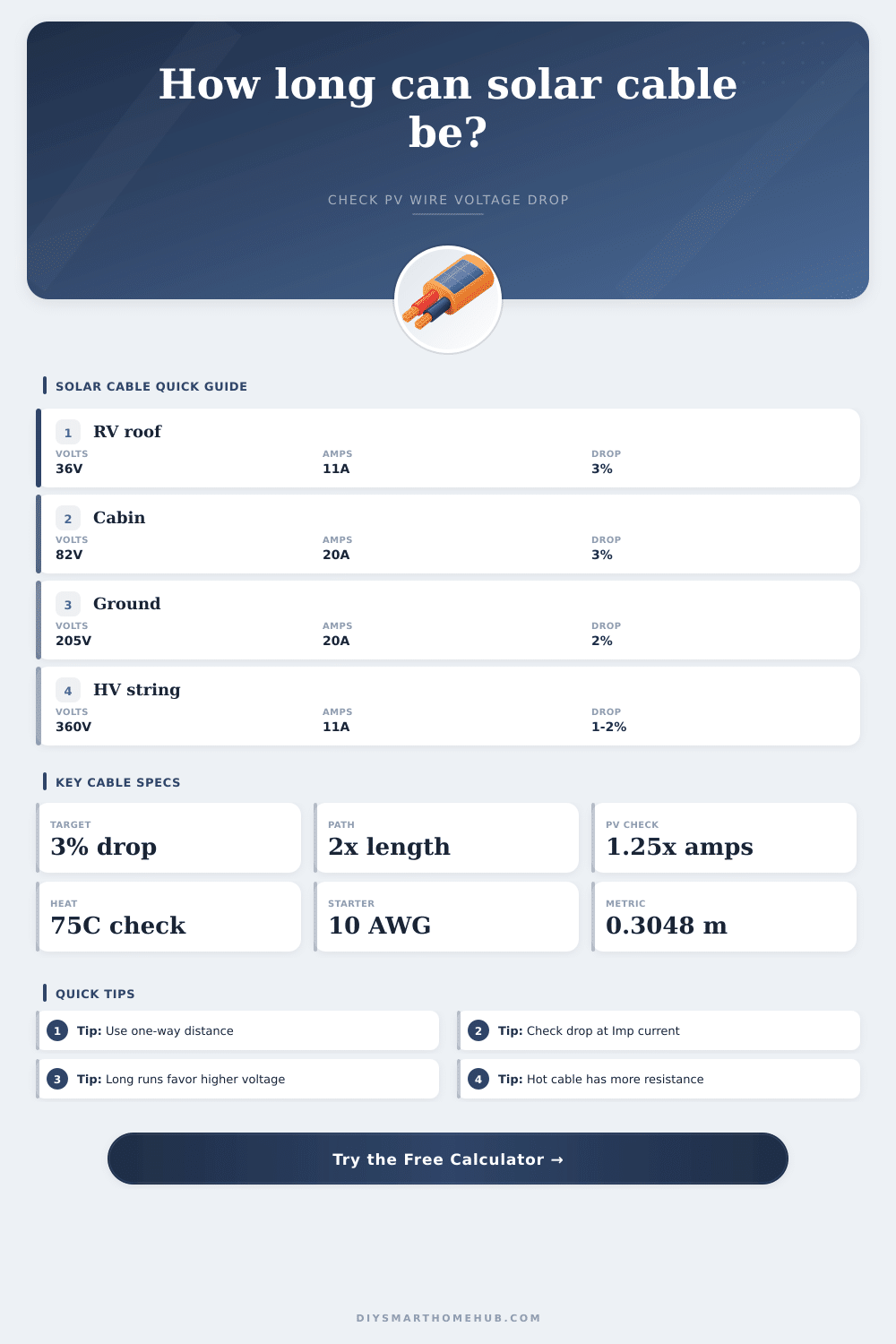
| RV roof to controller | 2% to 3% | Short DC systems often run higher current | Enter combined array current |
| Shed or cabin homerun | 2% to 3% | Long distance can erase PV harvest | Use hot-cable temperature profile |
| Ground-mount PV feeder | 1% to 2% | Distance is usually the dominant loss | Try higher string voltage presets |
| Controller to battery | 1% to 2% | Low voltage and high current multiply drop | Use battery-side voltage and amps |
| Project Scenario | Example Array | Typical Cable Start | Length Check Priority |
|---|---|---|---|
| Portable 100W kit | 18V, 5.6A, 20 ft | 12 AWG | Low voltage makes drop visible fast |
| RV roof pair | 36V, 5.6A, 28 ft | 10 AWG | Roof routing adds hidden distance |
| Cabin 2S2P array | 82V, 20A, 55 ft | 8 AWG | Parallel strings raise feeder current |
| Ground-mount 2kW | 205V, 20A, 120 ft | 6 AWG | Long trench runs need loss checks |
| Hybrid inverter string | 360V, 11A, 100 ft | 10 AWG | Higher voltage helps keep loss low |
| Cable Profile | Resistance Basis | Approx Factor | Calculation Note |
|---|---|---|---|
| Copper at 30°C | 20°C AWG table | 1.04x | Mild cable temperature check |
| Copper at 50°C | 20°C AWG table | 1.12x | Warm rooftop or conduit estimate |
| Copper at 75°C | 20°C AWG table | 1.22x | Conservative hot conductor check |
| Tinned copper at 75°C | Copper plus tinning allowance | 1.24x | Common marine and outdoor PV leads |
| Aluminum feeder at 75°C | Higher base resistivity | 2.00x | Use larger conductors for same drop |
When you size the solar cables, you must consider how much power is traveling through the solar cable before heat in the solar cable absorbs the power. A solar cable are not just a connection between the solar components. It is also a part of the performance of the photovoltaic system.
If the solar cable run is long and there is a high current in the circuit, there will be a voltage drop in the solar cable due to the length of the conductor. The voltage drop will also result in the solar system output being reduce. Additionally, the solar cable will run warmer due to the voltage drop.
How to Size Solar Cables
You must understand the electrical inputs of the solar system to correctly size the solar cable. The voltage of the solar system indicates the electrical pressure that will push the current through the solar cable. The current is the amount of flow of the voltage through the solar cable.
Adding more strings in parallel will increase the current while the voltage of the system remain the same. Therefore, a higher current will require a solar cable with higher ampacity. You must also consider the distance the electricity has to travel.
The electrical current travels out on one conductor and returns on another conductor. So the distance is doubled. Additionally, the resistance of the solar cable also has to be considered.
The higher the temperature of the copper in the solar cable, the more higher the resistance. Therefore, the solar cable will lose more voltage if it is in the sun than if it is in the shade. You can use reference tables to determine how the size of the solar cable will affect the resistance in the solar cable.
A calculator can be used to calculate the voltage drop in the solar cable with the inputs of the voltage of the solar array, the current of the solar array, and the length of the solar cable run. The calculator will tell you if the solar cable size will result in the voltage drop within the target limit, and it will also tell you if a larger solar cable conductor are needed. Many solar installers use a three percent voltage drop target as the target voltage drop for the solar system.
The three percent target is a balance between the cost of the solar cable and the performance of the solar system. A tighter voltage drop limit can be used if the voltage is low or if the solar cable is in a conduit. A looser voltage drop limit can be used if the solar cable run is short or if the voltage of the solar array is high.
A high voltage solar array will allow the same wattage of power to use less current in the solar cable run. A common error of solar installers is to size the solar cable for the solar panels but then to assume that that sized solar cable will be sufficient for the solar system run. It is true that small solar cable sizes work well for the solar panels.
However, using a small sized solar cable will result in a high voltage drop if the distance that the current travels in the solar cable is long. Additionally, the electrical code requires that solar conductors carry 125 percent of the continuous current in the solar system. The calculator will show the operating current and the design current of the solar system.
The design current is the current that will be used to size the solar cable run. There may be bends in the conduit or the solar array solar cable may have to follow the peak of the roof. These features will add to the distance of the solar cable.
Additionally, trees or buildings may shade the solar strings. These shaded areas may also change the string layout that is used to connect the solar panels to the solar inverter. Increasing the string voltage will allow the solar cable to be used over a longer distance.
Since power is the result of voltage and current being multiplied, increasing the voltage will allow the same wattage of power to travel through the solar cable with less current. Less current will result in less voltage drop in the solar cable run. However, higher voltages require that you check the insulation ratings and the solar cable cold temperature limits for each solar array connection.
Often, installers use aluminum conductors for the solar feeders over long distances to solar arrays since aluminum conductors are cheaper than copper. However, aluminum has higher resistivity than copper. Therefore, a larger diameter solar cable made of aluminum will be required to have the same performance as a copper solar cable.
Tinned copper also has a small performance loss with solar arrays, but it resists corrosion so is useful in areas with high humidity or coastal areas. Once you have all of the data for the solar array, you must determine if the larger solar cable will fit in the existing conduit. Additionally, you must determine if the cost of the larger solar cable is worth the increase in the energy that the solar array can produce.
For residential solar systems, the cost of the larger solar cable may be insignificant. For commercial solar systems, however, the cost of the solar cable can be significant. The goal is to have a small voltage drop in the solar cable; however, it is not the goal that the solar cable will have a zero voltage drop.
The voltage drop must be small enough so that the array performs as it should, but the solar cable should not be too expensive to purchase and install.