Inverter AC Power Consumption Calculator
Estimate inverter air conditioner running watts, daily kWh, monthly kWh, current draw, and standby energy from real capacity and efficiency inputs.
Estimated Power and Energy Use
| Rated Size | Cooling Output | Typical Min Input | Typical Rated Input | Typical Max Input |
|---|---|---|---|---|
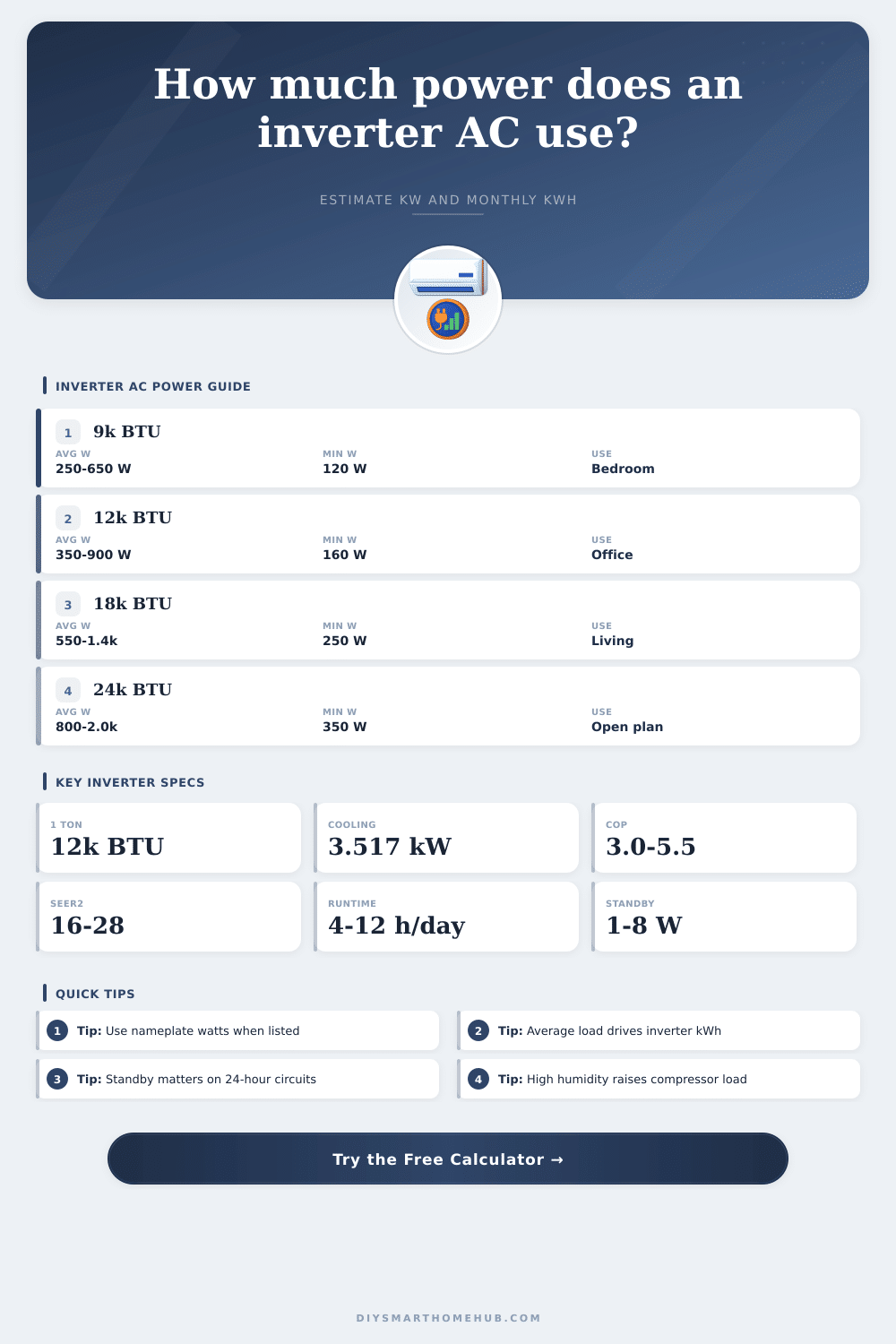
| 6,000 BTU/h mini split | 1.76 kW cooling | 90 to 140 W | 350 to 550 W | 600 to 800 W |
| 9,000 BTU/h inverter | 2.64 kW cooling | 120 to 220 W | 500 to 750 W | 850 to 1,100 W |
| 12,000 BTU/h inverter | 3.52 kW cooling | 150 to 300 W | 700 to 1,050 W | 1,100 to 1,500 W |
| 18,000 BTU/h inverter | 5.28 kW cooling | 230 to 450 W | 1,100 to 1,650 W | 1,800 to 2,400 W |
| 24,000 BTU/h inverter | 7.03 kW cooling | 320 to 650 W | 1,500 to 2,300 W | 2,500 to 3,200 W |
| Rating Type | What It Means | Power Formula Used | Best Use |
|---|---|---|---|
| EER | BTU/h per input watt at a fixed test point | Watts = BTU/h / EER | Full-load estimates |
| SEER | Seasonal BTU per watt-hour over a test season | Watts = BTU/h / SEER | Average season checks |
| SEER2 | Updated seasonal rating with higher external static pressure | Watts = BTU/h / SEER2 | Current US listings |
| COP | Cooling kW divided by electrical input kW | Watts = cooling kW / COP x 1000 | Metric spec sheets |
| Nameplate watts | Manufacturer listed electrical input | Use watts directly | Most direct estimate |
| Operating Pattern | Average Load | Powered Hours | Expected Behavior |
|---|---|---|---|
| Mild night bedroom | 25% to 45% | 6 to 10 h/day | Long low-speed operation after pull-down |
| Sunny afternoon room | 55% to 85% | 4 to 8 h/day | Higher compressor speed during peak heat |
| Server or equipment room | 60% to 95% | 12 to 24 h/day | Steady sensible heat load |
| Dry mode | 20% to 55% | 2 to 8 h/day | Lower sensible load with fan cycling |
| Oversized zone | 15% to 35% | Short or modulated | May run near minimum input watts |
| Scenario | Typical Size | Assumed Load | Daily Energy Range | Monthly Range |
|---|---|---|---|---|
| Small bedroom overnight | 9k BTU/h | 35% to 50% | 1.6 to 3.0 kWh | 48 to 90 kWh |
| Office during workday | 12k BTU/h | 35% to 60% | 2.0 to 4.8 kWh | 60 to 144 kWh |
| Living room evening | 18k BTU/h | 45% to 70% | 3.0 to 6.5 kWh | 90 to 195 kWh |
| Open-plan cooling | 24k BTU/h | 50% to 75% | 5.0 to 10.5 kWh | 150 to 315 kWh |
| Equipment room | 18k BTU/h | 70% to 95% | 15 to 35 kWh | 450 to 1050 kWh |
Air conditioners use compressors to cool the room. The way the air conditioner use a compressor have a direct effect on the electricity that the air conditioner will consume. Older air conditioning units use what is known as a fixed-speed compressor.
With this type of compressor, the compressor either runs at 100% power or it sit off completely. Because a fixed-speed compressor cannot fine-tune its operation to match the cooling needs of the room, these types of air conditioner tends to use more electricity then an air conditioner that uses an inverter compressor. Inverter air conditioners can change the speed at which the compressor runs.
How Air Conditioners Use Electricity
Because the compressor dont need to work as hard to maintain the temperature of the room, the inverter air conditioner uses less electricity then a fixed-speed air conditioner. Calculating the amount of electricity that an inverter air conditioner will use is more difficult than for a conventional air conditioner. The electricity that an inverter air conditioner use fits on a sliding scale, depending upon the work that the air conditioner must complete.
Many inverter air conditioners displays the maximum wattage that the unit will use. However, the air conditioner will not typically be operating at that maximum wattage. The unit will use the maximum wattage initially when the unit need to cool the air conditioner rapidly, or if the outdoor temperature is hot.
Air conditioner efficiency can be represented in a variety of ways. One of these ways is through the use of the SEER2 rating. The SEER2 represent the average efficiency of the air conditioner over a season.
Similarly, if you measured the fuel economy of a car over an extended time period, you would get a similar average. However, this figure do not represent the efficiency of the air conditioner during a specific hour when it is cooling a hot room. The EER rating represent the efficiency of the air conditioner during those specific periods of maximum needed cooling.
To determine the number of kilowatt-hours that each air conditioner will use, you can use the built-in calculator of an air conditioner. One figure for air conditioners is the compressor load. This represents the amount of effort that the air conditioner must use to cool the room.
If the room has good insulation, the load will be low. If the room have many windows or does not have good insulation to retain the cool air within the room, the load will be higher. The higher the humidity within the room, the higher the load of the air conditioner.
Air conditioners also use a small amount of electricity even when the compressor is off. For instance, sensors within the air conditioner use this standby power, and it is used 24 hour a day. This standby power should of also be factored into the calculation of how much electricity the air conditioner will use.
Another factor that influences the efficiency of air conditioners is the size of the air conditioner relative to the size of the room that it is cooling. If you buy an air conditioner that is too large for the room, that unit will not efficiently cool the space. If the air conditioner is too large for the room, the air conditioner will cycle on and off very rapid.
This short-cycling prevent the air conditioner from drawing moisture out of the rooms atmosphere. Inverter air conditioners are better suited to cooling large areas than are fixed-speed air conditioners. The efficiency of an inverter air conditioner also depends upon the environment in which the air conditioner is used.
For instance, if the environment in which the air conditioner is used has poor insulation, it will work at higher power settings than if it were within an insulated environment. In these case, the efficiency of the inverter air conditioner will be lower. If you know the total number of kilowatt-hours that an air conditioner will use during a period of time, you can make decisions about your home.
For instance, you could change the thermostat setting within your home, or you could improve the insulation of the window within your home. If you know the number of kilowatt-hours that your air conditioner will use during a period of time, you can understand why your electricity bill is of the amount that it is.