Home Heating Energy Calculator
Estimate peak heating load, delivered heat, input energy, fuel quantity, and carbon output from room size, design temperature, envelope quality, and heating system efficiency.
🏠Real Home Presets
⚙Heating Inputs
📊Heating Spec Grid
📐Reference Tables
| Envelope Level | Reference Load | Metric Equivalent | Use When |
|---|---|---|---|
| Passive / very tight shell | 10 BTU/hr per ft² | 31.5 W/m² | High insulation, low leakage, excellent windows |
| Modern tight home | 18 BTU/hr per ft² | 56.8 W/m² | Newer code-built home with good air sealing |
| Average insulated home | 28 BTU/hr per ft² | 88.3 W/m² | Typical insulated home with mixed window quality |
| Older leaky home | 40 BTU/hr per ft² | 126 W/m² | Older shell, drafts, or partial insulation |
| Poor insulation / high leakage | 55 BTU/hr per ft² | 173 W/m² | Unsealed envelope, weak insulation, many leaks |
| Heating System | Useful Efficiency Input | Energy Unit | Heat Content Basis |
|---|---|---|---|
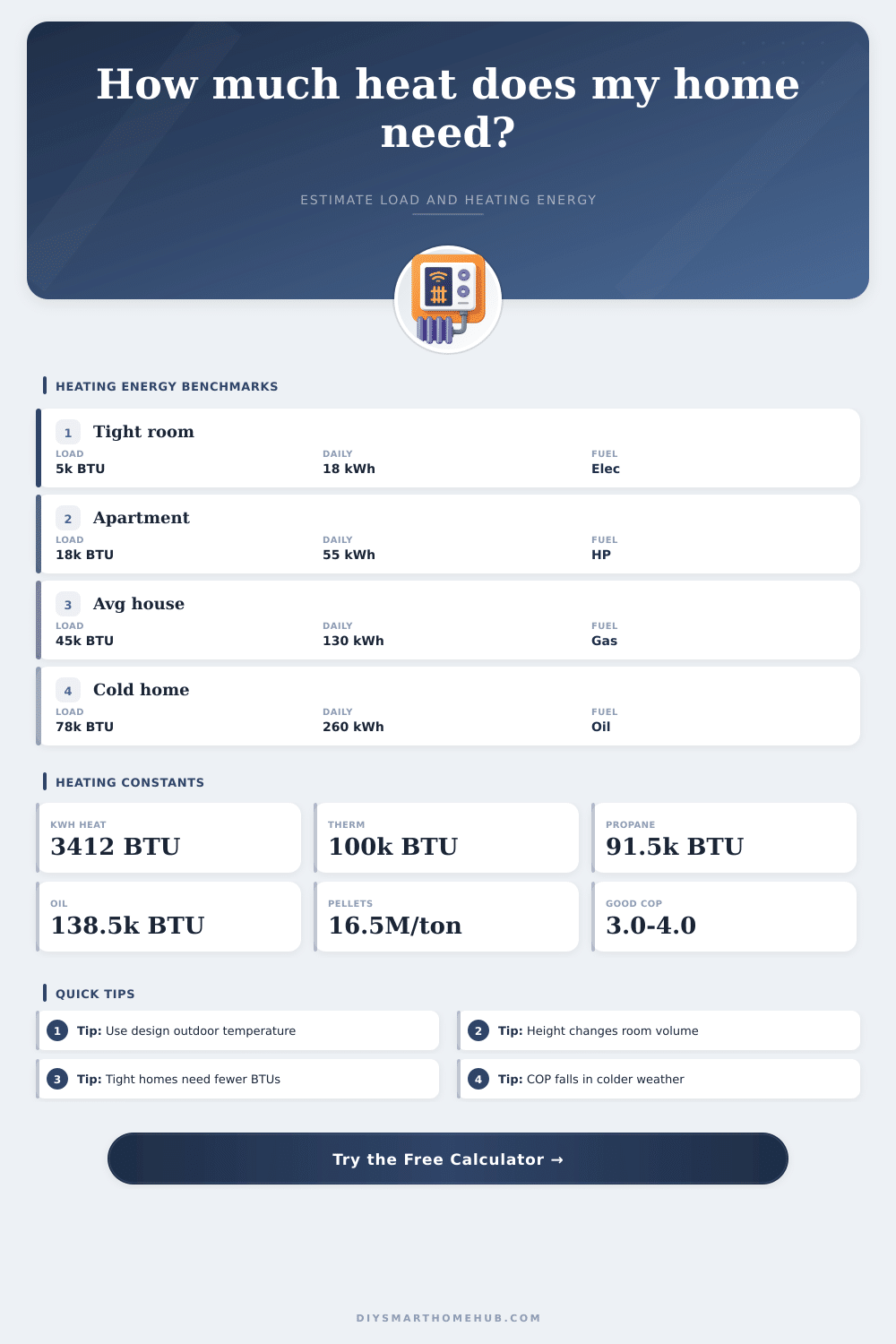
| Electric resistance | 1.00 efficiency | kWh | 3412 BTU per kWh |
| Air-source heat pump | COP 2.0–3.5 | kWh | Delivered heat equals kWh input times COP |
| Cold-climate mini split | COP 2.5–4.0 | kWh | Higher seasonal COP in zoned spaces |
| Natural gas furnace | 80–98 percent | therms | 100,000 BTU per therm |
| Propane furnace | 80–96 percent | gallons | 91,500 BTU per gallon |
| Heating oil system | 78–90 percent | gallons | 138,500 BTU per gallon |
| Wood pellet stove | 70–83 percent | 40 lb bags | About 16.5 million BTU per ton |
| Cordwood stove | 60–78 percent | cords | About 20 million BTU per cord |
| Project Size | Typical Area | Peak Load Range | Best Reading From Calculator |
|---|---|---|---|
| Single bedroom zone | 120–220 ft² / 11–20 m² | 2,000–8,000 BTU/hr | Useful for small electric or mini-split zoning |
| Apartment | 600–1,000 ft² / 56–93 m² | 12,000–32,000 BTU/hr | Compare daily kWh or therm demand |
| Open plan main floor | 500–900 ft² / 46–84 m² | 12,000–36,000 BTU/hr | Watch ceiling height and window exposure |
| Whole house | 1,500–2,500 ft² / 139–232 m² | 35,000–95,000 BTU/hr | Use peak load plus monthly energy together |
| Fuel or Energy | CO2e Factor Used | Calculator Unit | Interpretation |
|---|---|---|---|
| Grid electricity | 0.386 kg per kWh | kWh input | Approximate United States grid average |
| Natural gas | 5.3 kg per therm | therms | Direct fuel combustion estimate |
| Propane | 5.75 kg per gallon | gallons | Direct fuel combustion estimate |
| Heating oil | 10.16 kg per gallon | gallons | Direct fuel combustion estimate |
| Pellets or cordwood | biogenic shown as 0 | bags or cords | Combustion carbon varies by accounting method |
💡Calculation Tips
To understand how to heat a homes, one must understand how heat moves and how heating systems works to replace heat. A home function as a container for heat, but also allows that heat to escape through the wall, windows, and doors of the home. The heating system must be able to add heat to the home at a rate that exceed the rate at which heat can escape through the home envelope.
If the home lose heat at a fasterer rate than the heating system can add heat to the home, the temperature within the home will decrease. To determine how many heat a heating system must be able to provide to a home, the heating system must be sized to handle the peak heat load within the home. The peak heat load is the amount of heat that the heating system must provide during the coldest temperatures within a climate.
How Heat Leaves a Home and How Heating Works
The average temperatures within a region is typically not used to determine the heat load of a home’s heating system. Instead, the design temperature of the outside climate are utilized. The design temperature is the temperature of the coldest day within the climate that the heating system should of be design to handle.
If the heating system were sized to handle mild weather within a climate region, it may not be able to maintain the desired indoor temperature during colder weather. The physical shell of the home, often referred to as an home envelope, helps to determine the amount of heat that can escape out of the home. A high quality home envelope will reduce the amount of heat that can escape out of the home, and thereby, reduce the amount of work that the heating system must perform.
A poor quality envelope, however, allow for heat to easily escape the home. If the home envelope is of poor quality, the heating system will require more fuel or more electricity to maintain a constant temperature within the home. Thus, the quality of the home envelope can impact the heating requirement of a home.
The height of the ceilings within a home can also impact the heat load within the home. Heat naturaly rise within a volume of air. In homes with high ceilings, heat rises to those high ceilings.
High ceilings increase the amount of air within the rooms of the home. More air within a room increase the amount of energy that is required to heat those rooms. High ceilings also increase the surface area of the walls within the rooms.
The more area of the walls that are exposed to the outside of the home, the more heat can leave the home. Thus, high ceilings can increase the heat load within a home. After determining the heat load within a home, various methods of replacing that lost heat can be considered.
One method is the use of electric resistance heat. In electric resistance heat, electricity are converted to heat. This method of heating is often expensive due to the one-to-one efficiency of the electricity to heat conversion.
Another method of heating is the use of heat pump. Heat pumps move heat from outside of the home into the home using relatively small amount of electricity. Heat pumps are often measured by their coefficient of performance (COP).
A COP of 3.0 indicate that the heat pump can move three units of heat for every unit of electricity that it use. Thus, heat pumps with higher COP values are more efficient than electric heater. Combustion systems, such as natural gas, propane, and heating oil burn that fuel within the heating system to create heat within the home.
However, energy from the fuel can leave the combustion system through the chimney or exhaust system of the home. Combustion heating systems are measured by their annual fuel utilization efficiency (AFUE). For example, an AFUE of 95% indicates that the heating system uses 95% of the fuel that is burned in the system to heat the home; 5% of the fuel’s energy escape the system through the exhaust system.
Combustion heating systems with a high AFUE have lower operating cost than those with a low AFUE. Costs of heating systems include both the initial costs of purchasing the system and the operational costs of the system. For example, a high efficiency heat pump will have a higher initial cost than a heat pump with lower efficiency, but will have lower operating costs each month.
The same is true of systems like a wood pellet stove, which may have low operating costs but require a significant amount of manual labor and storage space for the fuel. Thus, managing a homes heating system is a process of managing the energy that enter the home from outside and ensuring that the heat that is added to the home is equal to the heat that leave the home.