Electricity Bill Calculator
Estimate a monthly electric bill from billed kWh, flat or tiered energy rates, time-of-use periods, delivery charges, fixed fees, taxes, and bill adjustments.
Electricity Bill Results
| Rate or region reference | Typical cents/kWh | What it includes | Use in calculator |
|---|---|---|---|
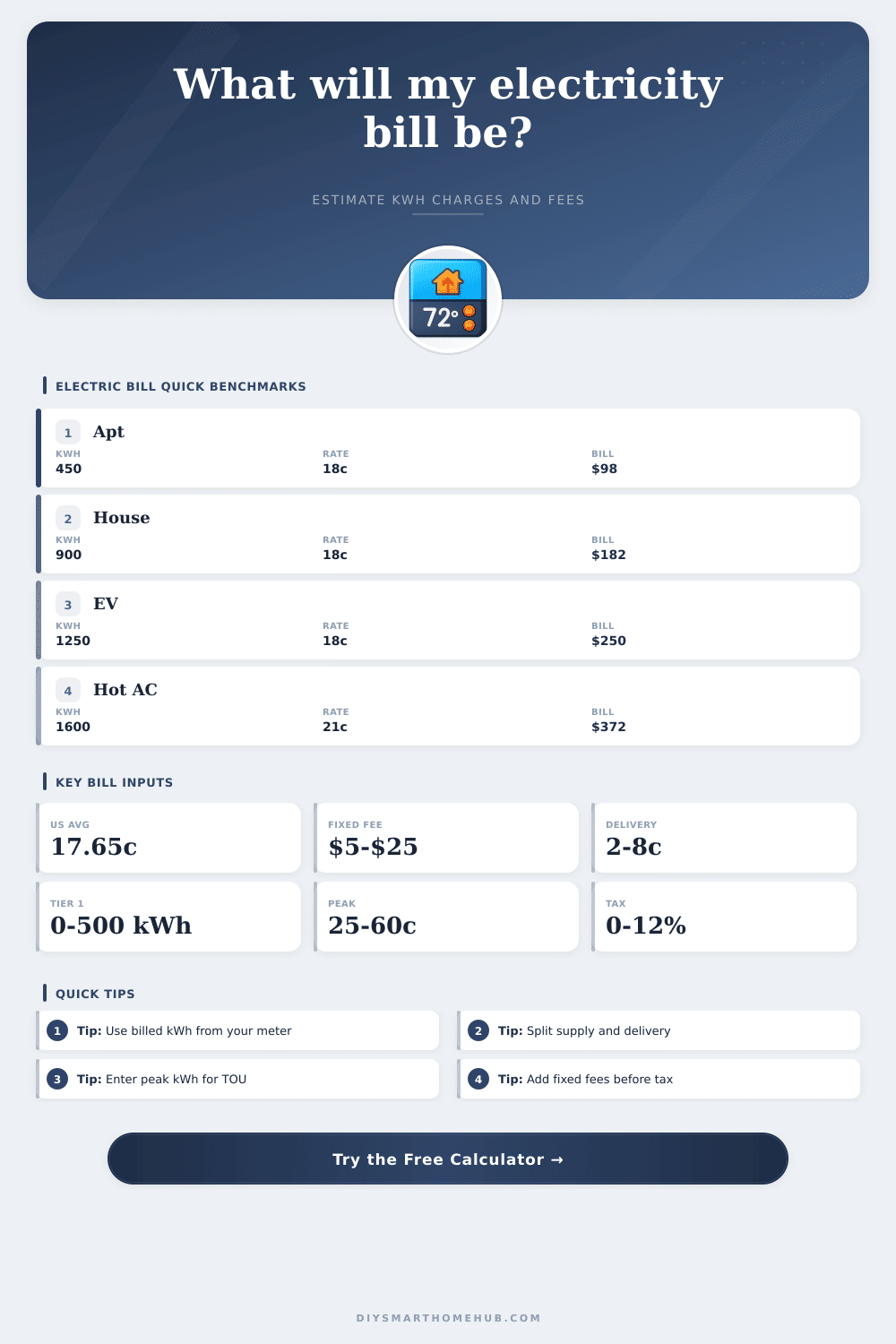
| Recent U.S. residential average | 17.65 cents/kWh | Average revenue per kWh, February 2026 EIA data | Good starting flat-rate estimate |
| Lower-rate regions | 10 to 14 cents/kWh | Often generation plus basic distribution in low-cost states | Enter as flat rate if the bill is simple |
| Typical residential range | 15 to 23 cents/kWh | Most all-in usage charges before fixed monthly fees | Use flat or tiered mode |
| High-rate coastal or island areas | 25 to 45+ cents/kWh | Higher supply, delivery, fuel, or policy riders | Separate supply and delivery if shown |
| TOU off-peak period | 8 to 18 cents/kWh | Overnight or low-demand hours | Enter off-peak kWh and rate |
| TOU peak period | 25 to 60+ cents/kWh | High-demand afternoon or evening hours | Enter peak kWh separately |
| Bill line item | Common unit | Typical range | Calculator input |
|---|---|---|---|
| Energy supply or generation | cents per kWh | 6 to 25 cents/kWh | Flat, tier, or TOU energy rate |
| Transmission and distribution | cents per kWh | 2 to 8 cents/kWh | Delivery and rider rate |
| Basic customer charge | dollars per month | $5 to $25 per month | Monthly fixed customer charge |
| Fuel, rider, or balancing adjustment | cents/kWh or dollars | Varies by tariff | Delivery rate or adjustment field |
| Municipal tax or franchise fee | percentage | 0% to 12% | Tax and franchise percentage |
| Bill credit or solar export credit | dollars | Negative line item | Credits or extra adjustments |
| TOU period | Common hours | Rate behavior | Calculation note |
|---|---|---|---|
| Super off-peak | Late night | Lowest cents/kWh | Often best for EV charging and water heating |
| Off-peak | Night and weekend | Low to moderate | Enter as off-peak kWh |
| Mid-peak or shoulder | Morning or evening | Middle rate | Enter as mid-peak kWh |
| Peak | Afternoon or early evening | Highest rate | Enter peak kWh carefully |
| Critical peak | Event hours | Very high temporary rate | Add as adjustment if your plan uses event billing |
| Scenario | Monthly kWh | Likely bill driver | Best rate mode |
|---|---|---|---|
| Efficient studio | 250 to 450 kWh | Refrigeration, baseline electronics, small cooling load | Flat rate |
| Two-bedroom apartment | 450 to 750 kWh | Air conditioning, laundry, cooking, plug loads | Flat or TOU |
| Average detached house | 800 to 1200 kWh | HVAC, water heating, dryer, appliance cycles | Flat or tiered |
| Summer AC month | 1200 to 1800 kWh | Long compressor runtime during hot weather | Tiered or TOU |
| All-electric winter month | 1400 to 2500 kWh | Heat pump auxiliary heat or resistance heating | Tiered |
| EV charging household | 1000 to 1800 kWh | Home charging added to ordinary house load | TOU |
A utility bill demonstrate the total cost of the electricity that a household used during a specific time period. There are various different types of charges that appear on a utility bill, which is one of the reason that utility bills can be difficult to understand. Beyond the cost of the electricity itself, utility bills also include charges for the delivery of that electricity to a household, and taxes and fees relate to that electricity.
The primary measurement of electricity that is listed on a utility bill is the number of kilowatt-hours that were used during that time period. A kilowatt hour is an unit of energy equal to the amount that a 1,000 watt appliance uses during a one hour period. Thus, the utility bill will display the total number of kilowatt hours that were used during the time period display on the bill.
What is on an electricity bill
However, the cost of each of those kilowatt hours are not necessarily the same price. Different utility company may charge different prices for kilowatt hours at different times, or based off the total amount of kilowatt hours that a household uses. Utility companies may use a variety of different models to determine the cost of the electricity that is supply to a household.
One model is the use of a flat rate for the cost of kilowatt hours. Flat rates mean that each kilowatt hour cost the same amount of money, regardless of during what period within the month the electricity is used. Another model is the use of tiered pricing for kilowatt hours.
With this model, the price of each kilowatt hour increase after a household reaches a certain amount of kilowatt hours. Thus, if a household use more electricity than the amount that is required to remain within the lower tier of pricing, they will move into a higher tier of pricing, and each of their kilowatt hours will cost more money. A third model is known as a time-of-use model.
With this model, the price of electricity vary throughout the month. For example, prices may be higher during certain hours of the day when more individuals is using electricity, but be lower during off-peak times of the day. By shifting the use of heavy appliance to the off-peak times of the day, a household could reduce it’s costs for that utility bill.
In addition to the supply and delivery of electricity, utility companies also separate the charge on a utility bill into two main category: the supply charge and the delivery charge. The supply charge is the cost of the electricity that is supplied to a household; in other words, the price of the electricity itself. The delivery charge is the cost of the infrastructure that is used to deliver that electricity to a household.
Both of these charges the household must pay. Beyond these two main categories of charge, utility bills often contain a third charge: the fixed customer fee. This fee is a set amount of money that a customer is to be paid each month to the utility company, and is independent of the amount of kilowatt hours that the household use.
This fee help to cover the costs associate with maintaining the meter that measures the amount of electricity that is used by a household. Finally, utility bills also contain taxes and franchise fees. These fee are often calculated as a percentage of the total electricity costs for the household; thus, as the cost of electricity increases, so will the taxes and franchise fees that are included on the bill.