Battery Reserve Capacity Calculator
Convert battery reserve capacity minutes into amp-hours, watt-hours, practical runtime, and battery count for smart home backup loads and small energy systems.
📌Real Reserve Capacity Presets
🔋Reserve Capacity Inputs
🧮Reserve Capacity Results
⚙Reserve Capacity Spec Grid
📊Reserve Capacity Conversion Table
| Single battery RC rating | Approx amp-hours | Nominal energy at 12 V | Practical 50% lead-acid energy | Typical backup fit |
|---|---|---|---|---|
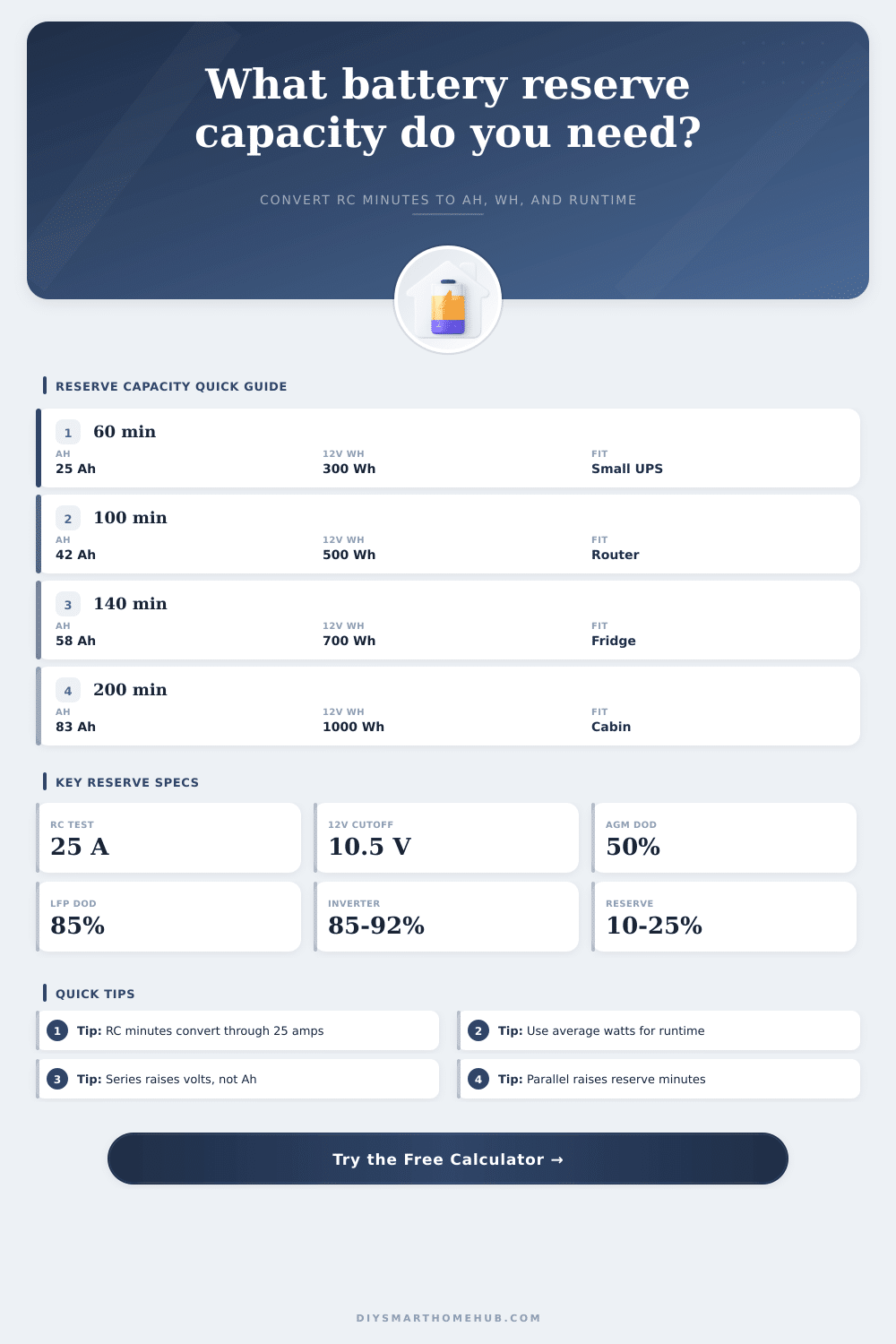
| 60 minutes | 25 Ah | 300 Wh | 150 Wh before conversion loss | Small DC router backup or alarm panel. |
| 90 minutes | 37.5 Ah | 450 Wh | 225 Wh before conversion loss | Modem, router, hub, and small bridge loads. |
| 120 minutes | 50 Ah | 600 Wh | 300 Wh before conversion loss | Network shelf or compact camera cabinet. |
| 160 minutes | 66.7 Ah | 800 Wh | 400 Wh before conversion loss | Longer internet backup or intermittent appliance load. |
| 200 minutes | 83.3 Ah | 1,000 Wh | 500 Wh before conversion loss | Large marine/RV battery or compact deep-cycle bank. |
🔌Battery Type Planning Table
| Battery type | Planning usable depth | Round-trip behavior | Reserve capacity interpretation | Best calculator use |
|---|---|---|---|---|
| Flooded starting lead-acid | 25-40% | High current, shallow-cycle design | RC is useful for comparison, but deep discharge shortens life. | Emergency cranking batteries and very occasional backup. |
| Marine deep-cycle lead-acid | 45-55% | Better cycling than starting batteries | RC and amp-hours usually track well for moderate loads. | Smart home shelf backup, RV, boat, and garage loads. |
| AGM deep-cycle | 45-55% | Good sealed lead-acid high-current behavior | Useful when manufacturer lists RC instead of Ah. | Indoor UPS cabinets, network racks, and security systems. |
| Gel deep-cycle | 40-50% | Best at lower current discharge | Use conservative depth for repeat backup cycles. | Slow-discharge standby loads and access-control systems. |
| Lead carbon | 60-70% | Better partial-state cycling | Reserve minutes can be used like deep-cycle energy data. | Frequent cycling and hybrid backup systems. |
| LiFePO4 reserve equivalent | 80-90% | Flat voltage and high usable energy | Often specified in Wh or Ah instead of RC minutes. | Use RC-equivalent only when comparing against lead-acid labels. |
⏱Common Load Runtime Table
| Smart home load group | Typical average watts | Energy for 8 hours | Energy for 24 hours | Reserve capacity sizing note |
|---|---|---|---|---|
| Fiber ONT, modem, and router | 25-45 W | 0.20-0.36 kWh | 0.60-1.08 kWh | Good match for one or two medium RC batteries. |
| Smart hub, alarm panel, and bridges | 15-40 W | 0.12-0.32 kWh | 0.36-0.96 kWh | Direct DC backup can stretch usable reserve minutes. |
| PoE switch with four cameras | 80-160 W | 0.64-1.28 kWh | 1.92-3.84 kWh | Night infrared draw can raise the average load. |
| CPAP, router, and bedside charger | 45-110 W | 0.36-0.88 kWh | 1.08-2.64 kWh | Humidifier heat changes runtime more than the blower. |
| Mini fridge average draw | 70-140 W | 0.56-1.12 kWh | 1.68-3.36 kWh | Use average watts for energy but check startup surge separately. |
| Sump pump during active run | 500-1000 W | 4.0-8.0 kWh if continuous | 12-24 kWh if continuous | Use duty cycle for energy and surge rating for inverter choice. |
🔧Series And Parallel Reserve Table
| Layout with 12 V batteries | Bank voltage | Bank amp-hours | Effective RC minutes | Planning meaning |
|---|---|---|---|---|
| 1 in series x 1 parallel | 12 V | Same as one battery | Same as one battery | One-battery backup for small DC or inverter loads. |
| 2 in series x 1 parallel | 24 V | Same as one battery | Same as one battery string | Double voltage, same Ah, lower current at the same watts. |
| 4 in series x 1 parallel | 48 V | Same as one battery | Same as one battery string | Good for larger inverter systems and lower DC current. |
| 2 in series x 2 parallel | 24 V | Two times one battery Ah | Two times one string RC | Parallel strings add reserve minutes and usable energy. |
| 4 in series x 3 parallel | 48 V | Three times one battery Ah | Three times one string RC | High-energy bank for extended smart home backup panels. |
📐Formula Reference Table
| Calculation step | Formula | Example | What it tells you |
|---|---|---|---|
| Reserve capacity to Ah | RC minutes x 25 A / 60 | 140 x 25 / 60 = 58.3 Ah | Approx amp-hours at the RC test current. |
| Reserve capacity to Wh | Ah x battery volts | 58.3 Ah x 12 V = 700 Wh | Nominal energy before usable-depth planning. |
| Load energy target | Watts x hours / efficiency x reserve | 120 W x 8 h / 0.90 x 1.15 = 1227 Wh | Battery-side energy needed for the backup goal. |
| Required RC minutes | Required Ah x 60 / 25 | 205 Ah x 60 / 25 = 492 min | Equivalent 25 A reserve capacity for the bank. |
| Runtime from bank | Usable Wh x efficiency / watts | 1400 Wh x 0.90 / 120 W = 10.5 h | Expected steady-load runtime after rounding battery count. |
✅Reserve Capacity Planning Tips
A labels on a battery may have a number like 140 RC. The RC represent the reserve capacity of the battery. The reserve capacity is different than amp hour because reserve capacity measures how long the battery will provide a 25 amp load before it reaches the low voltage that its connected device require to operate.
If the devices from which you are drawing power require a slow amount of energy, then the reserve capacity rating of the battery is not a direct indication of how long the device will run. Batteries has a reserve capacity that indicates the length of time that they can provide high-current discharges, but the devices in most homes requires batteries to provide low-current discharges. For these reasons, it is not wise for a person to attempt to utilize all of the capacity of a battery.
Planning a Home Battery Backup
Deep cycling lead acid batteries to completely drained (zero amp hours) will damage the battery. If the battery is damaged in this way, it will no longer function correctly. A person must take into account the depth of the battery that can be utilized without damaging the battery.
For instance, a person may utilize a deep cycle marine battery in only fifty percent of its total capacity to ensure that the battery lasts for a more longer period of time while in use. By utilizing only the portion of the capacity of the battery, a person is making a trade-off between the amount of energy that can be drawn from the battery today as opposed to in the future due to the need to replace the battery. In order to determine the total energy that a battery can provide, one can calculate the reserve capacity of the battery to provide watt-hours.
Watt hours is a measurement of the total amount of energy that a battery can provide. Once a person calculates the total energy that is required of the battery to power the devices, a person can determine how to connect the batteries in order to provide that energy to the devices. Batteries can be connected in either a series or in a parallel connection to the devices.
If the batteries are connected in a series connection, the voltage will increase to match the requirement of the inverter. By connecting batteries in series, the amp hours will not increase. In order to increase the amp hours of the batteries, batteries must be connected in a parallel connection.
Connecting batteries in parallel will increase the volume of energy that can be provided. By connecting batteries in series, the voltage will increase but the energy will not increase. In addition to considering how to connect the batteries to the devices that will utilize the energy from those batteries, there are additional considerations for each device.
For instance, different devices will have different requirement for both average and surge loads of energy. Devices such as a CPAP machine may require batteries to provide a relatively low average load of energy to the device, which will determine for how long the battery will last when the device is in operation. However, devices such as a sump pump may have high surge loads of energy with their devices.
A surge load is the amount of energy that is required from a device at the beginning of its operation. Such high surge loads of energy can lead to an inverter being tripped if the size of the inverter does not accommodate the surge load of the device that is being operated. Therefore, in addition to ensuring that the battery has enough energy to supply the devices with the energy that they require, it is also necessary to ensure that the inverter has enough capacity to handle the surge load of those devices.
In addition to accounting for the energy that is required by the devices, it is also necessary to account for the energy that is lost during the conversion from the battery to the devices. In order for devices to be powered, an inverter will convert the energy from the battery to the devices. Batteries have a relatively low voltage compared to the voltage that is required to power the devices.
In order to increase the voltage from the battery to the devices, an inverter is used. During this process energy is lost as heat from the inverter. The loss of energy during this process is approximately ten percent of the total energy of the battery.
Thus, the batteries will provide less energy then is calculated for the devices. Batteries will also lose energy through normal operation as they age and as the temperatures of the batteries decreases. To account for this energy loss in the calculations of energy requirements of the devices, a buffer of energy will need to be added to the total energy requirements for the devices.
A fifteen percent energy buffer ensures that devices will continue to run even as the batteries lose their capacity. Another consideration in the creation of a battery backup system is the chemistry of the batteries. For instance, one type of battery is a flooded battery.
Flooded batteries are not ideal for deep cycling, meaning they should not be deeply drained of their energy. In contrast, a second type of battery is a LiFePO4 battery. These batteries can be deeply drained without damaging the battery.
Because the LiFePO4 battery can be deeply drained, it can provide more usable energy than a flooded battery of the same capacity. The downside to using a LiFePO4 battery is that it has a higher initial cost to purchase the batteries. However, because usable energy from a battery is depth of energy that can be drawn from the batteries without damaging them, the depth of usable energy of the LiFePO4 battery is much greater than that of the flooded battery.
In order to create a backup system for a home or other structure, considerations must be made regarding energy loss due to conversion, battery chemistry, and the loads of the devices that will be powered by the system. Each person will have to decide which devices they deem as essential and which will not be necessary for operation during a power outage in order to ensure that they have an adequate amount of energy for those essential devices. By accounting for energy loss due to conversion and considering the chemical composition of the batteries, it will be possible to know how long the battery will run for in relation to the devices.
By knowing how long the batteries will run for in relation to the devices that will be using that energy, it will be possible to effectively plan for the power outage and know when the batteries will run out of energy.