Battery Sizing Calculator
Estimate the usable energy, nameplate capacity, DC amp-hours, and battery module count needed for smart home backup loads.
⚡Real backup presets
🔋Battery sizing inputs
Battery sizing results
⚙Battery chemistry spec grid
📊Chemistry sizing assumptions
| Battery type | Planning DoD | Typical efficiency | Best calculator use |
|---|---|---|---|
| Lithium iron phosphate (LFP) | 80 to 90% | 92 to 96% | Daily backup, home battery racks, long cycle life |
| Lithium ion NMC | 80 to 90% | 90 to 94% | Compact portable stations and high energy density packs |
| AGM lead acid | 40 to 50% | 80 to 88% | UPS cabinets, standby loads, moderate discharge depth |
| Flooded lead acid | 40 to 50% | 75 to 85% | Vented battery banks where maintenance is acceptable |
| Gel lead acid | 40 to 50% | 80 to 86% | Sealed standby banks with lower charge current |
| Nickel cadmium | 70 to 80% | 65 to 80% | Rugged standby systems with wide temperature swings |
🔌Smart home load references
| Backup load | Typical watts | 6 hour AC Wh | Sizing note |
|---|---|---|---|
| Fiber ONT plus WiFi router | 18 to 35 W | 108 to 210 Wh | Measure the power brick output and idle draw |
| PoE switch with 4 cameras | 45 to 80 W | 270 to 480 Wh | Include switch overhead, not only camera wattage |
| Smart hub, modem, NAS idle | 60 to 120 W | 360 to 720 Wh | Disk spin-up can briefly raise draw |
| Refrigerator running average | 100 to 200 W | 600 to 1200 Wh | Use average cycling watts for runtime math |
| Sump pump averaged cycling | 250 to 600 W | 1500 to 3600 Wh | Check starting surge separately on the inverter |
📐Battery voltage and module examples
| Nominal bank | Example module | Nameplate energy | Typical role |
|---|---|---|---|
| 12 V | 12 V 100 Ah | 1.2 kWh | Router, cameras, short small-load backup |
| 24 V | 24 V 50 Ah | 1.2 kWh | Network closet, controls, small inverter loads |
| 48 V | 48 V 100 Ah | 4.8 kWh | Critical circuits and larger inverter systems |
| 51.2 V | 51.2 V 100 Ah | 5.12 kWh | LFP rack batteries and modular home storage |
⏱Common project size examples
| Scenario | Load and runtime | Suggested bus | Approx bank |
|---|---|---|---|
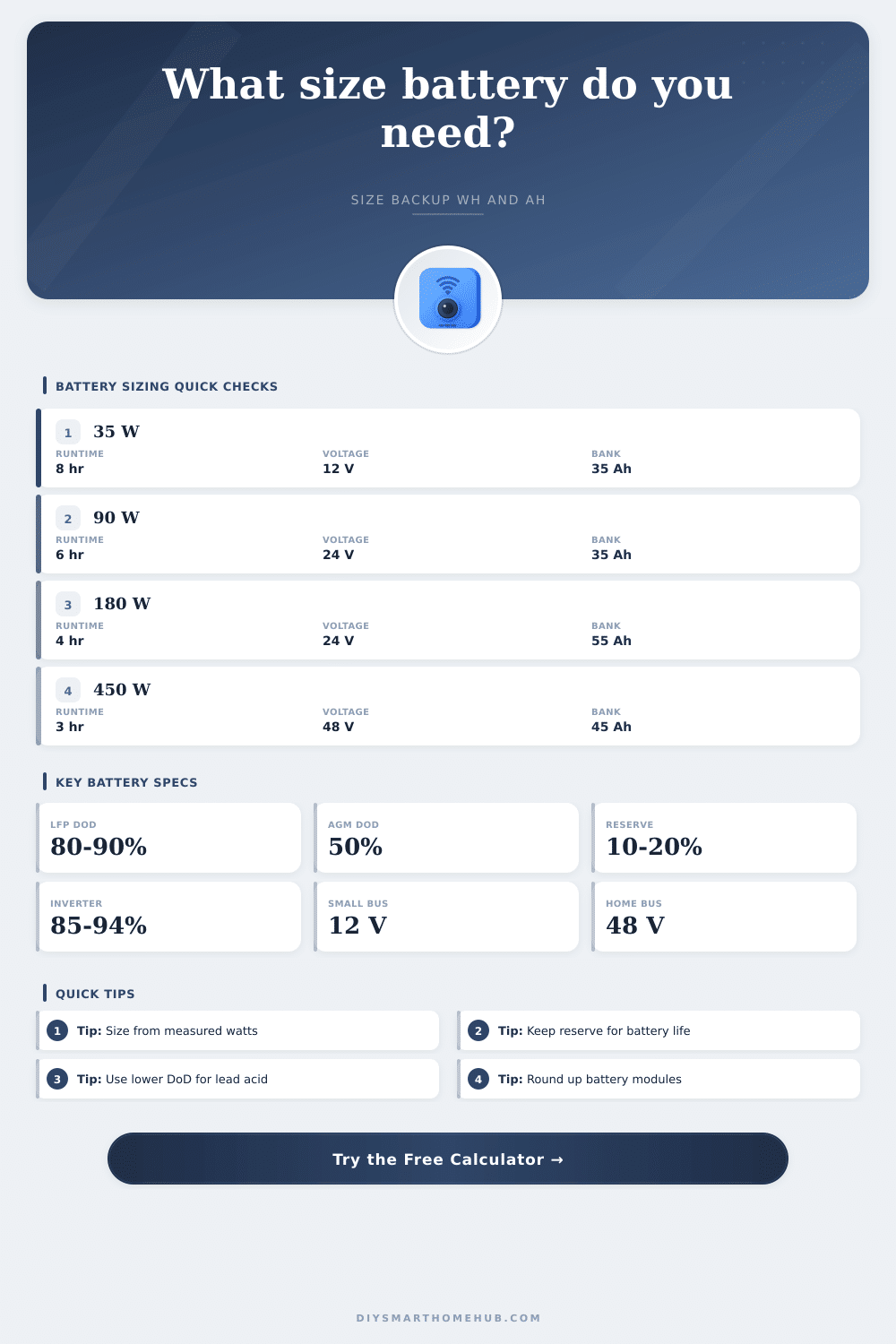
| Internet-only outage | 30 W for 8 hr | 12 V | 0.35 to 0.45 kWh |
| Security camera closet | 70 W for 6 hr | 24 V | 0.65 to 0.85 kWh |
| Home office backup | 180 W for 4 hr | 24 V | 1.1 to 1.5 kWh |
| Fridge and network | 230 W for 8 hr | 48 V | 2.8 to 3.8 kWh |
| Whole-home critical loads | 650 W for 6 hr | 48 V | 5.8 to 7.8 kWh |
💡Sizing notes
When you is planning to create a battery backup system, you must have an understanding of how to size the battery backup system correct. Many peoples feel that if they purchase a large battery, this will be sufficient for their needs for backup power. However, a large battery may not provide the amount of power that they requires.
In order to create a backup power system that functions correct, it is critical for the individual to calculate the power requirements of the devices that will be running off of the battery backup system. One of the first concept that you must understand is the concept of depth of discharge. The depth of discharge is the amount of energy that are removed from a battery.
How to Size a Battery Backup System
For lead acid batteries, if you remove the energy complete from the battery, the lead acid battery will be damaged. An amount of energy must remain in the lead acid battery to ensure that it can last for a long period of time. Additionally, lithium batteries, spesifically lithium iron phosphate batteries, allow for a more higher depth of discharge.
This means that more of the energy can be used from the lithium iron phosphate battery without damaging the battery. Another concept is inverter efficiency. Batteries store direct current (DC) power.
Most of the devices that is used in the home use alternating current (AC) power. An inverter are used to convert the DC power to AC power. During this process from DC to AC power, heat will be generated.
This heat is wasted energy. This lost energy reduce the amount of total power that can come from the battery backup system. For example, if the efficiency of the inverter is 90 percent, then 10 percent of the power will be lost to heat.
Another concept for a battery backup system is the voltage that will be used in the system. A 12-volt battery backup system is a common system that can be created. However, if the home also contain some of the large appliances that will require high amount of power, a 24-volt or 48-volt system will be better.
For these high voltage systems, less amperage will be used to supply the same amount of power to the appliances. Using less amperage allow for thinner wires to be used for the system, which produces less heat. Another concept is understanding the power requirements of the devices in the home.
Some device will have a steady load and some will have a cycling load. Devices with a steady load, like a router, will draw a consistant amount of power. Other devices, like a refrigerator, will cycle on and off during there operation.
It is critical to determine the power draw of each of these devices. For each device, the wattage labeled on the device may not provide the correct reading for the power that the device will use. Instead, you must calculate the average power draw for each device.
Another concept is the size of the battery module that will be used in the battery backup system. Battery modules come in set sizes; they cannot be purchased in amount that are specific to the individuals calculation for the system. Each system will have to be rounded up to the next whole battery module.
Thus, there will be an excess amount of capacity in the battery backup system. The total runtime of the batteries will have to be calculated again after the system is rounded up to the individual battery modules to determine the actual capacity of the battery backup system. Finally, another concept that must be understood is the importance of include a reserve margin for the battery backup system.
A reserve margin will provide extra capacity for the system. Batteries will lose there capacity over time. Additionally, batteries perform less efficient in colder temperatures.
If a reserve margin of 15 to 20 percent is included in the battery backup system, the system will be able to handle the aged batteries or cold temperatures in the environment. This provides a safety margin for the devices in the home to ensure that they wont lose power from the battery backup system.