AGM Battery State of Charge Calculator
Estimate AGM battery state of charge from measured bank voltage, load or charge correction, temperature, capacity, and reserve level for smart home backup planning.
📌Real AGM Battery Presets
🔋AGM Voltage And Capacity Inputs
Calculation Breakdown
⚙AGM Spec Grid
📊AGM Resting Voltage State Of Charge
| SOC | 12 V AGM Rested | 24 V AGM Rested | 48 V AGM Rested |
|---|---|---|---|
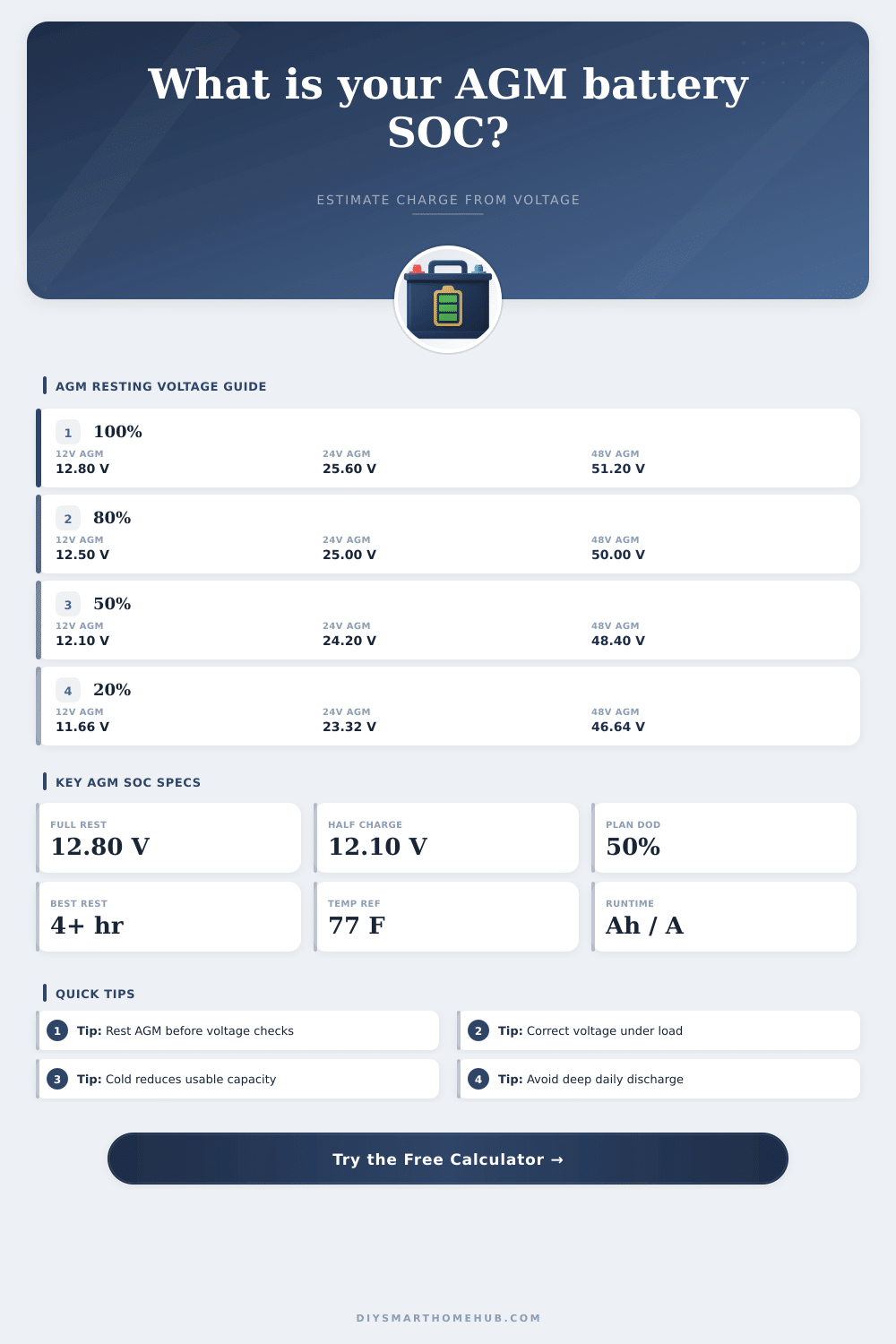
| 100% | 12.80 V | 25.60 V | 51.20 V |
| 90% | 12.65 V | 25.30 V | 50.60 V |
| 80% | 12.50 V | 25.00 V | 50.00 V |
| 70% | 12.37 V | 24.74 V | 49.48 V |
| 60% | 12.24 V | 24.48 V | 48.96 V |
| 50% | 12.10 V | 24.20 V | 48.40 V |
| 40% | 11.96 V | 23.92 V | 47.84 V |
| 30% | 11.81 V | 23.62 V | 47.24 V |
| 20% | 11.66 V | 23.32 V | 46.64 V |
| 10% | 11.51 V | 23.02 V | 46.04 V |
| 0% | 10.50 V | 21.00 V | 42.00 V |
Voltage SOC works best after the AGM battery has rested with no charging or discharge for several hours. Manufacturer curves override generic planning values.
🌡Temperature And Capacity Reference
| Battery Temperature | Approx Capacity Available | Voltage Reading Effect | Planning Note |
|---|---|---|---|
| 32°F / 0°C | About 80% | Voltage can look lower under load | Add reserve for garage and outdoor cabinets |
| 50°F / 10°C | About 90% | Small load sag increase | Useful derating point for cool utility rooms |
| 77°F / 25°C | 100% | Reference condition | Most AGM ratings are based near this temperature |
| 95°F / 35°C | About 97% | Voltage can recover faster | Heat shortens life even if capacity seems normal |
| 113°F / 45°C | About 92% | Charging voltage should be reduced | Use extra reserve in hot equipment closets |
🔌AGM Charge Voltage Reference
| Mode At 77°F | 12 V AGM | 24 V AGM | 48 V AGM |
|---|---|---|---|
| Rested full after charge | 12.75 to 12.90 V | 25.50 to 25.80 V | 51.0 to 51.6 V |
| Absorption charging | 14.4 to 14.7 V | 28.8 to 29.4 V | 57.6 to 58.8 V |
| Float maintenance | 13.5 to 13.8 V | 27.0 to 27.6 V | 54.0 to 55.2 V |
| Recharge soon threshold | 12.1 V rested | 24.2 V rested | 48.4 V rested |
📐Discharge Rate And Bank Examples
| AGM Use Case | Typical Bank | Planning Load | SOC Calculation Detail |
|---|---|---|---|
| Alarm panel standby | 12 V 7 Ah | 0.3 to 1 A | Voltage estimate is stable after a long rest period |
| Router and ONT shelf | 12 V 35 Ah | 1.5 to 4 A | Use load correction if measured while devices are powered |
| PoE cameras and NVR | 12 V 100 Ah | 8 to 18 A | Night infrared draw can increase voltage sag |
| 24 V network rack | 24 V 55 Ah | 4 to 12 A | Voltage curve doubles from the 12 V reference |
| 48 V UPS string | 48 V 100 Ah | 5 to 25 A | Check each 12 V block if string imbalance is suspected |
✅AGM SOC Tips
Absorbent Glass Mat batteries, or AGM batteries, is used for backup power applications due to the fact that AGM batteries dont leak acid and they can handle vibration. However, it is difficult to determine the state of charge of an AGM battery due to the deceptive voltage readings that they can display. When people believe AGM batteries are fully charged, they may actualy have a high voltage reading due to the fact that high voltage readings is typically the result of a “surface charge” in the battery.
A surface charge typicaly occur after you have disconnected an AGM battery from a charger. Additionally, when an AGM battery is being used to power an appliance, the voltage will sag under the load that the battery is experiencing. This voltage sag can make an AGM battery that is actualy fully charged and healthy appear as if it has no charge left.
How to Measure AGM Battery Charge and Find Its Run Time
Therefore, the only way to accurately measure the charge of an AGM battery that is being used to power an appliance is to either allow the battery to rest for several hours, or to account for the voltage sag when measuring the battery. The battery calculator can help account for both the surface charge and voltage sag of an AGM battery. The calculator allow you to enter the conditions under which you measured your AGM batterys voltage.
Based off these conditions, the battery calculator will account for the voltage loss due to the surface charge or voltage sag, and will provide you with the corrected voltage level of your AGM battery. After determining the true state of charge of your AGM battery, you must determine the usable capacity of the battery. The capacity of an AGM battery should never drop to a 0% state of charge.
If you regularly discharge an AGM battery to a 0% state of charge, the deep discharge will damage the battery and shorten it lifespan. Due to the damage that deep discharge can cause, many who use AGM batteries implement the practice of using only 50% of the total capacity of the AGM battery. The 50% reserve allow users to set the 50% mark of the battery as the 0% mark of the battery.
The usable capacity of the AGM battery is the most important figure regarding the total capacity of the AGM battery. By entering a reserve value into the battery calculator, the battery calculator will provide an amp-hour value that indicate the usable capacity of the AGM battery. The environment in which the AGM battery is located can impact the performance of the AGM battery.
One of the factors that can impact the AGM battery is the temperature of the environment. If the environment in which the AGM battery is located is very cold, the chemicals within the AGM battery will not function as efficient as they would in a warmer environment. As a result, the capacity of the AGM battery will be reduced in cold environments.
For instance, the AGM battery in a cold garage may only provide 80% of the capacity of the AGM battery when compared to if the battery were in a warm garage. Conversely, heat can also reduce the performance of an AGM battery. High temperatures will degrade the cells within the AGM battery at an accelerated rate.
Therefore, it is important to use a temperature reference within the battery calculator so that the battery calculator can derate the capacity of the AGM battery according to the temperature of its environment. By derating the capacity of the AGM battery according to its temperature, one can ensure that the runtime calculations for the AGM battery is accurate according to the environment in which the AGM battery will be used. The final calculation to make with an AGM battery is the calculation of its runtime.
The runtime of an AGM battery is not calculated by dividing the total capacity of the AGM battery by the current of the device that the AGM battery is powering. The reason that the runtime is not calculated in this way is due to the impact of the Peukert effect on the AGM battery. The Peukert effect states that if an AGM battery is discharged at a faster rate then the rate at which the battery was tested for capacity, the total capacity of the battery will be less than the total rated capacity.
AGM batteries are typically tested at slow discharge rates to determine their capacity. When an AGM battery is discharged at a high current to power heavy electrical equipment, its effective capacity will be less than if it was discharged at a slower rate. The battery calculator adjusts for this effect.
Therefore, by using the battery calculator to account for the corrected voltage, reserve level, temperature of the environment in which the AGM battery will be used, and the rate at which the battery will be discharged, one could of accurately calculate how many hours the equipment will run during a power outage.