UPS Runtime Calculator
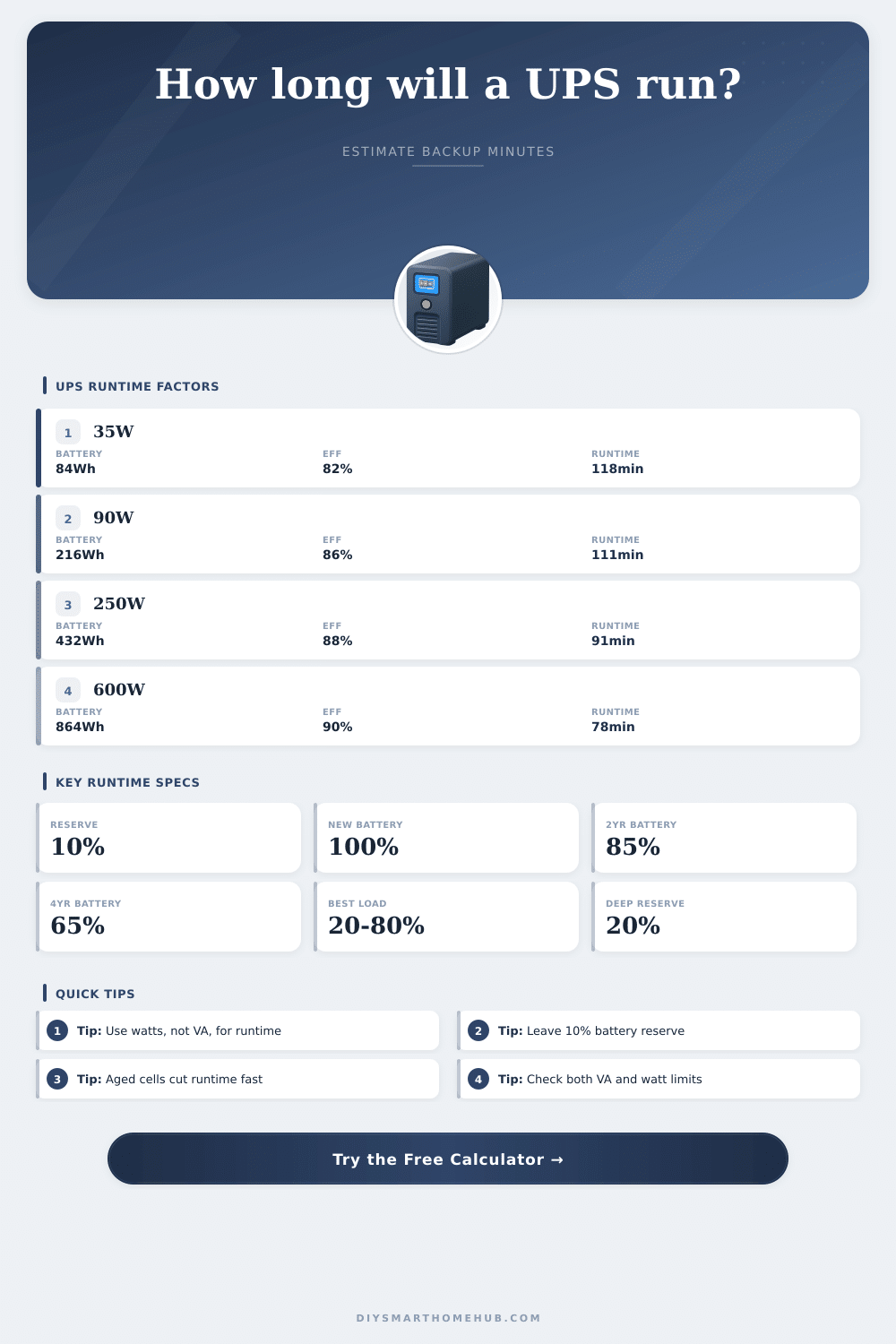
Estimate how many minutes a UPS can support routers, cameras, hubs, computers, NAS devices, and small home automation racks from real battery watt-hours.
📌Real UPS Presets
🔌UPS And Battery Inputs
Runtime Estimate
⚙Battery And Load Spec Grid
📊Reference Tables
| Device Group | Typical Load | UPS Class | Runtime Note |
|---|---|---|---|
| Fiber ONT, modem, WiFi router | 25 to 45 W | 450 to 650 VA | Small UPS can often cover a short outage window. |
| Router, switch, hub, bridge, alarm panel | 60 to 120 W | 850 to 1000 VA | Runtime usually depends more on battery size than inverter rating. |
| PoE switch with cameras and NVR | 150 to 350 W | 1000 to 1500 VA | PoE budgets can rise at night when infrared LEDs switch on. |
| Desktop PC, monitor, dock, router | 250 to 550 W | 1500 VA | Enough for saving work or orderly shutdown, not long backup. |
| NAS, 10G switch, mini server | 120 to 300 W | 1000 to 1500 VA | Use runtime plus USB shutdown settings to protect storage. |
| Battery Layout | Nominal Energy | Usable At 10% | Common UPS Size |
|---|---|---|---|
| 1 × 12 V 7 Ah | 84 Wh | About 76 Wh before inverter loss | Small 450 to 650 VA units |
| 1 × 12 V 9 Ah | 108 Wh | About 97 Wh before inverter loss | 650 to 850 VA compact units |
| 2 × 12 V 9 Ah | 216 Wh | About 194 Wh before inverter loss | 1000 to 1500 VA tower units |
| 4 × 12 V 9 Ah | 432 Wh | About 389 Wh before inverter loss | Larger tower or rack UPS units |
| 8 × 12 V 9 Ah | 864 Wh | About 778 Wh before inverter loss | Extended runtime rack systems |
| UPS Type | Transfer Behavior | Runtime Strength | Best Match |
|---|---|---|---|
| Standby UPS | Switches to battery after a brief outage detection | Efficient for light loads | Modems, routers, small hubs, and simple automation bridges |
| Line-interactive UPS | Regulates minor voltage dips without battery use | Good balance of runtime and protection | Network closets, NAS systems, and camera recorders |
| Online double-conversion UPS | Always powers the load through inverter output | Predictable output, slightly higher conversion loss | Sensitive servers, lab gear, and always-on rack equipment |
| External battery UPS | Uses add-on battery packs with the same inverter | Best for long runtime at moderate load | Home network racks and cameras that must ride through outages |
| Project Scenario | Input Load | Battery Example | Expected Result |
|---|---|---|---|
| Internet-only backup | 35 W | 12 V 7 Ah, one block | Roughly two hours when battery is healthy. |
| Smart home control shelf | 75 W | 24 V 9 Ah, one string | Usually around two hours with a 10% reserve. |
| Camera recorder cabinet | 180 W | 24 V 18 Ah, one string | Useful for short outages and orderly shutdowns. |
| NAS and switch rack | 240 W | 48 V 9 Ah, one string | Often near 90 minutes before reserve. |
| Extended battery network rack | 160 W | 48 V 18 Ah, two strings | Can move from minutes into multi-hour backup. |
🛡Runtime Tips
This calculator estimates steady-state runtime from battery energy. Startup surge, battery chemistry, temperature, UPS cutoff voltage, and manufacturer firmware can change real-world results.
An Uninterruptible Power Supply, or UPS, will provide backup power to your devices in the case of a failed electricity supply. A UPS can provide enough power to save digital files, but it can also provide power to essential devices for longer periods of time. Many individual purchase a UPS based off the numbers that are printed on the product box.
These numbers, however, are often misleading regarding the actual amount of energy that is stored within the product. When purchasing a UPS, individuals often see ratings of 1000VA or 1500VA. These measurements, however, dont represent the energy stored within the battery.
How Long a UPS Will Run
The energy that a UPS can provide is represented in watt-hours. Watt-hours can be determined by multiplying the voltage of the battery with the amp-hour rating of the battery. Another component of a UPS that convert DC power to AC power is the inverter.
Inverters are not 100% efficient in their ability to convert DC power to AC power. Some of the power that is converted is lost as heat. Thus, the length of time that a UPS will provide power to the connected devices will be less than the length of time that the battery alone could provide power to those devices.
The real wattage that the devices will draw will impact the length of time that the inverter will run and the amount of heat that that inverter will create. The health of the battery within the UPS will also impact the length of time that the UPS will provide power to the connected devices. A new lead-acid battery will contain more power than an old lead acid battery.
With prolonged use of a lead acid battery, the heat that the battery creates will degrade the chemical component of the battery. The capacity of the battery will shrink due to the degradation of its chemical components. Thus, an old battery will not be able to hold as much energy as a new battery of the same model number.
In order to compensate for the reduced capacity of an old battery, a derating profile should be used for that battery. Another factor to consider with a UPS is the need to provide enough power to the battery to allow for the devices to be turned off. If the battery is drained of all of it’s power, the chemistry of the battery may be damaged.
Most smart UPS units will provide a small percentage of the batterys power as a safety reserve to avoid damaging the chemical components of the battery. Thus, a person may need to accept that the UPS will not provide enough power for the devices to operate for the length of time that the battery could operate alone. However, if they do allow the battery to drain to provide enough power to turn the devices off, they will extend the life of the battery.
The devices that are connected to a UPS will also impact the amount of power that is drawn from the battery. Devices that use less power, such as a modem and router, will not drain the battery as quick as devices that use more power, such as a PoE switch and a group of security cameras. Security cameras may use more power during the night than during the day due to the use of infrared LEDs.
If they dont account for these infrared LEDs in the estimation of the length of time that a battery will run, the battery may not be able to last as long as expected. A UPS can be used for two different purpose, depending upon the type of equipment that is to be connected to the UPS. If the UPS is to be used for a NAS or a server, for instance, the UPS can be used to provide enough time for the connected devices to perform a graceful shutdown.
A graceful shutdown through the use of USB ports prevents the computer from experiencing issues with its file system or databases. For this type of use, however, the UPS will not need to provide power to the devices for many hours, but only needs to provide power for a period of 10-15 minutes. Finally, different types of UPS units will provide different types and qualities of power to the equipment.
Standby UPS units are commonly purchased for the router, but there are other types of UPS units that is recommended for other equipment. For instance, line-interactive UPS units or online double conversion UPS units will handle voltage sags better than a standby UPS. Although there is some power loss within these more complex UPS units, the additional cost and complexity of the UPS units will protect your sensitive audio and video gear from poor power quality.