Generator Fuel Tank Size Calculator
Estimate the fuel tank capacity needed for a generator by outage duration, electrical load, fuel type, usable tank percentage, reserve margin, and refill interval.
Fuel Tank Size Results
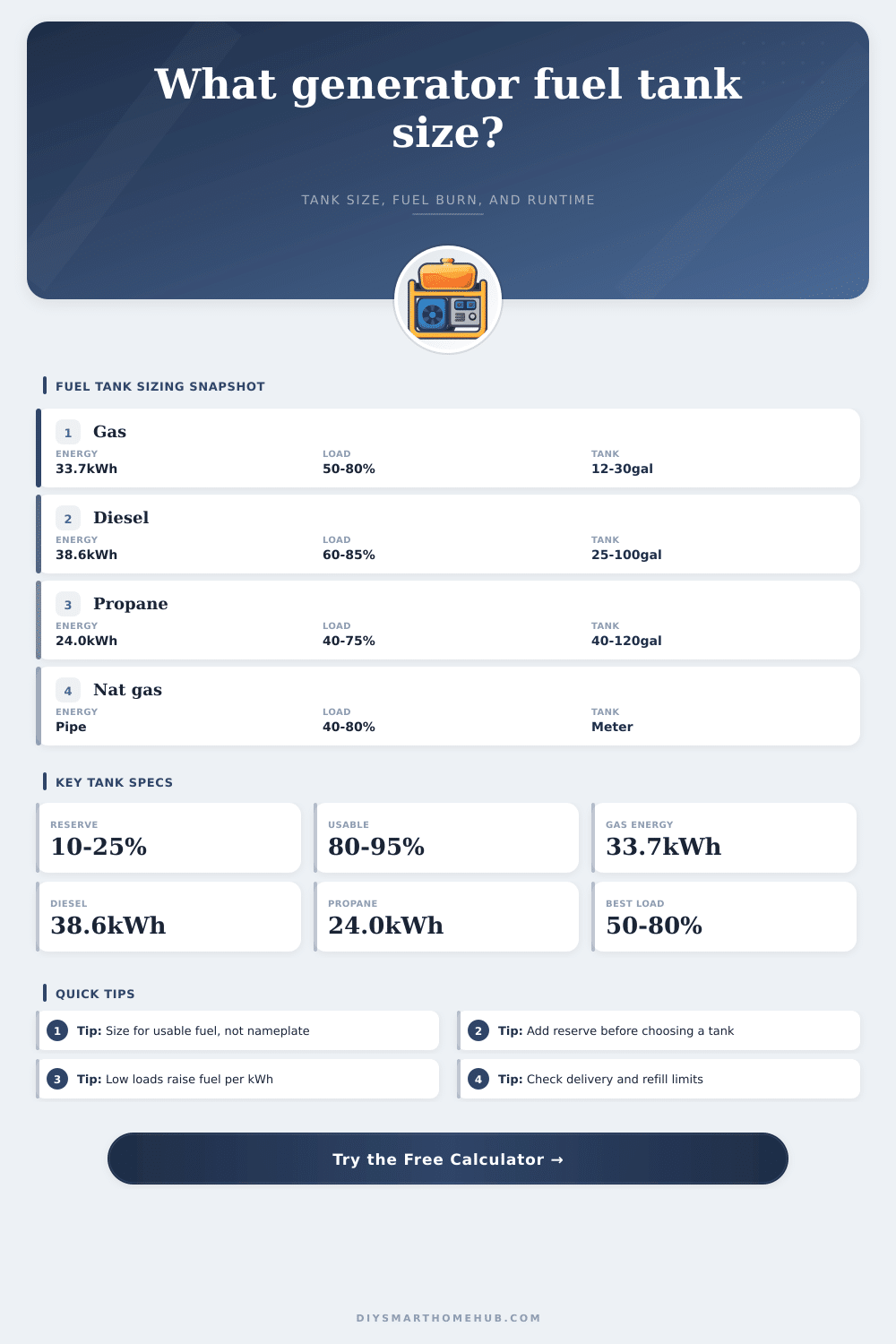
| Fuel type | Lower heating value | Typical generator use | Tank sizing note |
|---|---|---|---|
| Gasoline | About 33.7 kWh per gallon, 8.9 kWh per liter | Portable inverter and open-frame units | Use shorter storage assumptions and practical refill containers. |
| Diesel | About 38.6 kWh per gallon, 10.2 kWh per liter | Standby, trailer, farm, and commercial units | Higher energy density lowers gallons for the same kWh load. |
| Propane liquid | About 24.0 kWh per gallon, 6.3 kWh per liter | Portable dual-fuel and standby tanks | Nameplate tank volume is often only about 80 percent fillable. |
| Natural gas | About 0.293 kWh per cubic foot before generator losses | Piped standby generators | Tank sizing is replaced by gas meter and line capacity checks. |
| Backup scenario | Average load | Planning duration | Common nominal tank range |
|---|---|---|---|
| Refrigerator, lights, internet, chargers | 0.8 to 1.5 kW | 12 to 24 hours | 5 to 15 gallons or 19 to 57 liters |
| Sump pump and storm essentials | 1.5 to 3.0 kW | 24 to 48 hours | 12 to 35 gallons or 45 to 132 liters |
| Furnace, fridge, microwave, well cycling | 2.5 to 5.0 kW | 48 to 72 hours | 30 to 80 gallons or 114 to 303 liters |
| Whole-home essentials panel | 5.0 to 10.0 kW | 48 to 96 hours | 80 to 250 gallons or 303 to 946 liters |
Gasoline portable
Best for short-duration outages and small portable tanks. Fuel burn rises quickly when an open-frame unit runs far below its rated output.
Propane standby
Good for longer storage and larger fixed tanks. Size using usable liquid capacity, not the stamped tank water capacity.
Diesel standby
Strong fit for long runtime and higher continuous loads. Higher energy density can reduce tank volume for the same backup kWh.
Dual-fuel portable
Flexible for staged fuel planning. Recalculate when switching from gasoline to propane because propane needs more gallons per kWh.
| Profile | Best use case | Burn-rate effect | Why it matters |
|---|---|---|---|
| Steady critical load | Medical equipment, network gear, fixed heating controls | Neutral multiplier | Generator operates close to one predictable kW level. |
| Mixed household cycling | Fridge, furnace blower, sump pump, lights, outlets | Moderate multiplier | Starts, stops, and idle periods reduce average efficiency. |
| Motor-heavy pumps and tools | Well pumps, compressors, saws, wastewater pumps | Higher multiplier | Large starts and uneven loading add fuel overhead. |
| Light intermittent load | Oversized generator carrying a small load | Highest low-load penalty | Many generators burn inefficiently below about 30 percent load. |
| Preset | Runtime | Average load | Fuel planning focus |
|---|---|---|---|
| Fridge and Lighting 24 Hour | 24 hours | 1.1 kW | Small tank, short refill cycle, light load efficiency. |
| Well Pump and Kitchen 72 Hour | 72 hours | 3.8 kW | Motor cycling reserve and longer fuel storage window. |
| Whole Home Essentials 72 Hour | 72 hours | 7.2 kW | Large standby tank with household cycling margin. |
| Diesel Standby 5 Day Reserve | 120 hours | 9.5 kW | Continuous service tank volume and refill interval planning. |
A fuel tanks is not a vessel that allow a person to use every drop of fuel that is contained within the fuel tank. Fuel tanks contain an air gap at the top of the fuel tank to allow for expansion of the fuel and the fuel tank itself contain a pickup tube that does not reach the lowest layer of fuel within the fuel tank. As a result, the total volume of the fuel tank does not match the volume of fuel that is usable by the generator.
Furthermore, in order to determine how much fuel is actualy usable by the generator, you must calculate the percentage of the fuel tank that is usable. Should the percentage of usable fuel within the tank be assumed to be 100%, the generator will reach the fuel tanks minimum fuel levels at a rate that will deplete the fuel tanks fuel load sooner then intended. Additionally, running a generator out of fuel can lead to sediment being pull into the generators system.
How to Calculate Usable Fuel and Size a Generator Tank
The amount of fuel that a generator burn is not consistent. Different loads require different amount of fuel to be burned by the generator. Many individuals believe that a 10 kilowatt generator burns fuel at the same rate.
However, the generator is most efficient at operating at its middle capacity. If a large generator is utilized to power small electrical loads, the generator will waste fuel attempting to maintain the operation of the generator engine. Generators may experience steady loads or inconsistent loads.
Loads that are experienced as steady are easy to calculate and understand. Loads that are experienced within a home, for example, are difficult to accurately predict. Within the home, there are surges in electrical demands of appliances that are turned on or start motors, such as refrigerators, pumps, or furnaces.
By choosing the motor-heavy profile for the generators load, for example, the fuel requirements of the generator accounts for these surge. Fuel requirements are also accounted for these surges by considering that starting motors require more fuel than running motors. Fuel needs are therefore not based off wattage alone.
The type of fuel that is used will affect the energy that can be available to the generator. Gasoline is widely available but degrades over time. Propane degrades minimally but contains less energy per unit volume than gasoline.
Diesel fuel contains a high energy density but tends to be more expensive than gasoline and propane fuels. The energy content of the fuel will impact the length of time that the generator can be run. It is recommended to always include a reserve margin in the fuel tank to allow for extra fuel to be available in the case that fuel delivery is delayed or that fuel efficiency is reduced due to cold weather.
This reserve margin should be added to the fuel tank calculations prior to determine the tank size needed for the generator. Any extra fuel in the fuel tank will account for potential human and mechanical error in the system. Therefore, providing for a larger fuel tank than necessary is better than creating a fuel tank that is too small for the requirement of the generator.
The size of the fuel tank should be aligned with the length of time that the fuel tank should be refilled with fuel. For instance, if a fuel tank is to be refilled every twelve hour, the size of the fuel tank can be smaller. However, if you want to avoid replenishing fuel during the night, the size of the fuel tank will need to be determined for the total length of time that power is required.
The length of time that the fuel tank will be used can be compared to the length of time that the fuel tank will be refilled with fuel to determine any logistics for positioning the generator and fuel tank. In accounting for the usable tank percentage, the load profile, and the reserve margin for fuel, you can ensure the amount of fuel that the generator will require to continue running.