Generator Fuel Consumption Calculator
Estimate hourly fuel burn, total outage fuel, tank runtime, reserve margin, and load efficiency for gasoline, diesel, propane, or natural gas generators.
⛽ Real Generator Presets
⚙ Fuel Use Inputs
Fuel Consumption Results
📊 Fuel Energy Spec Grid
📋 Fuel Consumption Reference Table
| Generator size | Approx load | Gasoline gal/hr | Diesel gal/hr | Propane gal/hr | Natural gas ft³/hr |
|---|---|---|---|---|---|
| 2 kW inverter | 50% load | 0.14 - 0.20 | 0.11 - 0.17 | 0.18 - 0.27 | 16 - 24 |
| 5 kW portable | 50% load | 0.35 - 0.50 | 0.28 - 0.41 | 0.45 - 0.68 | 40 - 60 |
| 7.5 kW portable | 50% load | 0.52 - 0.75 | 0.42 - 0.62 | 0.68 - 1.02 | 60 - 90 |
| 14 kW standby | 50% load | 0.98 - 1.40 | 0.78 - 1.15 | 1.25 - 1.90 | 112 - 168 |
| 22 kW standby | 50% load | 1.54 - 2.20 | 1.23 - 1.80 | 1.98 - 2.97 | 176 - 264 |
⚖ Fuel Type Comparison Grid
| Fuel type | Calculator unit | Energy basis | Typical best load | Planning note |
|---|---|---|---|---|
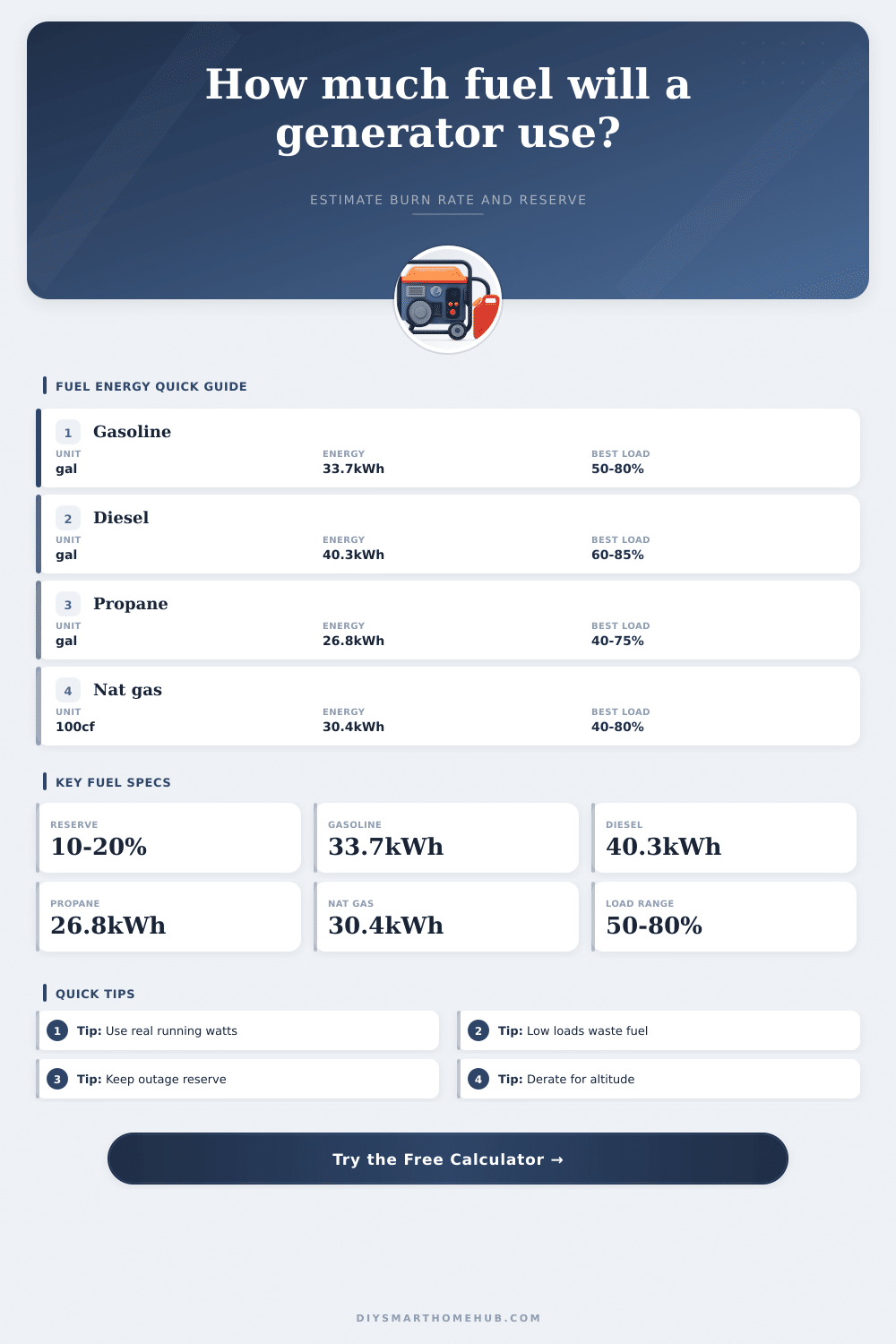
| Gasoline | Gallons | 115,000 BTU/gal lower heating value | 50% to 80% | Common for portable backup; partial-load burn rises quickly. |
| Diesel | Gallons | 137,000 BTU/gal lower heating value | 60% to 85% | High energy density; efficient under steady heavier loads. |
| Propane | Liquid gallons | 91,500 BTU/gal lower heating value | 40% to 75% | Cleaner storage; more gallons are needed for the same kWh. |
| Natural gas | Cubic feet | 1,037 BTU/ft³ typical pipeline gas | 40% to 80% | Use cubic feet per hour when checking meter and line capacity. |
🔋 Load Factor Efficiency Table
| Load factor | What it means | Fuel behavior | Best use case |
|---|---|---|---|
| Below 25% | Very lightly loaded | Highest fuel per kWh due to fixed engine losses | Small inverter generators with eco-throttle |
| 25% to 50% | Light to moderate backup | Good for cycling appliances but less efficient than mid-load | Fridge, lights, network gear, sump pump cycling |
| 50% to 80% | Normal efficient range | Best balance of fuel burn, voltage stability, and headroom | Most home outage plans and jobsite loads |
| Above 80% | Near continuous limit | Fuel burn is high and surge margin becomes tight | Shorter heavy-load periods with managed starts |
🏠 Common Backup Scenario Table
| Scenario | Typical generator | Average load | 12 hour fuel plan | Secondary check |
|---|---|---|---|---|
| Refrigerator, router, LED lights | 2 to 3.5 kW inverter | 0.8 to 1.4 kW | 2 to 4 gal gasoline | Low load favors inverter mode |
| Sump pump and furnace blower | 5 to 7.5 kW portable | 2.2 to 3.8 kW | 5 to 9 gal gasoline | Allow motor start headroom |
| Well pump, fridge, lights, outlets | 8 to 12 kW portable | 4 to 6.5 kW | 9 to 16 gal gasoline | Keep load near 50% to 75% |
| Whole-house essentials | 14 to 18 kW standby | 7 to 10 kW | 1600 to 2600 ft³ natural gas | Check gas meter capacity |
| Large home with central AC cycling | 22 to 30 kW standby | 10 to 16 kW | 2400 to 4300 ft³ natural gas | Soft-starts can reduce peaks |
💡 Fuel Planning Notes
To determine how much fuel a generator will use, you must understand how to calculate fuel consumption from the generator to maintain power during an outage. Many peoples dont know how much fuel a generator will use. Other people dont know how long the generator will run on the fuel that is loaded into the generator.
If you dont calculate fuel consumption for a generator, it is possible for a generator to run out of fuel prior to the outage ending. There are several variable to consider when calculating the fuel consumption of a generator. These variables include the load on the generator, the type of fuel used by the generator, the altitude at which the generator is running, and the fuel reserve in the generator.
How to figure out how much fuel your generator will use
The load on the generator is one of the primary variable in the measurement of how much fuel the generator will burn. Generators dont burn fuel at a steady rate. The longer the generator is running at full power, the more the generator burns fuel.
This is known as the load factor of the generator. If a large generator is used to power a few small appliance, the generator is inefficient at burning fuel. If a small generator is attempting to power the same amount of load as the generator can produce at full power, it may overheat and burn fuel at a rapid rate.
The best method of burning fuel efficient from a generator is to operate the generator between 50 and 80 percent of it’s maximum load. In calculating the fuel consumption of a generator, it is important to differentiate between the surge wattage of the appliances and the running wattage of the appliances. The surge wattage of an appliance is the power it uses to start the motor of the appliance.
The running wattage of an appliance is the power the appliance uses to run. Calculations of fuel needs is based off the running wattage of the appliances to accurately calculate fuel consumption by the generator. The type of fuel in the generator will change the amount of energy the generator can produce from each gallon of fuel.
Diesel burns longer than gasoline. Gasoline is harder to find in large quantities, but gasoline evaporates and degrades over time. Propane does not spoil during storage, but you will need more gallon of propane than diesel fuel to produce the same amount of electricity.
Natural gas fuel comes through the utility lines connected to your generator, so there is no need to store natural gas in containers. However, you must ensure that the natural gas line connected to your generator can supply the needed amount of gas for your generator to perform at its optimum capacity. The altitude at which you use your generator will also affect the generators performance and the amount of fuel that the generator consumes.
At high altitudes, the air contains less oxygen than air at sea level. Because the generator engine require oxygen to function, it will produce less power at high altitudes. If you calculate the fuel consumption of your generator based on the manufacturers specs without considering the altitude at which you will use your generator, you may find that your generator is less efficient and depletes its fuel reserves at a faster rate then you plan.
You should always maintain a fuel reserve in your fuel tank to ensure that you have enough fuel to run your generator during a power outage. The fuel reserve is an extra amount of fuel that you dont plan to use to power your primary appliances. Maintaining a fuel reserve allows your generator to handle irregular fuel pump and the difficulty of refueling your generator during a storm.
By maintaining a fuel reserve, you create a safety margin to ensure that your generator does not run out of fuel while you are still waiting for the power outage to end. The load profile of the appliances that you will power with your generator will also impact the amount of fuel that your generator consumes. A steady load means that the total wattage drawn from the generator will remain the same.
A mixed load means that the wattage drawn from the generator will change as you turn on and off the appliances that the generator will power. A mixed load causes the generator engine to change speeds. When the engine changes speed, the amount of fuel that is burned increases.
An inverter generator can adjust to the changing load of the appliances and maintain a steady engine speed. However, you should consider the efficiency of the inverter generator when calculating the fuel that the generator will consume during operation. If you calculate your generators fuel needs correctly, you will know the amount of fuel your generator will need to run your appliances for a specific amount of time.