Generator Wattage Calculator
Estimate the running watts, motor starting surge, buffer, recommended generator size, and approximate amp capacity for common home backup loads.
Recommended Generator Capacity
| Load Type | Running Watts | Starting Watts | Notes |
|---|---|---|---|
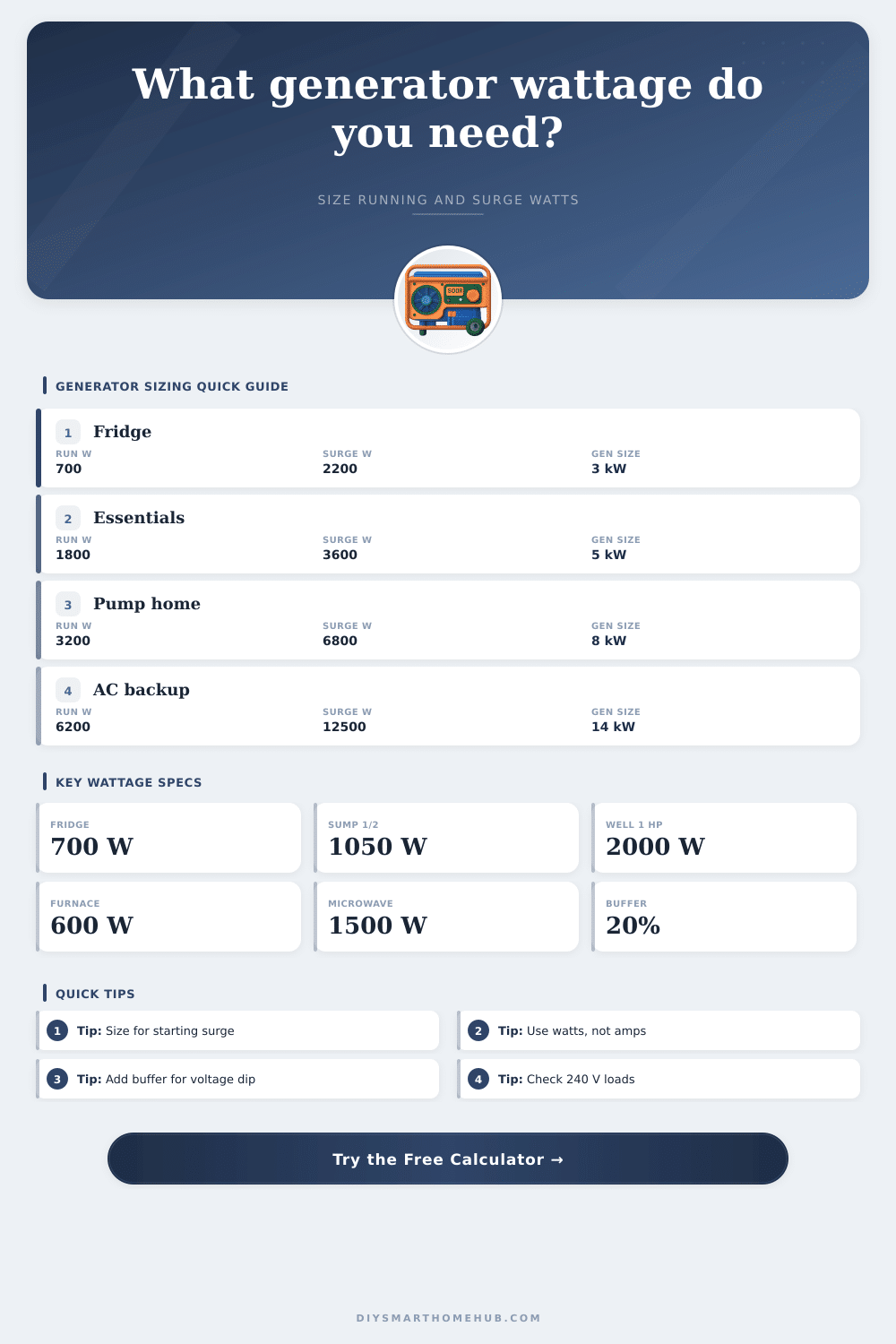
| Refrigerator or freezer | 500 to 800 W | 1800 to 2400 W | Compressor startup drives the generator size. |
| 1/2 HP sump pump | 1000 to 1100 W | 2100 to 2200 W | Short but demanding startup surge. |
| 1 HP well pump | 1900 to 2100 W | 3800 to 4300 W | Often requires a 240 V generator outlet. |
| Gas furnace blower | 500 to 800 W | 1200 to 1800 W | Includes blower motor and controls. |
| 10,000 BTU window AC | 1100 to 1400 W | 2500 to 3600 W | Startup varies by compressor design. |
| Microwave | 1200 to 1600 W | 1200 to 1600 W | Input watts are higher than cooking watts. |
| Generator Class | Best Fit | Typical Running Capacity | Spec Watch |
|---|---|---|---|
| 2,000 W inverter | Fridge, lights, network gear | 1600 to 1800 W | Limited surge and no large pumps. |
| 3,500 W portable | Apartment essentials | 3000 to 3200 W | Check starting watts before adding motors. |
| 5,000 to 6,500 W portable | Fridge, sump, furnace, outlets | 4500 to 6000 W | Good match for many essential circuits. |
| 7,500 to 9,500 W portable | Well pump homes and heavier loads | 7000 to 8500 W | Look for 240 V output and enough L14-30 capacity. |
| 12,000 W plus standby | Large AC or broader home backup | 10000 W and up | Startup surge and transfer equipment matter. |
| Scenario | Included Loads | Typical Running Watts | Common Generator Class |
|---|---|---|---|
| Fridge and lights | One refrigerator, LED lights, router | 1200 to 1600 W | 3 kW class |
| Apartment essentials | Fridge, microwave, lights, electronics | 2500 to 3200 W | 4 to 5 kW class |
| Storm outage core | Fridge, sump, furnace, outlets | 3200 to 4200 W | 6 to 8 kW class |
| Well pump home | Fridge, 1 HP well pump, furnace | 4500 to 5600 W | 8 to 10 kW class |
| Central AC backup | Essentials plus 3 ton AC | 8000 W and up | 14 kW plus class |
| Load | Surge Multiplier | Calculation Use | Generator Concern |
|---|---|---|---|
| Compressor refrigerator | 2.5x to 4x | Add one largest startup event | May dim lights if generator is small. |
| Sump or well pump | 2x to 3x | Use nameplate LRA when available | Needs reserve capacity at startup. |
| Furnace blower | 2x to 3x | Include controls plus blower motor | Cleaner power helps control boards. |
| Air conditioner | 3x to 5x | Soft start can lower surge | Largest motor usually dominates sizing. |
| Resistive heat or toaster | 1x | Use steady running watts | High continuous load reduces headroom. |
Sizing a generator require an understanding of the difference between running watts and starting watts. Many people attempt to calculate total wattage for appliances listed on the appliances, but this are incorrect. The running wattage for appliances is the amount of power that the appliance use while running.
Starting watts is the amount of power required by appliance with motors to start to operate. Appliances with motors use more starting watts than running watts. If the generator dont have enough starting watts to power the motor for appliances, the generator will stall or fail to power the appliance.
How to Size a Generator
Therefore, you must calculate starting watts for all motorized appliances. The appliances that you must power will need to be prioritized because the portable generator will have a limited amount of total wattage. It is common for people to attempt to use a portable generator to power an entire house.
However, the generator will not have enough wattage to power all of the appliances in the house. Appliances that will need to be powered include refrigerator, LED lights, and internet equipment. These appliances use a low wattage.
Appliances such as sump pumps and well pumps requires a significant higher amount of wattage. In the case of using a well for water, the wattage will have to be sufficient to power the well pump. A safety buffer will be necessary to generators because running the generator at 100% of the generator capacity will not be efficient for the generator.
By using only 80% of the capacity of the generator, 20% of the capacity will be left as a safety buffer. This safety buffer will be used for appliances that use more watts than they is labeled for. This safety buffer will prevent voltage dips in the power that may damage the appliances.
By leaving a safety buffer for the generator, the engine will not be strained and will use the fuel more efficient. In addition to the wattage, the voltage and the type of plugs that you will use with the generator must also be considered. High wattage is not beneficial if the voltage of the generator do not match the appliances that are to be used.
For example, if the voltage of the generator is 120 volts but the appliances require 240 volts, the generator will not be able to power the appliances. Adapters are unable to change the output voltage from the generator. Thus, the generator will have to provide a proper voltage for the appliances.
Appliances such as HVAC systems and pumps will require heavy duty outlets and specific voltage that may require specific types of generators. Appliances in the kitchen, such as microwaves and coffee makers will also impact the total wattage that the generator can use. Microwaves and coffee makers use resistive heating, which requires a significant amount of power from the generator.
Although the microwave does not have a starting watt surge as large than a refrigerator, it may use up a significant amount of the total wattage that can be provided by the small generator. Using the microwave at the same time as the refrigerator may cause a failure of the generator. Thus, managing the appliances and the time when they is used will ensure that the generator is not overwhelmed with the total wattage of the appliances.
Finally, it is also necessary to look at the specifications of the generator, specifically the difference between the peak wattage and the running wattage. The peak wattage is the total amount of wattage that the generator can produce for a very short time. The running wattage is the amount of wattage that the generator can continuous produce.
When calculating the wattage of appliances that will be used in the home, you should use the running wattage. Thus, by calculating the starting watts for the motors in the appliances and using a 20% safety buffer, a generator can be purchased that will power the homes appliances.