PV Cell Calculator
Estimate solar cell count, series and parallel layout, panel area, and daily PV energy from real cell formats and site sun hours.
PV Cell Sizing Result
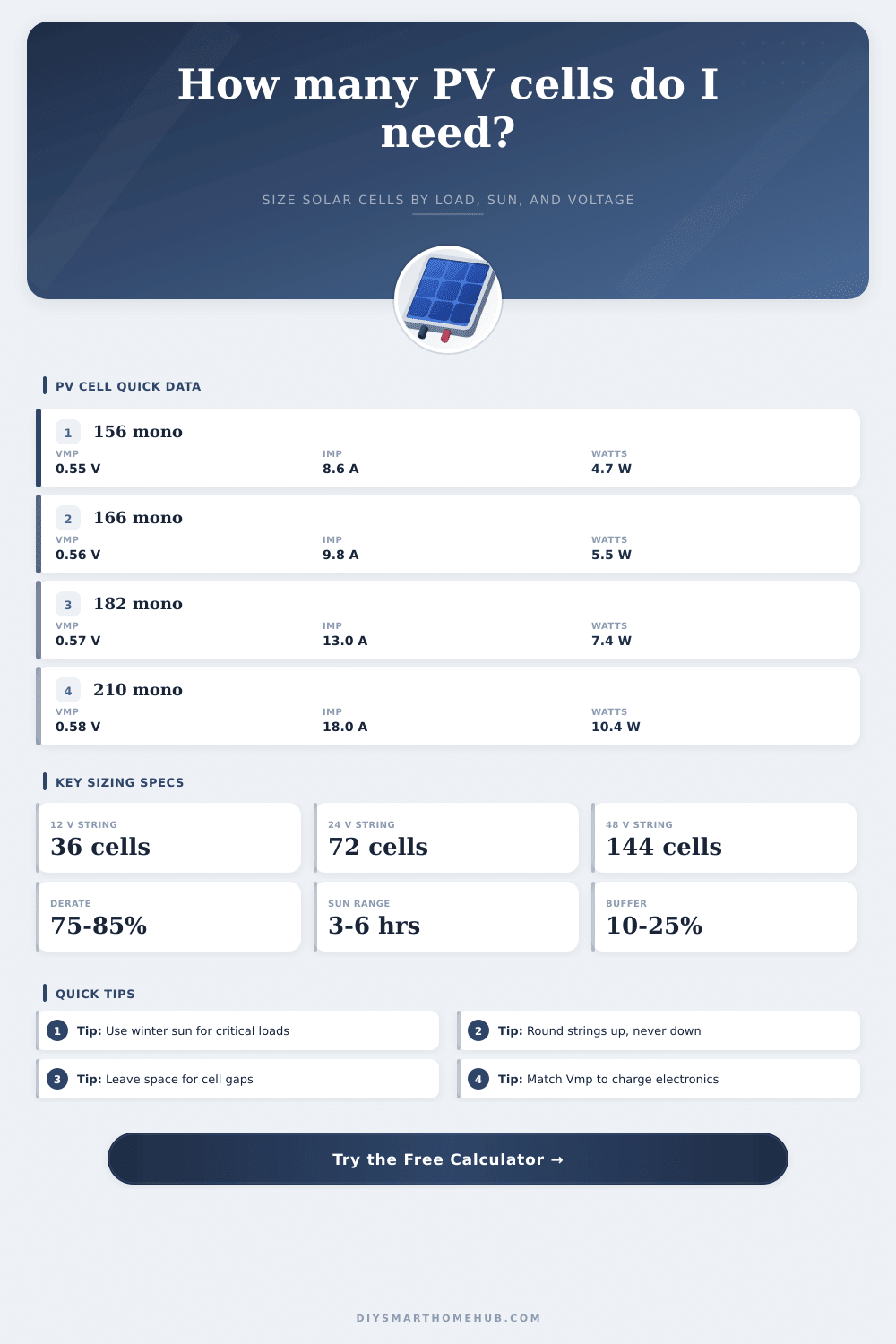
| Cell format | Typical Vmp | Typical Imp | Cell watts | Cell area |
|---|---|---|---|---|
| 156 mm poly full cell | 0.53 V | 8.0 A | 4.2 W | 243 cm² / 0.262 sq ft |
| 156 mm mono full cell | 0.55 V | 8.6 A | 4.7 W | 243 cm² / 0.262 sq ft |
| 166 mm mono M6 full cell | 0.56 V | 9.8 A | 5.5 W | 276 cm² / 0.297 sq ft |
| 166 mm half-cut cell | 0.56 V | 4.9 A | 2.7 W | 138 cm² / 0.149 sq ft |
| 182 mm mono M10 full cell | 0.57 V | 13.0 A | 7.4 W | 331 cm² / 0.356 sq ft |
| 182 mm half-cut cell | 0.57 V | 6.5 A | 3.7 W | 166 cm² / 0.178 sq ft |
| 210 mm mono G12 full cell | 0.58 V | 18.0 A | 10.4 W | 441 cm² / 0.475 sq ft |
| Flexible thin-film strip | 1.50 V | 0.65 A | 1.0 W | 240 cm² / 0.258 sq ft |
| DC target | PV string Vmp target | Approx full-cell count | Use case |
|---|---|---|---|
| 6 V electronics | 6 V | 11 cells at 0.56 V | USB charger, low-voltage lithium charger front end |
| 12 V battery | 18 V | 33 cells at 0.55 V or 32 at 0.56 V | Small 12 V lead-acid or MPPT battery projects |
| 24 V battery | 36 V | 65 cells at 0.55 V or 65 at 0.56 V | Higher-current shed, pump, or lighting loads |
| 48 V battery | 72 V | 131 cells at 0.55 V or 129 at 0.56 V | Compact inverter input or distributed DC systems |
| 72 V MPPT input | 108 V | 193 cells at 0.56 V | Controller input window with additional voltage margin |
| 96 V MPPT input | 144 V | 258 cells at 0.56 V | Larger controller input window where code allows |
| Daily energy load | Typical device group | Array watts at 4.5 sun / 80% | Example 166 mm cells |
|---|---|---|---|
| 8 Wh/day | Garden sensor, soil monitor, beacon | 2.2 W before buffer | One small string if voltage permits |
| 30 Wh/day | Field logger, USB tracker, radio node | 8.3 W before buffer | Usually voltage-driven cell count |
| 120 Wh/day | 12 V camera, LTE bridge, relay box | 33.3 W before buffer | One 18 V string of full cells is typical |
| 250 Wh/day | Shed lights, controller, small fan | 69.4 W before buffer | Two 18 V strings with M6 cells |
| 600 Wh/day | Balcony station or network backup | 166.7 W before buffer | Three to four 18 V strings |
| 1800 Wh/day | Small 48 V inverter duty | 500 W before buffer | Several high-voltage strings |
| Condition | Performance factor | What it represents | Good for |
|---|---|---|---|
| Harsh heat or shade | 70% | Temperature, angle, dust, wiring, and partial shading loss | Small fixed outdoor panels with uncertain sun |
| Conservative DIY panel | 75% | Real-world losses with simple charge electronics | Critical small loads and winter-biased sizing |
| Typical DIY panel | 80% | Clean panel, practical wiring, moderate heat | General PV cell estimates |
| Good airflow and MPPT | 85% | Better operating point tracking and lower temperature rise | Well-mounted panels with MPPT controllers |
| Lab-like clean estimate | 90% | Optimistic cell output with minimal field losses | Comparing cell formats before adding margin |
PV cell output varies with irradiance, temperature, soldering loss, optical cover, and charge controller behavior. Use the result as a sizing model, then confirm against component datasheets.
When you are building a solar array for a remote sensor or a security camera, you must calculate the correct balance between voltage and currents. To effectively charge the battery for a remote sensor or security camera, you need to have enough voltage to push the charge into the battery and enough current to fill the battery before the sun sets. If you do not have enough voltage, the battery will not charge.
Additionally, if you do not have enough current, the battery will not charge quick enough. A single solar cell produce a very small amount of power. A single solar cell will typically produce less than one volt of power.
How to Size a Solar Panel for a Remote Sensor or Security Camera
Since a single solar cell produces less than one volt, you cant use a single solar cell to charge a 12-volt battery. Multiple solar cell have to be connected in series string to produce the necessary voltage to push the charge into a battery. The voltages of the solar cells in a series string add up.
You have to make sure that the total voltage of the solar cells in your series string is enough to charge your battery. You can always use a regulator to lower the voltage of your solar array to your target voltage, but you can not increase the voltage of your solar array. In order to determine how many solar cells are necessary for your array, you must factor in the energy requirement of your device and any environmental factor that may reduce the efficiency of your solar cells.
A solar panel will not always produce the wattage stated on manufacturer’s label. Various environmental factors like clouds, the amount of dust on the solar panel glass, and how hot it is outside can reduce the efficiency of the solar cells. The hotter it is outside the less efficient the silicon solar cells becomes.
Therefore, you have to plan for reduced efficiency from your solar cells to allow for cloudy weather to pass through. In order to calculate how many solar cells are necessary to provide the power requirement for your device, you must calculate the peak sun hours for your area. Peak sun hours are not the same than the amount of hours between sunset and sunrise.
Peak sun hours is the number of hours that the sun will provide the most efficient amount of light (direct angle). The number of peak sun hours in a specific location will change with the season. For critical applications, you must calculate the peak sun hours for the month that has the least peak sun hours.
It is better to have a solar array that is larger than necessary for operation in the summer than to have a solar array that is to small to power your device in the winter. The calculator that is provided will allow you to calculate how many solar cell are needed in your solar array in order to supply the power requirements for your device. The calculator will take your target voltage and the load of your device in order to calculate the number of series strings and the number of parallel strings of solar cells that are necessary to supply the wattage requirements for your device.
Using this calculator will ensure that you do not construct a solar array that has the correct voltage but does not contain enough amperage. If your solar array has the correct voltage but does not contain enough amperage, your solar array will not be able to effectively charge your battery. In addition to calculating how many solar cells are necessary, you must calculate the size of your solar array.
You must account for the gaps between the solar cells, the frame of the solar panel, and the laminate of the solar panel. If you calculate the area of the solar cells but do not account for the gaps between the cells, the frame, and the laminate your solar array will be too large for the area in which you constructed your sensor or security camera. You can consult the reference tables to determine what type of solar cells you should use in your solar array.
Monocrystalline cells tend to be more efficient than polycristalline or thin-film solar cells. Therefore, if you have limited space to construct your solar array, you should use monocrystalline cell. If you have more space and would like to reduce your cost, you can use less efficient solar cells.
Your options for solar cells will depend upon the amount of space you have available and the amount of money that you are willing to spend on your solar array. Finally, you can use the sizing method described to reduce the risks of your solar array not being able to provide enough power for your device to perform its function throughout the year. When sizing your solar array you should include a design buffer for the declining capacity of the battery over time and for the possibility of unpredictable weather patterns.
You should round the number of series strings of solar cells that is necessary to perform your calculations up to the next available number because electronic components require some overhead power. In accounting for the possible loss of efficiency in your solar array you will ensure that your device will have enough power throughout the year.