How Many Solar Panels to Power a House Calculator
Estimate panel count, array size, seasonal production, battery backup, roof fit, and household coverage from real solar sizing inputs.
Solar Sizing Results
| Location Pattern | Typical Peak Sun Hours | Seasonal Factor | Sizing Use |
|---|---|---|---|
| Cloudy northern or coastal climate | 3.0 to 3.8 h/day | 60% to 75% | Use conservative winter factor for full-house coverage. |
| Mixed four-season climate | 4.0 to 4.8 h/day | 70% to 85% | Good default range for many residential estimates. |
| Sunny inland or southern climate | 5.0 to 5.8 h/day | 80% to 95% | Annual coverage is easier, but summer heat can add losses. |
| Desert high-sun climate | 6.0 to 7.0 h/day | 85% to 100% | Fewer panels may hit annual use, subject to utility rules. |
| Panel Class | Nominal Rating | Approx. Area | Why It Changes Panel Count |
|---|---|---|---|
| Older or compact module | 300 W to 340 W | 17 to 19 sq ft | More panels are needed for the same daily kWh target. |
| Mainstream residential module | 370 W to 420 W | 20 to 22 sq ft | Good baseline for most home roof estimates. |
| High-output residential module | 430 W to 470 W | 21 to 23 sq ft | Reduces panel count where roof planes are limited. |
| Large-format module | 500 W to 600 W | 24 to 30 sq ft | Fewer modules, but roof handling and layout may be harder. |
| Backup Goal | Load Share | Duration Input | Formula Meaning |
|---|---|---|---|
| No battery estimate | 0% effective | 0 days | Calculator returns 0 kWh battery capacity. |
| Essential circuits only | 25% to 40% | 0.5 to 1 day | Sizes refrigeration, network, lights, and limited outlets. |
| Critical loads plus comfort | 45% to 70% | 1 to 2 days | Supports more appliances but grows battery capacity quickly. |
| Whole-home backup | 80% to 100% | 1 to 3 days | Requires large storage and careful load management. |
| Home Scenario | Daily Use | Example Inputs | Approx. Panel Count |
|---|---|---|---|
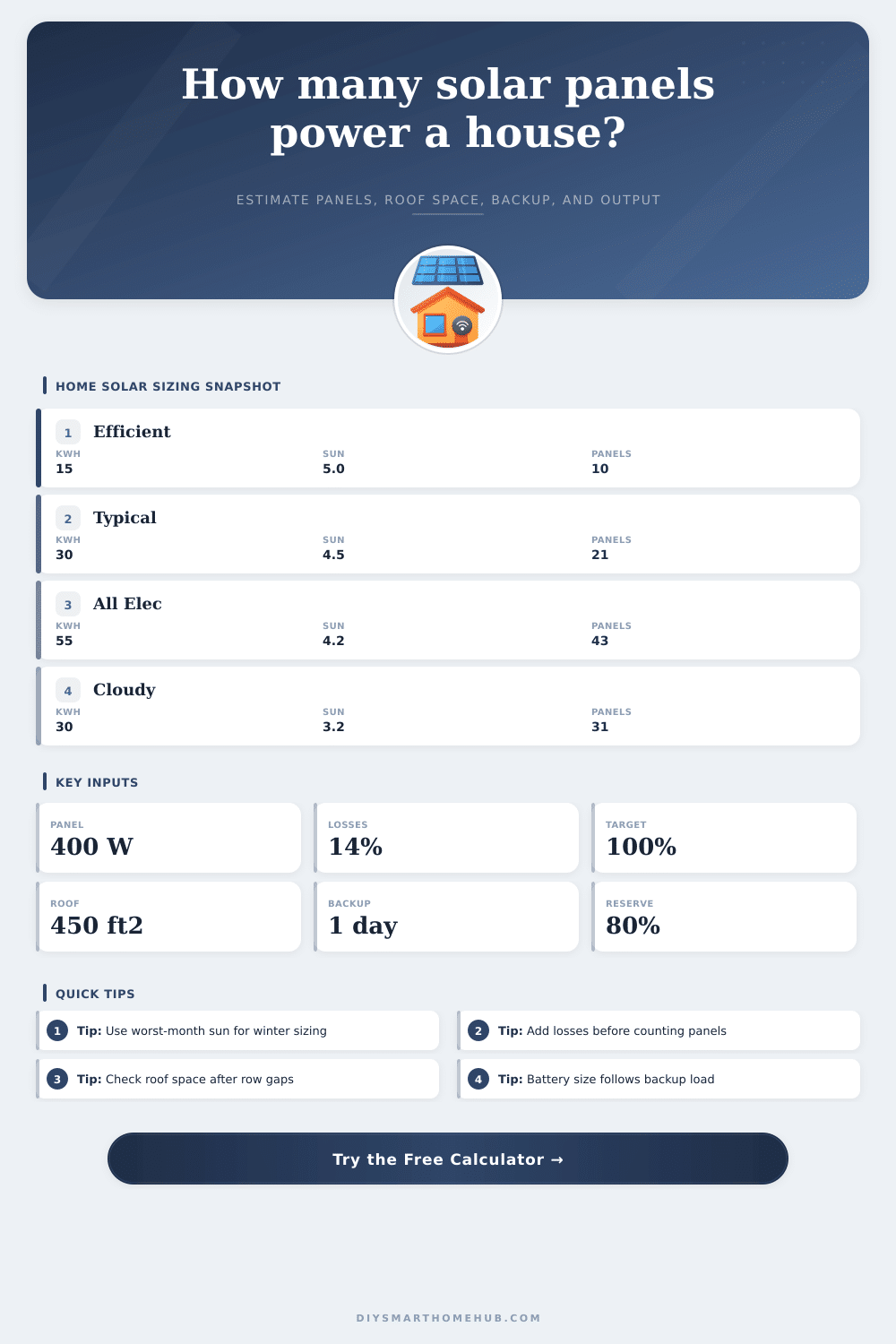
| Efficient smaller home | 15 kWh/day | 5 sun h, 400 W, 14% losses | About 10 panels for full annual coverage. |
| Typical family home | 30 kWh/day | 4.5 sun h, 400 W, 14% losses | About 21 panels before roof constraints. |
| All-electric household | 55 kWh/day | 4.2 sun h, 400 W, 16% losses | About 43 panels when winter factor is included. |
| Cloudy-climate full coverage | 30 kWh/day | 3.2 sun h, 420 W, 16% losses | About 31 panels with conservative seasonal sizing. |
| Constraint | Typical Planning Value | Calculator Input | Result Impact |
|---|---|---|---|
| Panel footprint | 20 to 22 sq ft each | Area per panel | Sets base roof area before spacing. |
| Setbacks and access | 5% to 20% extra | Spacing buffer | Increases roof area needed per panel. |
| Shade or nonideal azimuth | 70% to 95% factor | Roof orientation factor | Reduces effective output per panel. |
| Small usable roof plane | 250 to 450 sq ft | Usable roof area | May cap panel count below energy target. |
When planning a solar energy system, there are many differents factors that you should consider. The solar energy system will not function with perfect efficiency. Some energy will be lost within the system, and your roof has certain limitation regarding the installation of solar panels.
For example, solar panels does not convert all of the sunlight into usable electricity. The heat can make the panels more less efficient, and the inverter will also lose some of the energy created by the panels when it convert that energy into electricity usable by the appliances in your home. The inverter will always lose some of that energy because it converts the electricity to a form that the appliances can use.
How to Plan Your Home Solar System
An analysis of the energy use in your home in kilowatt hours will help you to plan your system. However, you should also consider the sunlight in your area throughout the year. The sunlight available to your roof will not be the same from month to month.
For example, your area may receive a great deal of sunlight in the summer when you plan to size your solar energy system, but there may not be enough sunlight in the winter to power your home. To combat this, you should plan the energy system with seasonal design factors so that your home will be powered during the month when there is less sunlight falling onto the roof. Your roofing tiles may not be the perfect surface for installing solar panels.
There may be vents and other obstacle on your roof. Furthermore, your local fire code may require empty space on the roof. You will need to account for these spaces when determining how many solar panels you can install on your roof.
There may also be shade from other structures that cover part of your roof. You may desire to offset 100% of your energy use. However, your roof may only have enough space to install solar panels to provide 70% of your energy use.
Another significant part of planning your solar energy system is the type of solar panels that people will use. Not all solar panels has the same wattage. The higher the wattage of the solar panels, the more electricity that they will produce per square foot of roof area.
If you have limited space on your roof, you will likely have to purchase solar panels with a high output that will allow you to meet your energy need within such a small area. Many people will want to include a battery in their solar energy system. The battery will provide control over the electricity in the home during a power outage.
Most solar energy systems that are grid-tied will shut off during a power outage to protect the system. Therefore, if you would like your lights to stay on during a power outage, you will need a battery system. However, using a battery system to power your entire house is very expensive.
Instead, you can use the battery to power only the essential loads in your home. Essential loads include appliances like refrigerators and electronic device like internet routers. Powering only these essential loads will lower the cost of your battery system.
You will also have to account for energy losses in your system. Even if you purchase a solar panel that produce 400 watts of energy, it will not always produce 400 watts of energy. Various factors will cause losses in the system.
For example, solar panels can lose energy due to dirt, wiring, and degradation from heat. There will always be energy losses in these systems; 14% are the standard for energy losses in solar panel systems. However, if your area has alot of dust, the energy loss could be higher.
Furthermore, if your wiring system is complex, the energy loss could be higher. If you do not account for these energy losses, you may find that your solar energy system is under sized for your energy needs. An under sized solar energy system will not be able to produce the amount of energy necessary to power your home.