Solar Pool Heater Sizing Calculator
Estimate collector area, panel count, heat gain, and coverage ratio from pool geometry, sun exposure, cover habits, and collector type.
☀Descriptive Pool Presets
📏Pool And Solar Inputs
⚙Collector Spec Grid
📊Reference Tables
| Collector Type | Efficiency Used | Best Fit | Sizing Note |
|---|---|---|---|
| Unglazed polypropylene panels | 72% | Outdoor pools in normal swim season | Usually sized from 70% to 100% of pool surface area. |
| Glazed flat-plate collectors | 58% | Cooler air, shoulder season, or higher target water | Lower raw output for pool temperatures, but better in wind and cool air. |
| Evacuated tube collectors | 50% | Compact high-temperature arrays | Useful when roof area is tight, but pool flow design matters. |
| Low-profile roof mat | 64% | Large shallow roof areas | Works best with strong sun, short runs, and broad roof coverage. |
| Dome coil collectors | 46% | Small above-ground pools or supplemental heat | Needs more area than flat panels for the same pool load. |
| Ground-rack unglazed array | 70% | Ground locations with adjustable aim | Good when roof direction is poor or shade blocks the house. |
| Pool Condition | Starting Ratio | Metric Equivalent | When To Increase |
|---|---|---|---|
| Warm climate, covered at night | 50% to 70% of pool area | 0.5 to 0.7 m² collector per m² pool | Increase for shade, high target temperature, or short heat-up window. |
| Mild climate, typical cover use | 70% to 90% of pool area | 0.7 to 0.9 m² per m² | Increase when nights are cool or roof faces east or west. |
| Temperate climate, uncovered often | 90% to 110% of pool area | 0.9 to 1.1 m² per m² | Increase for wind, spillovers, and water features. |
| Cool shoulder season | 110% to 130% of pool area | 1.1 to 1.3 m² per m² | Increase when aiming for fast warm-up rather than steady maintenance. |
| Adjustment | Calculator Factor | Reason | Practical Meaning |
|---|---|---|---|
| Solar cover most nights | 0.72 load factor | Evaporation is the largest overnight heat loss for many pools. | Collector area can often stay closer to the low end of the range. |
| Uncovered spillover or water feature | 1.12 load factor | Moving water increases evaporation and exposed surface cooling. | Plan extra collector area or a longer heat-up window. |
| East or west roof | 0.86 solar factor | The array misses part of the strongest midday solar window. | The same daily load needs more collector surface. |
| High lift roof and long plumbing | 0.82 output factor | Flow restrictions and heat lost along piping reduce useful output. | Use the derate when panels are far from the equipment pad. |
| Common Pool Size | Surface Area | Typical Collector Area | Typical Panels |
|---|---|---|---|
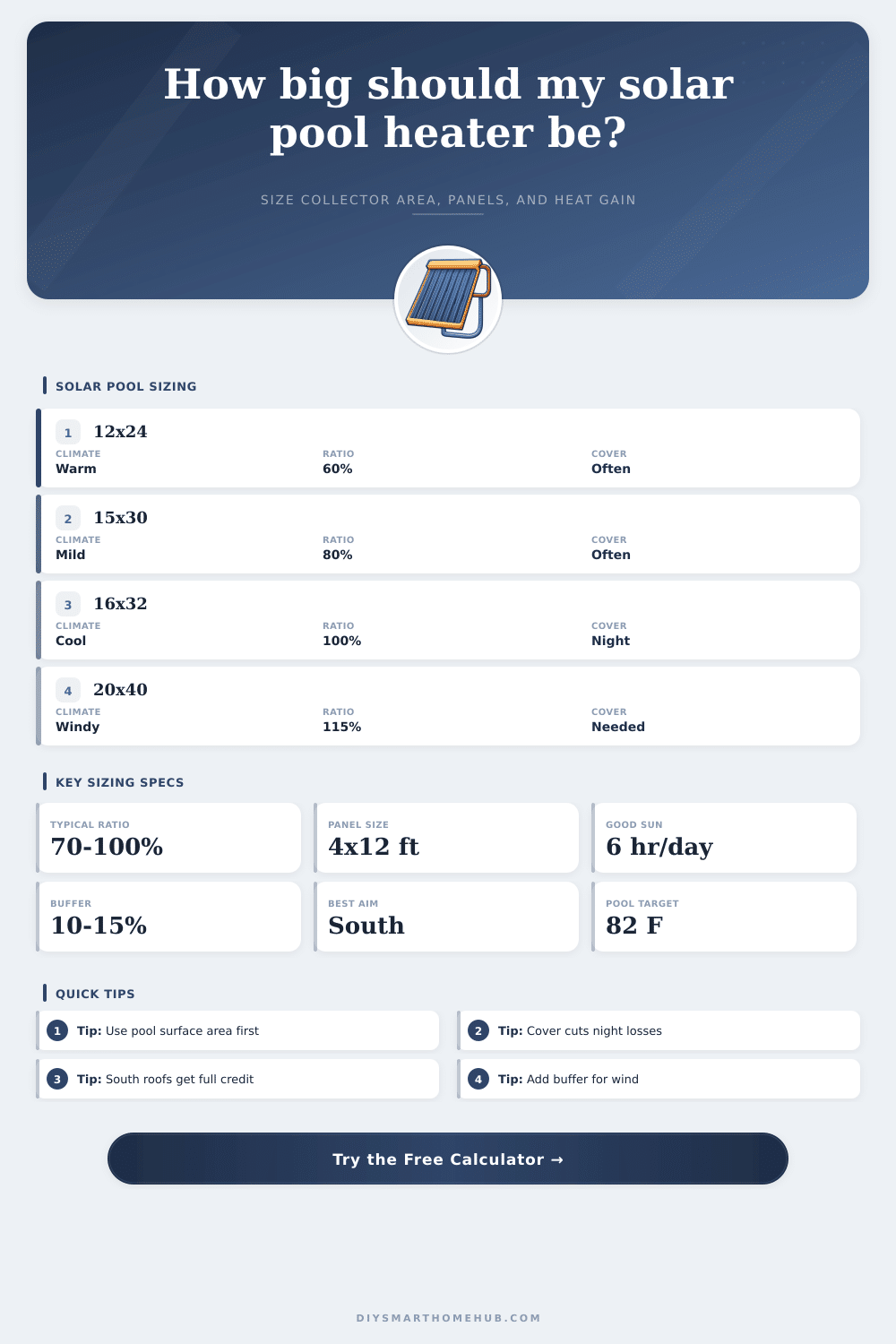
| 12 x 24 ft rectangle | 288 ft² / 26.8 m² | 200 to 290 ft² | 5 to 7 panels at 40 ft² |
| 15 x 30 ft rectangle | 450 ft² / 41.8 m² | 315 to 450 ft² | 7 to 10 panels at 48 ft² |
| 16 x 32 ft rectangle | 512 ft² / 47.6 m² | 410 to 565 ft² | 9 to 12 panels at 48 ft² |
| 20 x 40 ft rectangle | 800 ft² / 74.3 m² | 640 to 960 ft² | 14 to 20 panels at 48 ft² |
🔍Spec Comparison Grid
| System Style | Roof Area Demand | Sun Sensitivity | Recommended Use |
|---|---|---|---|
| Full unglazed roof array | High, often near pool surface area | Moderate; performs best in direct sun and warm air | Main pool heating for spring through fall swimming. |
| Glazed compact array | Medium; fewer panels may cover shoulder-season loads | Lower; handles cool air better than unglazed panels | Higher target temperatures, cool nights, or smaller roof sections. |
| Ground rack array | Ground area instead of roof area | Low when tilt and azimuth are adjustable | Properties with shade on the house but clear yard exposure. |
| Supplemental dome coils | Low per module but many modules needed | High; output falls quickly with weak sun | Small pools, above-ground pools, or incremental boost only. |
💡Sizing Notes
Solar pool heating are a method of increasing the temperature of the pool waters by using the energy from sun. Many peoples want to use solar heating for there pool because it will heat the pool water to a more warmer temperature. However, many people makes mistakes when calculating the amount of solar pool heating equipments they need.
In addition to provide heat to the pool water, solar pool heating must also account for the amount of heat that leave the pool water. The pool water loses heat to air through evaporation and the movement of the wind. If the pool is exposed to alot of winds, more solar heating panels will be required for the pool water to still reach the desired temperature.
How to Heat Your Pool with Solar Panels
There is different types of solar pool heating collectors that can be used for these systems. One of the most common types of solar pool heating collector are the unglazed polypropylene panel. These types of panels is relatively inexpensive and work best in warm climate.
These panels use plastic material to absorb the sunlight that heat the pool water. However, the unglazed panels can lose heat to the air if the air is very coldly. An alternative to unglazed polypropylene panels are the glazed collector.
These types of collectors use a plastic or glass shield around the panels to allow the heated water to lose less heat to the surrounding air. The glazed collectors retains more heat from the pool water and are better for cold air temperature. However, glazed collectors is more difficult to install proper.
The orientation of the roof on which the solar pool heating panels is installed can also affect their efficiency. A south facing roof is the best orientation for solar panel installations because it receive the most sunlight during the day. If the roof face east or west, the panels will receive sunlight at an angle, which reduce the efficiency with which the panels can perform.
More solar pool heating panels will be required if the roof faces east or west then if it face south. Using a pool cover will help to retain the heat in the pool. Most of the heat that a heated pool loses is lost to the evaporation of the pool water.
Using a pool cover will prevent the evaporation of the pool water. If the pool cover is use during the night hours, the pool will retain more heat. Using a pool cover will allow the use of a smaller solar pool heating system.
If the pool is not cover, the heated pool water will lose heat during the night. More solar pool heating panels will be required to heat the pool if it isnt covered during the night hours. One of the factor to consider when installing a solar pool heating system is the size of the system.
One of the factors to consider is the desired temperature lift of the heated water. The temperature lift is the number of degrees that you would like to increasing the temperature of the pool water. A higher temperature lift will require a larger solar pool heating system.
A smaller temperature lift will require less solar pool heating panels. Another factor to consider is the volume of water in the pool. The larger the volume of water in the pool, the more solar pool heating panels that will be require to heat that volume of water.
Finally, another factor to consider is the purchase of a slightly larger solar pool heating system than the calculations indicate for the pool. This will provide a degree of flexibility in cases of cloudy days and windy weather that may make it difficult to heat the pool water to the desired temperature.