Solar Panel Orientation Efficiency Calculator
Estimate how panel facing, tilt, latitude, and design sun hours change annual solar output so you can compare roof planes, flat-roof racks, and seasonal tilt goals before layout work starts.
📌Scenario presets
These presets cover common roof orientations from ideal south-facing arrays to compromise east-west roofs and a north-facing roof in the southern hemisphere. Each preset updates all fields and reruns the output.
☀Orientation inputs
Enter your site data to estimate orientation efficiency, adjusted sun hours, and annual production.
📊Quick reference bands
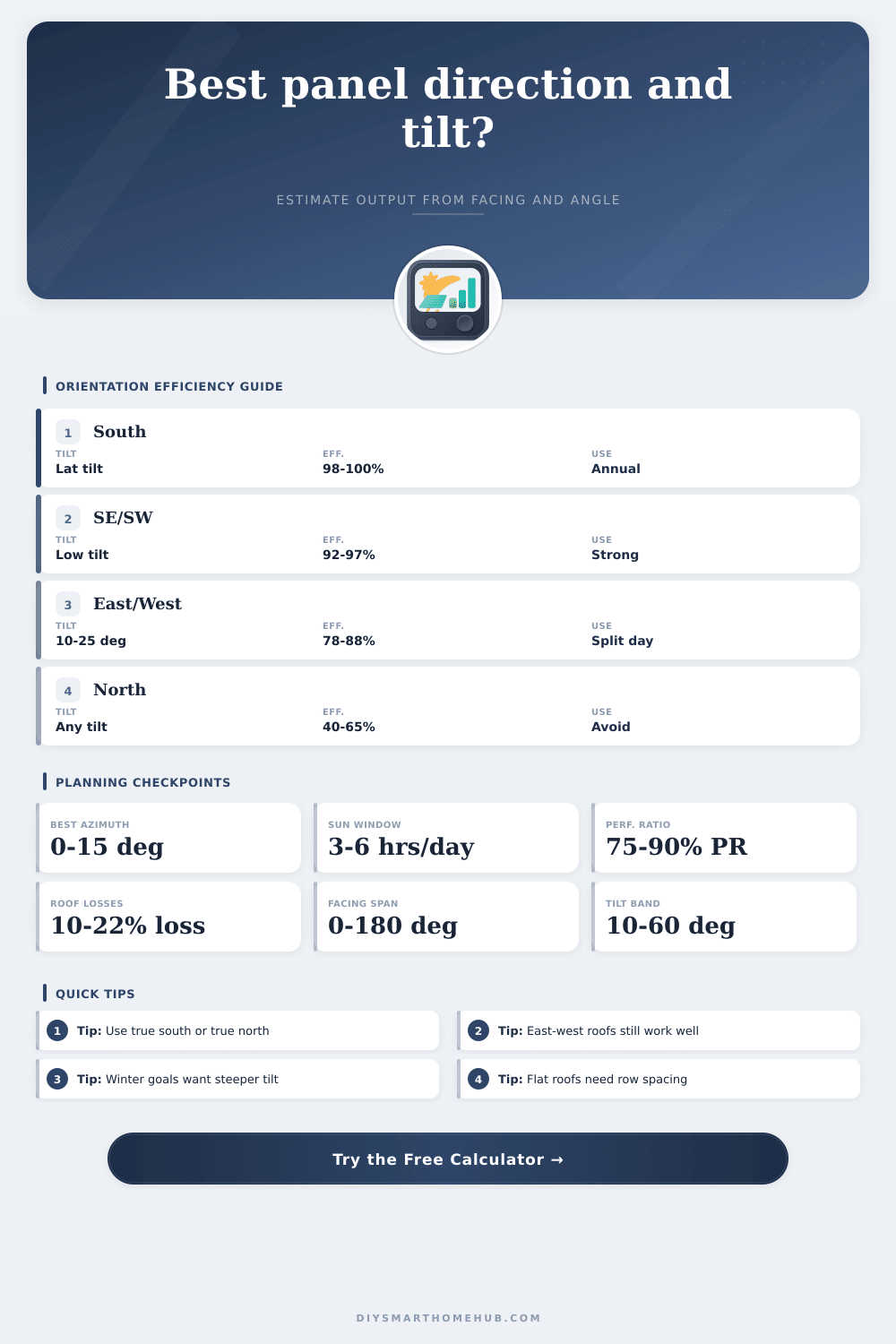
Use these shorthand bands to judge a roof plane before running exact numbers. The calculator below uses a smoother interpolation between these anchor points.
📑Orientation tables
Annual efficiency bands assume a fixed array with normal rooftop shading control and standard production losses already separated into the performance ratio input.
| Facing band | Azimuth error | Annual factor | Use note |
|---|
Tilt targets change with latitude and with whether you want balanced annual output, summer bias, or stronger winter harvest.
| Latitude band | Annual tilt | Summer tilt | Winter tilt |
|---|
📋Common roof examples
These example scenarios var you compare realistic roof planes, flat-rack compromises, and hemisphere differences using the same annual estimation method as the calculator.
| Scenario | Facing | Tilt | Eff. |
|---|
🛠Practical notes
Panel azimuth should be based on true north, not magnetic north. A small local declination error can make a good roof look worse than it really is if you do not correct the bearing first.
A roof that points close to the right compass direction often performs very well even when the pitch is not perfect. Large azimuth errors usually cost more output than modest tilt mismatch.
Solar panel orientations is a process that determines how much energy the solar panels will produce from the sunlight that falls upon them. Solar panels produces electricity based off the direction in which they face, as well as an angle of the tilt of the solar panels. By choosing the correct direction and tilt for the solar panels, the panels will produce a higher amount of energy.
If, however, the panels are oriented towards an incorrect direction or at an incorrect angle of tilt, then the solar panels will produce less energy for an area. The first of the main factor to consider in the orientation of the panels is the direction in which the panels face. In the northern hemisphere, the best direction for the panels to face is true south.
Best Direction and Tilt for Solar Panels
The reason that true south is the best choice is because it can capture the most amount of sunlight that falls upon the panels throughout the day. The earth’s magnetic declination causes people to utilize true south rather than magnetic north. Placing the panels in a direction towards the southeast will allow them to produce the most energy during the mornings, but the panels will produce less energy during the afternoons.
Southwest facing panels will produce the most energy during the afternoons, but will produce less energy during the mornings. Panels facing east or west will produce energy throughout the day, but only for one portion of the day. Finally, if the panels face north, they will be generally inefficient panels in the northern hemisphere, since they will receive very little sunlight.
The second of the main factors to consider is the tilt of the panels. The tilt is the angle of the panels in relation to the ground. The tilt should be set according to the latitude of the area in which the panels are to be installed.
A person should ideally adjust the tilt angle to be the same than the latitude of the area. In areas that has high latitudes, a steeper tilt should be used for the panels to ensure that they can capture sunlight during the winter months of the year. In areas that are near the equator, however, the tilt should be more shallower, since the sun is directly overhead.
For areas with a steep angle of installation, snow will slide off the panels, which helps in snowy climates. However, steep angles of solar panels will cause the panels to produce less energy during the summer months of the year, however. The critical measurement for determining the proper angle and direction for the panels is the latitude of the area.
Areas near the equator experiences the sun to remain high in the sky throughout the year. Thus, the tilt of the panels will be low for these area. In areas that have high latitudes, the sun remains low in the sky for much of the year.
The panels should tilt at a steeper angle towards the sun in these areas. Finally, in areas that lie in the southern hemisphere of the earth, the panels should be installed to face north, since the sun passes through the northern portion of the sky in these areas. Additional factors in the determination of the proper orientation of solar panel installations include shading of the panels.
Any panels that are shaded will produce less energy than panels that are not shaded. Another environmental factor in the efficiency of solar panels is that dirt and heat will reduce the efficiency of the panels. Thus, these factors should also be accounted for in the installation of the panels.
Additionally, even if the roof is not perfectly oriented towards the south (the best direction for the northern hemisphere), solar panels can still be installed on those roofs. While the panels will produce energy, they will produce less energy than if they were facing true south. Finally, mathematical calculations exists to determine the efficiency of the orientation of the solar panels.
For instance, if the solar panels are oriented according to the direction of the roof, that efficiency can be calculated. If the direction of the solar panels is within fifteen degrees of true south, the efficiency will remain very high. However, if the panels are oriented towards east or west, there efficiency may drop to between seventy-five and eighty-five percent.
Thus, evaluating each potential roof area for implementation of the panels can help to ensure that the solar panels will produce enough energy for the utilization demands of the structures in which they will be installed.