Solar Fuse Size Calculator
Estimate fuse sizes for PV source circuits, combiner outputs, charge controller battery leads, and inverter feeds using module Isc, parallel string count, controller amps, and battery voltage.
📌Project presets
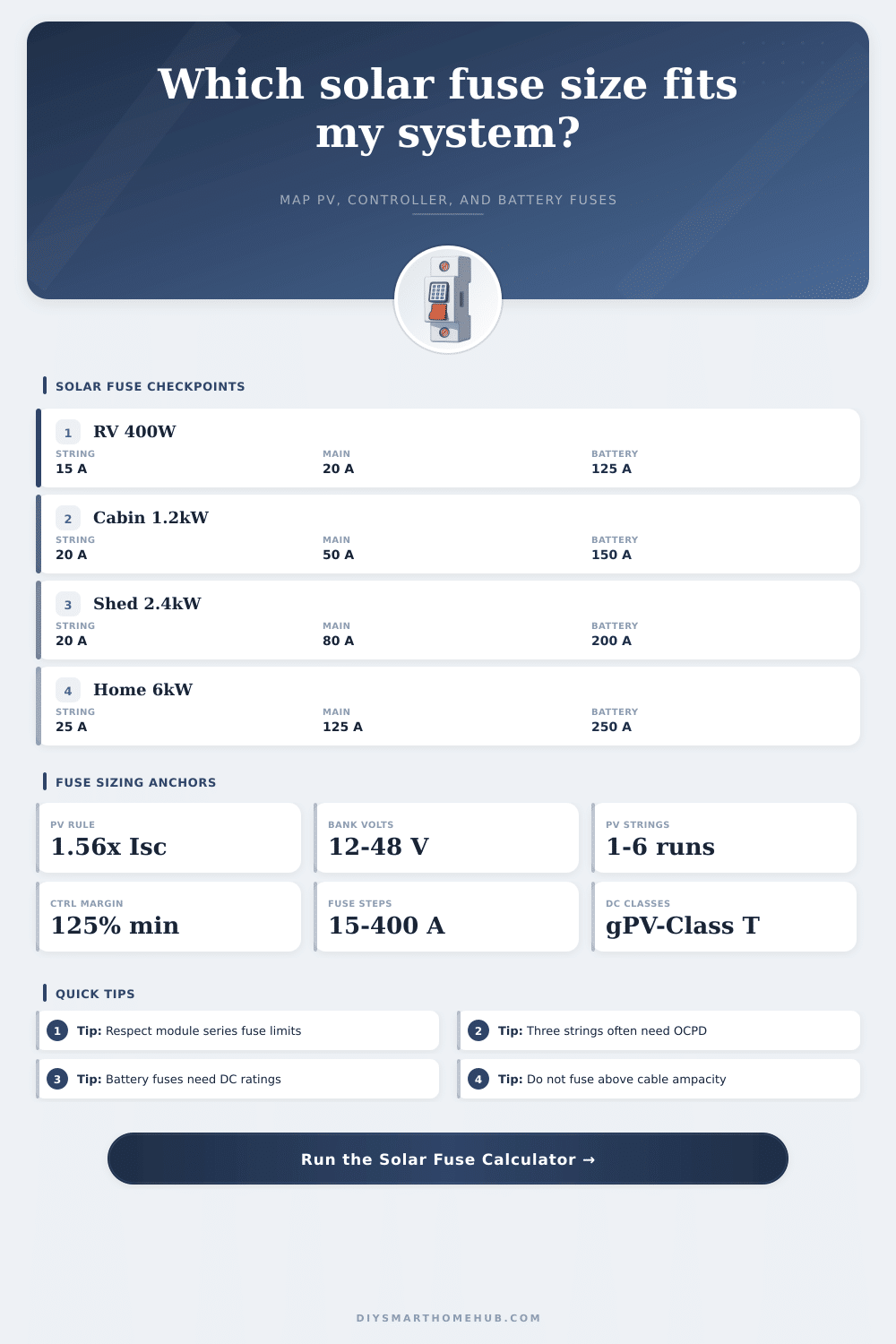
Each preset fills in realistic module current, string count, controller size, bank voltage, and inverter load so you can compare common solar builds without starting from a blank form.
⚡Fuse sizing inputs
Enter your solar values to see recommended fuse sizes across the PV and battery side of the system.
📊Fuse family spec grid
These cards summarize where each fuse family is commonly used in small and mid-size solar builds. Always confirm interrupt rating, holder listing, and temperature limits from the actual part.
📋PV source circuit quick table
These examples assume a 1.56x PV multiplier and typical string currents seen on modern residential modules. Use them as a rough checkpoint, not a substitute for the exact module datasheet.
| Module Isc | Parallel Strings | Calculated PV Current | Common Fuse Pick |
|---|---|---|---|
| 8.5 A | 1-2 | 13.3 A per string | 15 A gPV |
| 10.2 A | 2-3 | 15.9 A per string | 20 A gPV |
| 11.5 A | 3-4 | 17.9 A per string | 20 A gPV |
| 13.1 A | 4-6 | 20.4 A per string | 25 A gPV |
📘Battery-side fuse class comparison
Battery bank fault current can be much higher than PV source current, so DC interrupt rating matters. This table helps separate common low-voltage solar fuse families.
| Fuse Family | Typical DC Use | Voltage Range | Why It Gets Chosen |
|---|---|---|---|
| Class T | Main battery and inverter | Up to 160 VDC | Fast clearing and high interrupt ratings for lithium banks |
| MRBF | Short battery studs | Up to 58 VDC | Compact terminal mount for marine and small banks |
| MIDI / MEGA | Medium DC branch circuits | 32-58 VDC | Good for controllers and distribution panels |
| ANL | Legacy inverter feeds | 32-80 VDC | Common and easy to source, but check the interrupt rating carefully |
📈Preset benchmark table
Benchmark outputs for the included presets show how quickly battery-side fuse sizes climb as inverter power rises or the battery bank voltage drops.
| Preset | Array Layout | String Fuse | Inverter Fuse |
|---|
🛠Standard fuse step table
This step table shows how the calculator rounds up from a calculated current to the next common fuse size. The exact list changes with the selected fuse family.
| Calculated Current | Next Common Fuse | Typical Family | Use Case |
|---|---|---|---|
| 13-15 A | 15 A | gPV / MC4 | Small source circuits and compact strings |
| 16-20 A | 20 A | gPV / midget | Modern high-current residential modules |
| 45-63 A | 60-70 A | MIDI / MEGA | Controller battery leads on 24V and 48V banks |
| 140-180 A | 150-200 A | Class T / MRBF | Compact inverter feeds and battery mains |
| 210-280 A | 225-300 A | Class T / ANL | Larger inverter or hybrid battery circuits |
💡Practical fuse notes
When the PV calculation lands above the module max series fuse value, do not simply upsize the fuse. Re-check the module datasheet, string count, and the exact listing requirements for that source circuit.
Solar source fuses and battery fuses solve different problems. PV fuses need high DC voltage ratings, while battery-bank fuses need enough interrupt capacity for very high available fault current.
When you design a solar power system, you must ensure that you use the correct fuses to protect the solar panels, the wires, and the batteries. Solar system fuses will interrupt the electrical currents in the case of excesive current. Using fuses will prevent the damage that high current can cause to the solar system components.
Using the wrong size fuse might cause the wires to melt due to the high current or cause nuisance blows that turn off the solar system power unnecessarilly. To calculate the fuse size for the solar panels, you must use the short-circuit current of the solar panel, also known as Isc. The short-circuit current is higher then the normal current output of the solar panel under sunlight condition.
Choose the Right Fuses for Your Solar System
You must multiply the short-circuit current by 1.56 to calculate the fuse size for the solar panel to allow for continuous operation of the solar panel. The fuse size must not exceed the maximum series fuse limit for the solar panel as exceeding the maximum series fuse limit might cause fires. For solar strings connected in parallel, the current from the functioning solar string might flow backwards into the failed solar string.
If you have three or more solar strings, you must use overcurrent protection for each of the solar strings as the National Electrical Code require overcurrent protection for three or more solar strings. The fuse considerations for the battery side of the solar system are different than the solar panel side of the system. You must add 125% of the maximum output of the charge controller to the battery for the fuse size to allow for the steady load on the battery.
For inverters, the fuse must be able to handle the high starting current that the inverter will pull when the motors start. For a 3000-watt inverter running on a 12-volt battery system, the inverter will pull more than 250 amps of direct current. For a 3000-watt inverter on a 48-volt battery system, the current drawn will be less due to the higher voltage.
Using higher voltage batteries allows for a reduction in the current require in the solar system. For fuse applications for the solar system using batteries, you must also consider the ambient temperature in which the system will operate. Fuses will lose there ability to carry high currents if they become too hot to operate at their normal efficiency.
Fuses must be increased in size by 5% to 15% in hotter areas. For solar panels, you must also ensure that you consider the open-circuit voltage, also known as Voc, of each solar panel. The Voc of each solar panel will add up if you place the solar panels in series.
The sum total of the Voc of each solar panel must not exceed the voltage rating of the fuse that you will use in the solar system for the solar panel. If you have four solar panel each with a Voc of 50 volts, the total Voc is 200 volts. For this example, you will have to use a fuse with a voltage rating of at least 200 volts.
Different types of fuses is used within the solar power system for different components. GPV fuses are used for solar panel strings as these fuses can handle high voltages of direct current and extinguish arcs. Class T fuses are used for battery mains in a solar power system as these fuses can handle high fault currents from the lithium batteries used in the battery.
The smaller MRBF fuses are used for charge controllers and other smaller branches of the solar power system. The MRBF fuse is smaller in size for the branches of the solar system. For example, the MRBF fuse has a maximum voltage of 58 volts, whereas the Class T fuse has a voltage capacity of 160 volts.
The fuse size for a solar power system must also match the ampacity of the wires used in the system. The ampacity is the maximum current that can travel through the wire. Using a fuse with a higher current than the ampacity of the wire might cause the wire to melt.
For example, a wire with an ampacity of 200 amps will not take a 225-amp fuse. The fuse must protect the wire. Finally, you should label the solar power system with the fuse calculations.
The short-circuit current of the solar panel and the open-circuit voltage of the solar panel measured in cold weather must be noted. The specification sheets for the charge controller should also be noted. Labeling the system will aid in the maintenance of the solar system and ensure it abides by the local electrical code.
If you follow these guidelines to the letter, your solar power system will operate safely for many years.