Hybrid Solar System Calculator
Estimate solar array size, battery storage, hybrid inverter class, and daily grid offset from your energy use, backup target, peak demand, and site sun hours before you commit to a system layout.
📌Scenario presets
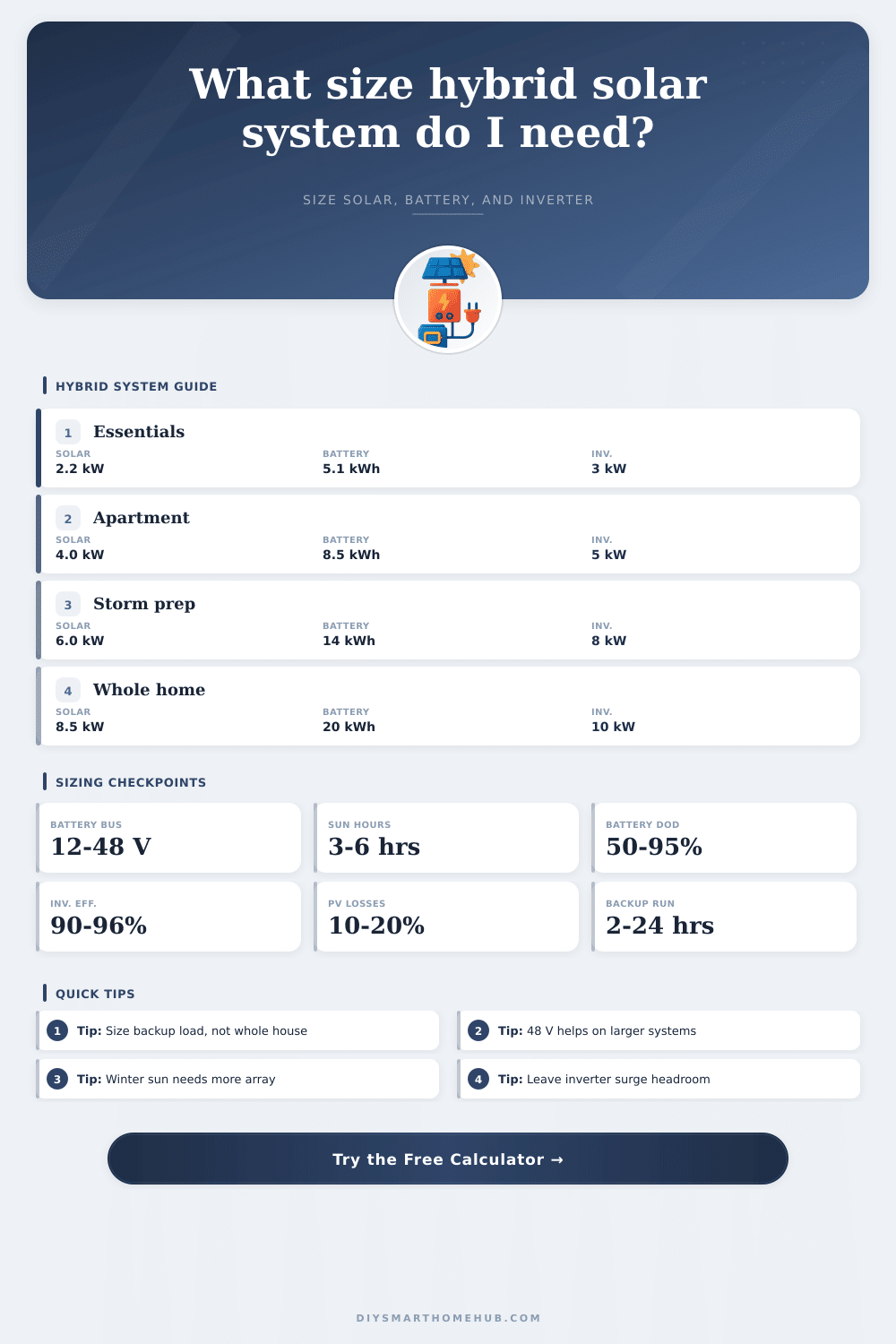
These presets cover apartment backup, storm-ready systems, and larger whole-home hybrid plans. Each one loads realistic solar share, battery chemistry, backup load, and inverter demand so you can compare setups quickly.
☀System inputs
💡Planning insights
🔋Battery chemistry specs
Use this grid to compare usable depth of discharge, round-trip efficiency, and typical module size before you translate backup hours into a battery bank.
📊Reference tables
| Scenario | Daily Load | Solar | Battery |
|---|
| Chemistry | Usable DoD | Round-trip | Best Fit |
|---|
| Hybrid Strategy | Solar Share | Reserve | Best Use |
|---|
📘Practical tip boxes
Hybrid solar systems solve two jobs at once. Size the array from the daytime energy you want to offset, then size the battery from the protected load and outage hours you actually need.
The same hybrid inverter pulls much higher battery current at 12 V than at 48 V. Once inverter size and charge current climb, a higher-voltage bus usually makes the build cleaner.
A hybrid solar system is a system that incorporate solar panels with battery storage. Solar panels will collect the energy from sun, and the batteries will store that energy so that a person can use that energy either during the daytime or even in the event of a power outage in the area. Using a hybrid solar system will save a person money on there utility bills each day, as well as provide backup power in the case of a power outage.
To set up a solar system, a person must first calculate the energy usage of a home. This number can be located on the utility bill for the home. The number of solar panels that a system will require will depend on the total number of kilowatt-hours that is used by the home.
How to set up a hybrid solar system
All of the electrical loads in the home, from lights to appliances to internet routers, must be accounted for. Some individuals may opt for a strategy that places emphasis on maintaining the batteries in the system are kept fully charged in the event of an outage. Others may opt for a strategy that focus upon providing power to the entire home, which would require the installation of more solar panels to provide for all of the electrical loads in the home.
Batteries is one of the main components of a solar system. One type of battery that may be use in a solar system is a lithium iron phosphate battery. These batteries can be discharged to 90% of their capacity without damaging the battery.
In contrast, lead-acid batteries are another type of battery that may be used in solar systems, but they can only be discharged to 50% of their capacity. For this reason, more lead-acid batteries would be required to supply the same amount of energy as a lithium iron phosphate battery. Additionally, the cycle life of a lithium iron phosphate battery is more high than that of a lead-acid battery, meaning that the battery will last for more charge and discharge cycles before it fades.
To calculate the number of solar panels that the system will require, the average number of peak sun hours for the area need to be determined. This number should be the lowest average, such as the average number of peak sun hours available in the winter region, as solar panels produce less energy during the winter months of the year. A person must also factor in the energy that is lost through the system through heat, dirt on the panels, wiring, and the inverter.
The inverter is the device that converts the direct current from the solar panels into alternating current for the home. If a person does not account for energy losses through the system, the solar panels may not produce enough electricity to meet the energy need of the home. Another important factor to consider when creating a hybrid solar system is the sizing of the inverter.
The inverter must be able to handle the power draw of the home. However, the inverter must be able to handle the start-up power of appliances in the home. Appliances such as well pumps and compressors require a large amount of power to start.
Therefore, the inverter should have a surge capacity that is 20 to 35 percent more high than the power draw of the home. Otherwise, the inverter may fail when an appliance that requires a large amount of start up power is turned on. Furthermore, if the system is using batteries to store the energy created from the solar panels, the voltage of the battery system should be considered.
A 48-volt battery system is often better than a 12-volt system. The 48-volt system requires thinner wires to transport the electricity from the solar panels to the home, and the system creates less heat. A person must also consider the placement of the solar panels.
Solar panels should face south to maximize the energy create. However, the panels can face east or west. Placing the panels in an area that is shaded by trees or vents will reduce the energy that they can produce.
Furthermore, batteries lose capacity with time. Batteries lose 5 percent of their capacity each year. Therefore, a person should of include extra capacity in the batteries to compensate for the naturaly way that batteries lose capacity over time.
Finally, another factor to consider is the runtime of the solar system. To calculate the runtime of the batteries, divide the total usable kilowatt-hours of the batteries by the power draw of the protected loads. Protected loads are devices that are connected to the battery backup system, such as an internet router or a refrigerator.
Another factor to consider is if the solar panels can recharge the batteries in one day. If the solar panel system cannot recharge the batteries in one day, the homeowner will have to rely on the power grid if there is a storm that lasts for several days. Separating these two goals will allow a person to create a system that is both economical and provides power backup for emergencies.