Surge Protector Calculator
Estimate the surge protection stack that makes sense for a smart home zone, rack, or whole-house panel by combining branch length, device sensitivity, connected load, outside line exposure, and service risk.
📌Quick surge scenarios
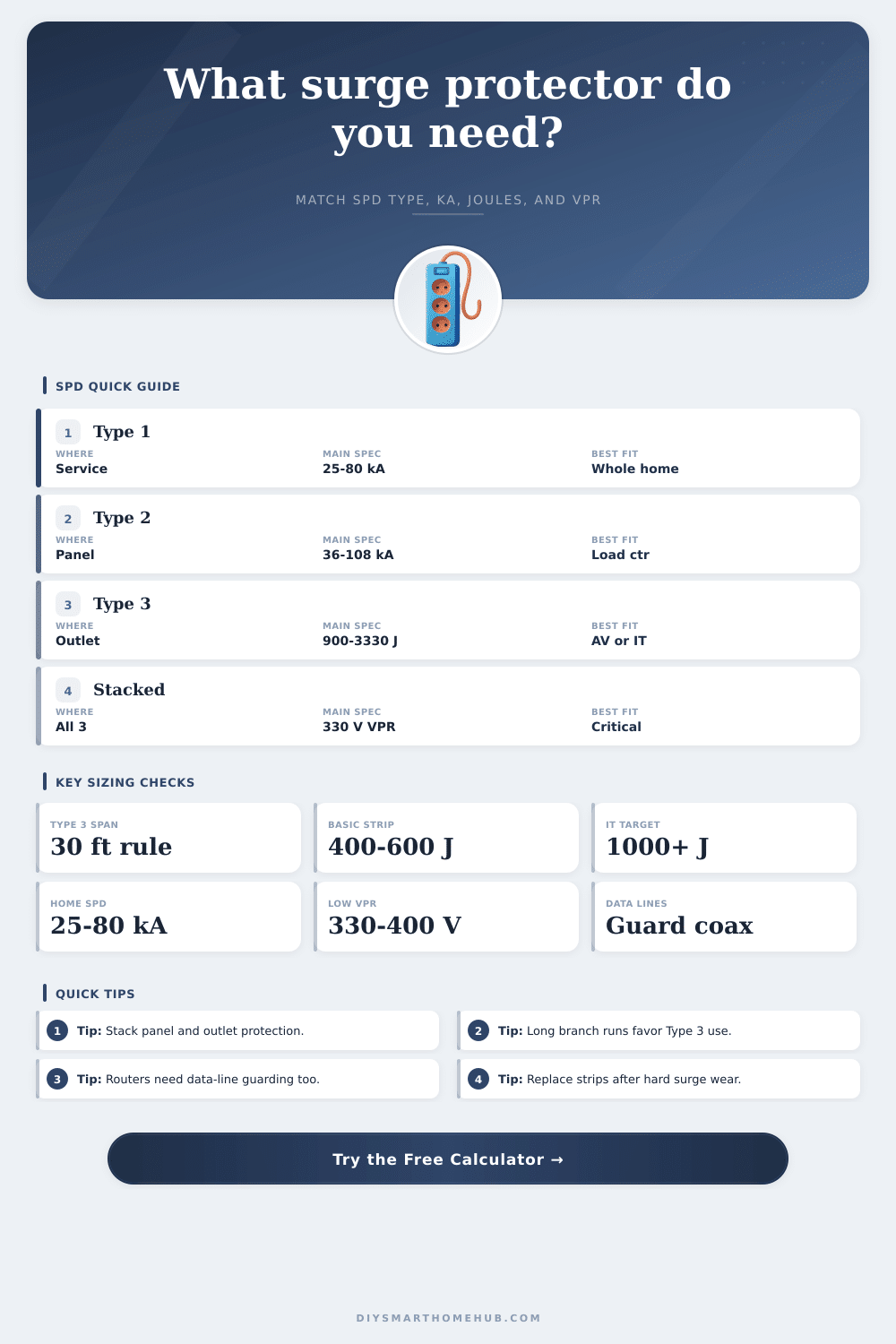
The model leans on practical SPD categories instead of brand claims: Type 1 at service, Type 2 at panels, and Type 3 near sensitive loads, with whole-home kA bands and point-of-use joule tiers mapped to exposure.
⚙Protection inputs
Area is used as a proxy for how spread-out the protected zone is, while branch length, outside lines, and utility exposure shape whether the right answer is only a strip, a panel SPD, or a layered stack.
💡Planning notes
📈Surge protection results
📊Surge sizing snapshot
📑SPD type guide
| SPD type | Usual location | What it handles | Best fit |
|---|
🛡Whole-home kA guide
| kA tier | Typical fit | Exposure level | What it means |
|---|
🔌Point-of-use joule guide
| Joule tier | Gear profile | Suggested VPR | Use case |
|---|
🏠Common surge scenarios
| Scenario | Stack | Panel SPD | Strip tier | Read |
|---|
📝Practical notes
Whole-home devices limit the large incoming event, while a point-of-use protector near routers, AV gear, or a small rack cleans up the residual surge and usually gives you the lowest VPR close to the load.
If a camera run, coax feed, gate cable, or Ethernet line exits the building, the AC protector alone is incomplete. Add matching protection on the data path or the surge can bypass your strip entirely.
Surge protector are devices that are used to protect electrical equipment from the effects of voltage spikes. Voltage spikes are phenomena in which the voltage within an electrical circuit sudden increases. Lightning strike, or the turning on and off of large appliance in a home can cause voltage spikes.
When a voltage spike reaches an electronic device, the voltage can overwhelm the insulation of that device’s electrical component, which can cause the device to fail. Therefore, surge protectors are necessary to provide protection for electronic device in a home. There are different type of surge protection that can be used to protect electronic devices.
How to Protect Your Home Electronics from Power Surges
Many individual use what is refered to as a layered approach to providing surge protection. A layered approach to surge protection include the use of both a whole home surge protector, as well as point of use surge protectors. People install whole home surge protectors at the electrical panel in a home, and they can handle the most largest amount of energy that flows into the homes electrical system.
Point of use surge protectors are power strip that are placed at the location of the electronic devices that should be protected from voltage spikes, and which can handle the residual voltage in the electrical system after the whole home surge protector handles its share of the voltage. Each of these type of surge protectors should be used in a home in order to ensure that the devices are protected from voltage spikes. The wiring within a home can impact the transmission of voltage spikes into the device in that home.
The length of the wiring within a home can impact the strength of a voltage spike. For instance, if the branch wiring within the home is longer than thirty feet from the electrical panel, the voltage spike may become more powerfully as it moves throughout the wiring system. Many electronic device, such as network router and audio visual devices, require a low let through voltage for those devices to function proper.
Low let through voltage is a protection that limits the voltage that is sent to the devices. Therefore, you should consider the length of the wiring within a home when purchasing a surge protector for the devices. The type of utility connection can also impact the needs of a home for surge protector.
Homes that has overhead utility line are more likely to experience lightning strike than those with underground utility lines. Thus, homes that have overhead utility lines should have a whole home surge protector installed at the electrical panel in the home. Additionally, the data cables in a home also should be protected from voltage spikes, as they can experience surges of voltage that are transferred directly to the electronic devices that utilize those data cables, without passing through the protection of the AC surge protectors.
Finally, surge protectors will wear down over time. After a surge protector experience a major voltage spike, it may no longer be able to provide adequate protection for the devices that are connected to it. Therefore, point of use surge protectors should be replaced every few year, and a surge protector should be immediately replaced after a major surge within the home.
Many whole home protectors have indicators for whether the surge protectors are still working, but they should be tested each year to ensure that the surge protection for the devices in the home is still functional. If the electrical wiring in a home is old, or if the outlet within the home are not grounded, a surge protector will not be able to provide protection for the devices in that home. Therefore, the electrical wiring in a home should be properly grounded before using any surge protectors.
In order to provide adequate protection for the electronic devices in a home, the type of surge protector that is purchased should be matched to the home’s existing electrical system. The length of the wiring in the home should be considered, the type of utility connection that is installed should be considered, and the sensitivity of the devices to voltage spikes should be considered. Additionally, the use of both a whole home surge protector and point of use surge protectors will provide more protection for the devices in that home than the use of only one type of surge protector.
Thus, using a layered approach will ensure that each of the electronic devices in the home are protected from voltage spikes.